NASA and SpaceX are preparing to launch the Nancy Grace Roman Space Telescope on Sunday from Florida. The observatory is scheduled to lift off no earlier than 7:26 a.m. Eastern Time aboard a Falcon Heavy rocket from Launch Complex 39A at Kennedy Space Center. Once in space, it will travel approximately 1.5 million kilometres to the Sun-Earth Lagrange point L2, the same region occupied by the James Webb Space Telescope.
A Flagship Observatory Ready Ahead of Schedule
The Roman Space Telescope represents NASA’s next major astrophysics mission after Webb. With a programme cost of about 4.3 billion dollars, the project has reached the launch pad nearly nine months earlier than its formal readiness target. Teams completed propellant loading, encapsulation in the payload fairing and integration activities in the weeks leading up to the planned liftoff.
Named after Dr Nancy Grace Roman, NASA’s first chief of astronomy, the mission carries a 2.4-metre primary mirror—the same diameter as Hubble’s—paired with a wide-field infrared camera. That combination allows the telescope to image large stretches of sky at high resolution, covering an area roughly 100 times greater than a single Hubble exposure in comparable detail.
Destination and Timeline After Launch
After separation from the Falcon Heavy, Roman will begin a roughly 100-day journey to L2. During transit, mission controllers will commission the spacecraft and its instruments. Once on station, the observatory will maintain a stable orbit around the Lagrange point, where the gravitational influences of the Sun and Earth help keep it in a relatively fixed position relative to our planet.
The primary science mission is planned for five years, with the potential for extended operations depending on propellant reserves and system health. Science observations are expected to begin after the spacecraft reaches L2 and completes its commissioning phase. Early images could become available in the months following arrival.
Science Goals: Dark Energy, Dark Matter and Distant Worlds
Roman’s core objectives address some of the most fundamental unanswered questions in cosmology and planetary science. The telescope will map the distribution and evolution of galaxies across vast volumes of the universe, helping astronomers measure how cosmic expansion has changed over time. Those measurements are designed to constrain the properties of dark energy, the poorly understood component thought to drive the accelerating expansion of the cosmos.
The same wide-field surveys will also chart the large-scale structure shaped by dark matter, the invisible mass that holds galaxies and clusters together. By observing billions of galaxies, Roman will provide statistical power that earlier telescopes could not achieve in comparable time.
A second major focus is exoplanets. Through gravitational microlensing and other techniques, the mission is expected to conduct a broad census of planetary systems, including planets that are difficult to detect with other methods. The observatory also carries a coronagraph technology demonstration intended to test the precise blocking of starlight so that light reflected from orbiting planets can be studied more directly.
Complementary Role with Existing Observatories
Roman is designed to work in concert with Hubble and the James Webb Space Telescope rather than replace them. Webb and Hubble excel at detailed, narrow-field observations of individual objects. Roman’s strength lies in surveying enormous areas quickly, identifying interesting targets and mapping cosmic structures on the largest scales. Astronomers can then use the higher-resolution or different-wavelength capabilities of the other telescopes for follow-up study.
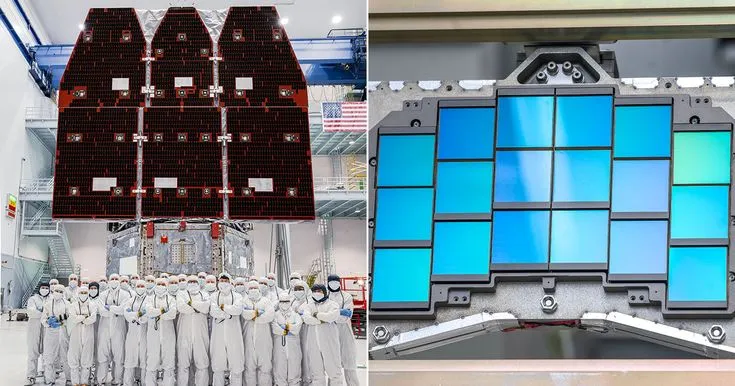
This complementary approach expands the overall scientific return of the existing space observatory fleet. Wide surveys generate candidate lists and statistical samples; pointed observations extract finer detail from selected sources.
Launch Coverage and Public Interest
NASA plans live coverage beginning well before liftoff, with streams available through its usual platforms. A post-launch news conference is scheduled after the critical early milestones of the ascent and spacecraft separation. The mission’s early delivery relative to original schedules has drawn attention as an example of a large, complex project remaining within its resource constraints.
The Falcon Heavy, chosen for its capacity to deliver the observatory onto the required trajectory, will perform the ascent from the historic Launch Complex 39A. Once the payload fairing is jettisoned and the spacecraft separates, Roman will begin the sequence of deployments—solar arrays, sunshade, antenna and aperture cover—that prepare it for the long cruise to L2.
Significance of the Mission
The Nancy Grace Roman Space Telescope arrives at a moment when questions about the composition and fate of the universe remain central to astrophysics. Dark energy and dark matter together appear to account for the large majority of the universe’s content, yet their nature is still unknown. A wide-field infrared surveyor capable of mapping billions of galaxies offers a powerful new tool for testing theoretical models against actual cosmic structure and expansion history.
At the same time, the exoplanet survey component will enlarge the known population of worlds beyond the solar system and improve understanding of how planetary systems form and evolve. The coronagraph demonstration may open pathways for future missions aimed at characterising the atmospheres of smaller, cooler planets.
Looking Beyond Liftoff
If the launch proceeds as planned on Sunday, the next phase will be the measured journey to L2 and the careful activation of the observatory’s systems. Success in those early months will determine how quickly the scientific community can begin using the data. Because the mission’s survey strategy is designed to produce large, publicly available datasets, researchers worldwide are expected to analyse the observations for years after the primary mission concludes.
The Roman Space Telescope therefore represents both an immediate observational capability and a long-term resource for cosmology and planetary science. Its launch from Florida marks the transition from years of design, construction and testing to the start of a new era of wide-field infrared exploration from a vantage point 1.5 million kilometres from Earth.
Read more – Instantdua.com