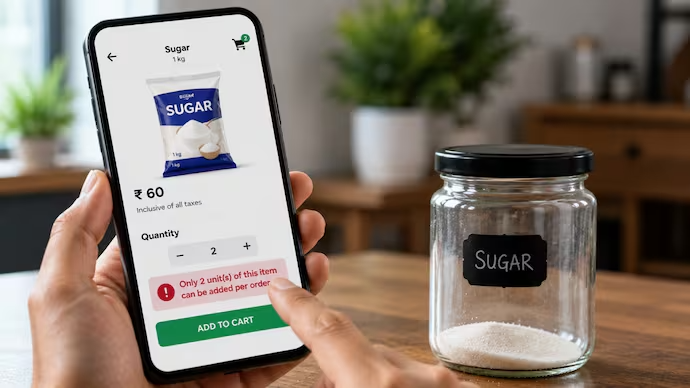
Sugar is getting more expensive just as India heads into a period when demand for the everyday kitchen staple usually rises. Consumers are now seeing purchase limits on quick-commerce platforms such as Zepto, Blinkit and Swiggy Instamart, with some listings allowing only limited quantities per order.
The restrictions have appeared as wholesale sugar prices have climbed and concerns around supply have increased ahead of the festive season. For shoppers, the change is simple but noticeable: buying a few packets for regular household use may not be an issue, but larger purchases are becoming harder in some locations.
There is an important distinction here, though. India is not necessarily facing a nationwide sugar shortage. Industry representatives have indicated that adequate stocks are available for the festive period, while the recent price increase is being linked to production, consumption, market behaviour and stock accumulation.
The timing is what makes the situation particularly important. Festive demand is about to become stronger, and sugar is one ingredient that finds its way into homes, sweet shops, bakeries, restaurants and food businesses during this period.
Why Sugar Prices Are Rising
The latest rise in sugar prices comes against a backdrop of tighter market conditions. India’s sugar production during the current season has been lower than some earlier expectations, while domestic consumption remains high.
Sugar production has been estimated at around 27.9 million tonnes, compared with domestic consumption of approximately 28 million to 28.5 million tonnes. Sugar diverted towards ethanol production and other market requirements has also affected the quantity available for conventional consumption.
But production alone does not explain the sudden price movement.
Industry officials have pointed towards stockpiling and speculative buying as additional factors. When traders or large buyers expect prices to rise further, they may purchase more sugar than they immediately need. That can reduce the amount circulating freely in the market and put additional pressure on prices.
For ordinary consumers, the result is eventually visible at the retail level.
Quick-Commerce Orders Face Caps
The biggest change shoppers are noticing is on fast grocery delivery platforms.
Zepto, Blinkit and Swiggy Instamart have introduced quantity restrictions on certain sugar products in some markets. The exact limit is not necessarily the same everywhere because inventory, product availability and local demand can differ between locations.
A customer may therefore find a sugar pack available but discover that only a limited number of packets can be purchased in one transaction.
These restrictions are generally intended to prevent bulk buying. Quick-commerce companies operate through local fulfilment centres, and inventory at those facilities can become strained when demand suddenly increases.
If several customers purchase large quantities at once, a particular location can run out of stock quickly. Purchase limits allow retailers to distribute the available inventory across a larger number of customers.
For households, this means the immediate impact is more about quantity than complete unavailability.
Festive Season Is Adding Pressure
The timing of the price increase is particularly significant because India’s festive season is approaching.
Sugar demand typically increases during festivals because households prepare sweets, while commercial kitchens and sweet manufacturers increase production. Bakeries, restaurants, caterers and food companies also require larger quantities of sugar.
This creates a situation where demand can rise across multiple parts of the market simultaneously.
A family buying two kilograms may not make much difference individually. But when thousands of households increase purchases while commercial buyers also build inventories, the combined effect can become significant.
That is one reason retailers are taking a more cautious approach to stock management.
The concern is not necessarily that India will run out of sugar. Instead, retailers want to avoid a situation where panic buying or bulk purchasing creates temporary shortages at individual stores and fulfilment centres.
Government Moves To Control Prices
The government has also stepped in as sugar prices have risen.
One major measure allows duty-free imports of up to one million tonnes of raw sugar until October 31, 2026. The objective is to increase domestic availability and reduce pressure on prices before festive demand reaches its peak.
Another measure targets large sugar consumers.
From September 1, bulk users consuming more than 10 metric tonnes of sugar per month will be subject to stockholding restrictions. They will be permitted to maintain only around 15 days of inventory, with the measure remaining in place until November 30.
The thinking behind these steps is straightforward. Sugar should continue moving through the supply chain instead of being held in unusually large quantities while prices remain elevated.
Government intervention is therefore focused on both sides of the problem: increasing supply and discouraging excessive stock accumulation.
Is There Actually a Sugar Shortage?
This is probably the biggest question for consumers.
The current situation should not automatically be described as a nationwide sugar shortage.
Industry representatives have indicated that India has sufficient stocks to meet festive requirements. The issue is more complicated because available sugar has to move through mills, traders, retailers and other parts of the distribution network before reaching consumers.
At the same time, higher prices can encourage buyers to purchase more than they normally would.
That creates a cycle.
People hear that prices are increasing, so they buy extra sugar. Retailers see stronger demand and lower available inventory. More buyers then become concerned about availability and purchase additional stock.
Such behaviour can make a manageable supply situation look much worse at the retail level.
This is also why purchase limits can appear even when overall national stocks remain adequate.
What Shoppers Should Expect
For most families, the current restrictions are unlikely to completely disrupt normal grocery shopping.
Customers purchasing sugar for everyday consumption should generally be able to find products, although specific brands or pack sizes may temporarily be unavailable in certain areas.
Prices can also differ depending on the seller and product. Consumers may therefore notice that one sugar brand is unavailable while another remains listed.
Quick-commerce inventory can change particularly fast because each neighbourhood is served by different fulfilment locations.
Someone living in one part of a city could see a quantity restriction while another customer several kilometres away may not see the same restriction.
This means consumers should not assume that an unavailable product on one platform represents a nationwide shortage.
Will Sugar Prices Fall Again?
The next few weeks could determine where prices head.
Several factors are working in opposite directions. Festive demand could push prices higher, while government measures and additional imports could increase availability.
The government has also been working towards changes in the sugar allocation system, including a move towards fortnightly quotas. More frequent allocation could help maintain a steadier flow of sugar into the market rather than allowing supplies to become unevenly distributed.
Imports are another factor to watch.
Although the government has permitted duty-free raw sugar imports, actual imports may not reach the entire permitted quantity if domestic prices fall enough to make importing less attractive for mills and refiners.
This means the impact of the import policy will depend partly on how domestic prices behave.
Businesses Could Feel Bigger Impact
The situation is more important for businesses that use sugar in large quantities.
Sweet shops, bakeries, restaurants, beverage manufacturers and food-processing companies cannot simply purchase small household packs whenever they need supplies. Their operations depend on predictable bulk availability and pricing.
Higher sugar costs can therefore affect their production expenses.
For sweet manufacturers, this becomes particularly important during the festive period because demand for products such as traditional sweets normally rises. Businesses have to balance higher ingredient costs against customer expectations and competitive retail prices.
If sugar prices remain elevated for an extended period, some businesses could eventually pass part of the additional cost to consumers.
What Happens Next
The sugar market is entering a crucial period.
Festive demand is expected to remain strong, but the government is simultaneously trying to increase availability, limit stockpiling and prevent excessive speculation.
For consumers, the most visible signs of the situation may continue to be higher retail prices and temporary purchase caps on quick-commerce platforms.
However, those restrictions should not automatically be interpreted as evidence that India has run out of sugar.
The bigger issue is market management. India needs enough sugar to meet normal household demand while also supplying large commercial buyers during one of the busiest consumption periods of the year.
If additional supplies reach the market smoothly and stock restrictions reduce excessive accumulation, price pressure could ease. If demand rises faster than supply, consumers could continue seeing higher prices for some time.
For now, households have little reason to panic-buy. Purchasing according to normal requirements, checking prices across retailers and avoiding unnecessary stockpiling remains the more sensible approach.
The coming weeks will reveal whether government measures can cool the market before festive demand reaches its peak. Until then, sugar is likely to remain one of the everyday grocery items worth keeping an eye on.
Read More :- RedTeaDetoxCleanse.com