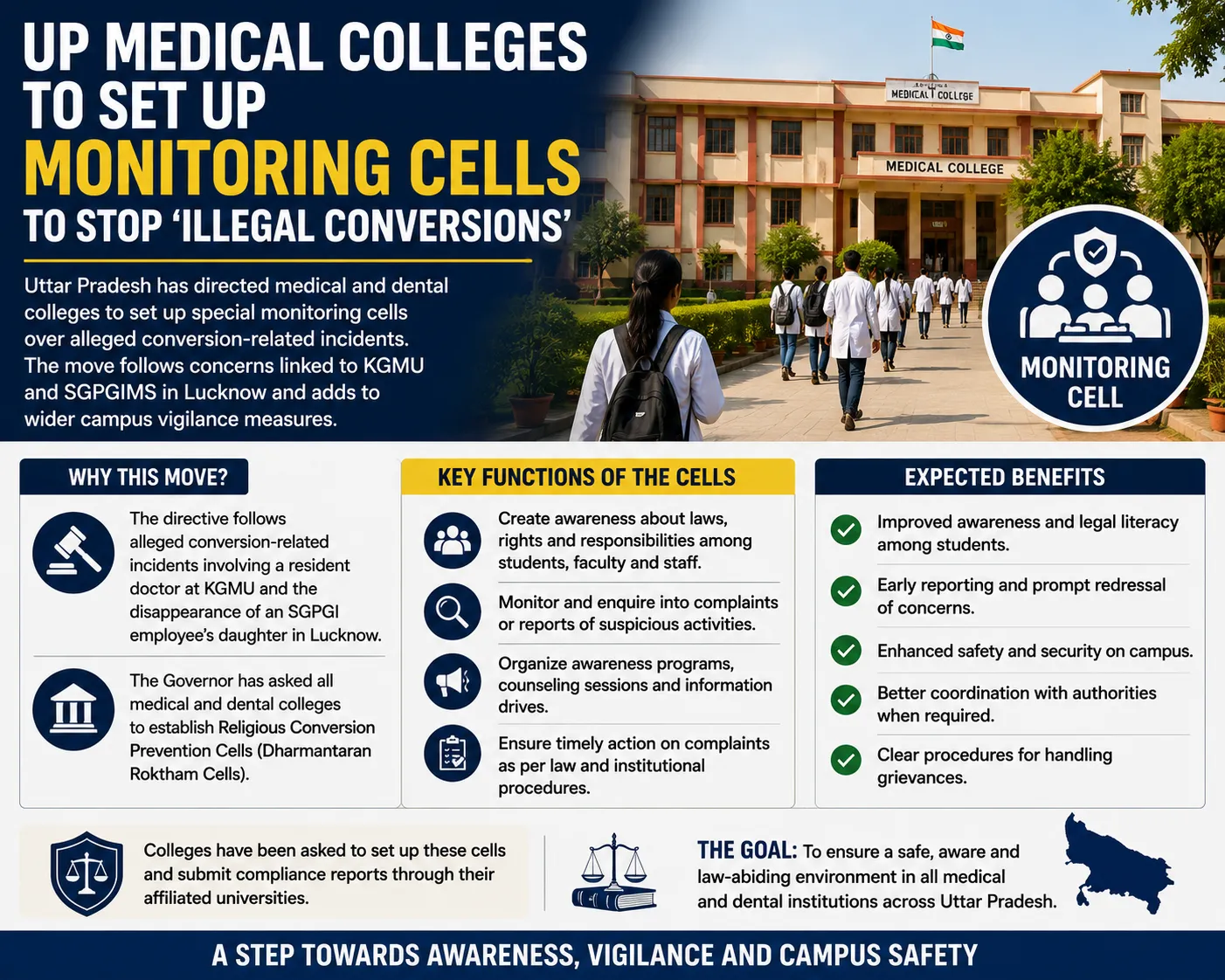
The Uttar Pradesh government has introduced a new campus monitoring initiative aimed at strengthening vigilance and awareness within medical and dental educational institutions across the state. Under the latest directive, all medical and dental colleges have been instructed to establish dedicated monitoring units known as Religious Conversion Prevention Cells, commonly referred to as Dharmantaran Roktham Cells.
The decision comes in the wake of concerns arising from alleged conversion-related incidents that attracted public attention in Lucknow and triggered discussions regarding student safety, institutional responsibility, and campus oversight. The move is being viewed as part of a broader effort to increase monitoring mechanisms within educational institutions while ensuring that students, faculty members, and staff remain informed about relevant laws and regulations.
As the directive begins to be implemented, it has generated significant debate regarding campus governance, student welfare, legal awareness, and the evolving role of educational institutions in addressing sensitive social issues.
Why the Directive Was Issued
The decision follows a series of incidents that prompted concerns among authorities regarding alleged religious conversion activities connected to individuals associated with medical institutions in Uttar Pradesh.
Particular attention was drawn to developments involving King George’s Medical University (KGMU) and Sanjay Gandhi Postgraduate Institute of Medical Sciences (SGPGIMS) in Lucknow. These incidents led to calls for stronger preventive measures and better monitoring systems within educational environments.
Authorities believe that institutions should have mechanisms in place to identify complaints early, provide guidance to students, and ensure that any concerns are addressed through appropriate legal and administrative channels.
The directive reflects a broader emphasis on preventive action rather than reactive intervention.
What Are Religious Conversion Prevention Cells?
The newly proposed cells are expected to function as institutional monitoring and awareness bodies within medical and dental colleges.
Their primary objective is to create awareness among students, doctors, resident physicians, faculty members, and non-teaching staff regarding relevant laws, rights, responsibilities, and grievance procedures.
The cells are also expected to monitor complaints or reports of suspicious activities that may require administrative attention.
In addition to monitoring functions, colleges have been encouraged to organize educational programs, awareness campaigns, counseling sessions, and information drives to ensure that members of the campus community understand legal provisions and institutional policies.
Authorities have emphasized that awareness and education will play a key role in the functioning of these bodies.
Growing Focus on Campus Vigilance
The latest directive is part of a larger trend toward strengthening monitoring systems within educational institutions.
Across India, universities and professional colleges have increasingly adopted various forms of oversight mechanisms designed to address student safety, harassment prevention, mental health concerns, ragging, discrimination, and other campus-related issues.
Medical institutions face unique challenges due to the nature of their environment. Students often work long hours, interact closely with patients, participate in intensive academic programs, and spend significant time on campus.
As a result, administrators frequently seek systems that allow concerns to be identified and addressed at an early stage.
The establishment of dedicated monitoring cells is being presented as an extension of that approach.
The Role of Medical Colleges Beyond Education
Modern educational institutions are no longer viewed solely as centers for academic instruction.
Universities increasingly play a broader role in shaping professional ethics, social responsibility, legal awareness, and personal development.
Medical colleges in particular are expected to create environments that promote professionalism, respect, ethical conduct, and compliance with legal frameworks.
Students entering healthcare professions are often required to understand not only medical science but also legal responsibilities, patient rights, ethical standards, and professional accountability.
Supporters of the new directive argue that awareness programs conducted through the proposed cells could contribute to this broader educational mission.
By informing students about relevant laws and institutional procedures, colleges may help reduce misunderstandings and improve awareness regarding legal rights and responsibilities.
Potential Benefits of the Initiative
If implemented effectively, the monitoring cells could provide several potential benefits.
Improved Awareness
Many students may have limited knowledge of legal provisions related to religious freedom, personal rights, coercion, and criminal law.
Awareness programs can help ensure that students understand the legal framework governing such issues.
Early Reporting Mechanisms
Dedicated cells can offer a structured channel for reporting concerns, complaints, or grievances before situations escalate.
Early intervention often helps institutions address problems more effectively.
Enhanced Campus Safety
A formal monitoring system may contribute to a greater sense of security among students and staff by ensuring that concerns are acknowledged and reviewed promptly.
Better Coordination with Authorities
Institutions equipped with designated monitoring bodies may be better positioned to coordinate with law enforcement or regulatory agencies when necessary.
Clear Administrative Procedures
Standardized reporting and monitoring processes can improve transparency and consistency in handling complaints.
Concerns and Challenges
Like many policy initiatives involving sensitive social issues, the proposal also raises important questions.
One challenge involves ensuring that the cells operate fairly, transparently, and in accordance with constitutional rights and legal protections.
Educational institutions must balance vigilance with respect for individual freedoms, privacy, and due process.
Students come from diverse religious, cultural, and social backgrounds. Maintaining an inclusive academic environment remains essential to the functioning of universities and professional colleges.
Another challenge will involve defining the scope and operational procedures of the cells.
Institutions may need clear guidelines regarding complaint handling, evidence assessment, counseling processes, confidentiality protections, and coordination with external authorities.
Without well-defined procedures, implementation could vary significantly from one institution to another.
The Importance of Awareness and Counseling
Experts often emphasize that awareness and counseling can be among the most effective tools for preventing conflicts and misunderstandings within educational settings.
Young adults entering universities frequently encounter new social environments, diverse viewpoints, and increased personal independence.
Providing access to guidance, counseling, and accurate information can help students make informed decisions while reducing confusion and vulnerability.
Educational programs focused on legal literacy, personal rights, consent, digital safety, and ethical conduct can strengthen the overall campus environment.
The success of the new monitoring cells may depend largely on how effectively they integrate awareness-building and support services into their activities.
Impact on Medical Education Institutions
Medical and dental colleges across Uttar Pradesh will now need to establish the required cells and develop operational frameworks that comply with the directive.
Administrators may be required to designate faculty coordinators, establish reporting channels, organize awareness programs, and submit compliance reports to relevant authorities.
For institutions already operating grievance redressal mechanisms, anti-ragging committees, internal complaints committees, and counseling centers, the new cells may become an additional component of the broader student support and monitoring system.
The implementation process is expected to vary depending on institutional size, resources, and administrative structure.
Looking Ahead
The establishment of Religious Conversion Prevention Cells represents another step in Uttar Pradesh’s efforts to strengthen oversight and awareness within higher education institutions.
Supporters view the initiative as a preventive mechanism designed to improve vigilance, legal awareness, and campus safety. Critics and observers, meanwhile, will likely continue to monitor how the policy is implemented and whether it successfully balances security objectives with individual rights and institutional autonomy.
As medical and dental colleges begin establishing these monitoring units, their effectiveness will depend on clear guidelines, transparent procedures, fair implementation, and sustained engagement with students and faculty members.
Ultimately, the success of any campus monitoring initiative depends not only on oversight but also on education, trust, communication, and a commitment to creating safe and respectful learning environments for all members of the academic community.