The artificial intelligence industry continues to evolve at a remarkable pace, with companies racing to develop increasingly capable models that can solve complex problems, accelerate innovation, and transform the way people work. In a significant development for the AI sector, Anthropic has introduced Claude Fable 5, the first publicly available model from its new Mythos-class family of artificial intelligence systems.
The launch marks an important milestone for both Anthropic and the broader AI ecosystem. While the company has previously showcased advanced AI capabilities through its Claude family of models, Fable 5 represents a new level of performance that was initially considered too powerful for unrestricted public release. By combining advanced capabilities with extensive safety measures, Anthropic aims to make frontier AI accessible while minimizing potential risks.
What Is Claude Fable 5?
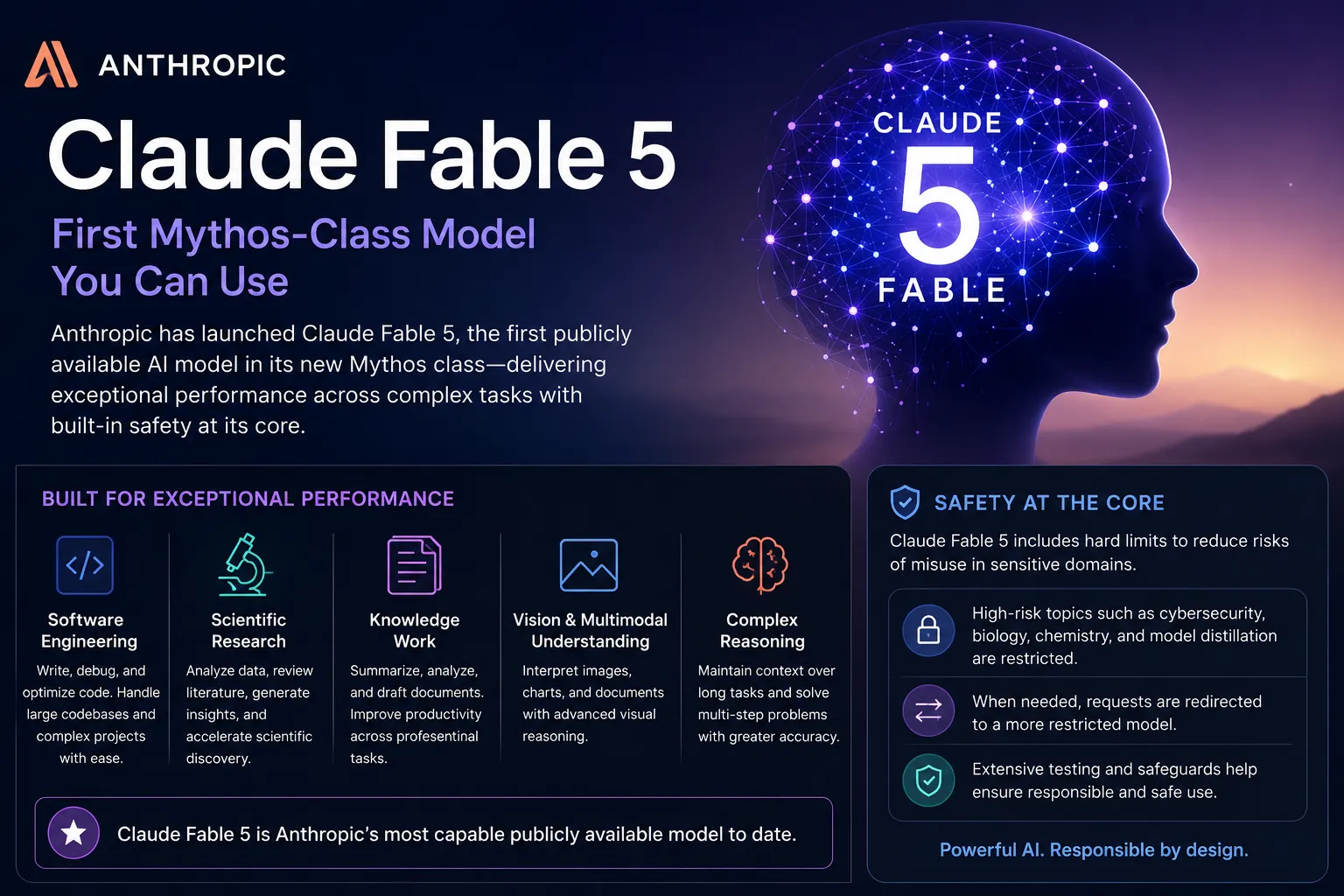
Claude Fable 5 is Anthropic’s most advanced publicly available AI model to date. It belongs to the company’s newly introduced Mythos class, a category of models designed to outperform previous generations across a wide range of tasks.
According to Anthropic, Fable 5 demonstrates exceptional capabilities in software engineering, scientific research, knowledge work, visual reasoning, and long-duration problem-solving. The model is particularly effective when dealing with complex projects that require sustained reasoning, planning, and execution over extended interactions.
Unlike traditional AI systems that often struggle with multi-step workflows, Fable 5 is designed to maintain context and deliver more consistent performance throughout longer and more sophisticated tasks.
The introduction of a Mythos-class model signals Anthropic’s belief that AI systems are entering a new phase of capability, where they can handle increasingly demanding professional and technical workloads.
Why Mythos-Class Models Matter
The Mythos class represents a substantial leap beyond earlier generations of AI models. These systems are designed to tackle challenges that require deep reasoning, extensive contextual understanding, and the ability to process large amounts of information effectively.
For businesses, researchers, engineers, and developers, such capabilities could significantly improve productivity. Tasks that previously required hours or days of manual effort may be accelerated through advanced AI assistance.
Software development is one area where Fable 5 is expected to have a particularly strong impact. Modern software projects often involve millions of lines of code, complex architectures, and extensive documentation. An AI model capable of understanding these environments can assist with debugging, code generation, optimization, testing, and maintenance.
Similarly, scientific research may benefit from the model’s ability to analyze large datasets, summarize complex findings, identify patterns, and support hypothesis generation.
As AI systems become more capable, their potential to contribute to innovation across industries continues to expand.
The Challenge of Powerful AI
While advanced AI offers enormous opportunities, it also introduces significant challenges.
One of the key concerns surrounding highly capable models is their potential misuse. As AI becomes more effective at reasoning, problem-solving, and information analysis, there is a growing risk that these capabilities could be exploited for harmful purposes.
Cybersecurity has emerged as one of the most important areas of concern. Advanced AI models can potentially assist in identifying software vulnerabilities, analyzing security systems, or generating technical guidance that could be used maliciously if placed in the wrong hands.
Because of these risks, Anthropic initially limited access to its Mythos technology, making it available only to selected organizations and trusted partners. The company spent months conducting safety evaluations, adversarial testing, and security assessments before deciding to release a public version.
The launch of Fable 5 reflects an effort to balance innovation with responsibility.
Safety Through Built-In Guardrails
One of the defining features of Claude Fable 5 is its extensive system of safeguards.
Rather than allowing unrestricted access to all of its capabilities, Anthropic has implemented hard limits in several high-risk domains. When users attempt to engage the model on sensitive topics related to cybersecurity, biology, chemistry, or model distillation, the system can redirect those requests to a more restricted model.
This approach allows Anthropic to provide powerful AI functionality for most users while reducing the likelihood that advanced capabilities could be exploited for harmful activities.
The company has stated that these safeguards are intentionally conservative. In some cases, harmless requests may trigger protective measures. However, Anthropic believes this cautious approach is necessary as increasingly powerful AI systems become available.
The strategy represents a broader trend in the AI industry toward responsible deployment, where capability improvements are accompanied by stronger safety mechanisms.
Applications Across Industries
The release of Claude Fable 5 could influence numerous industries and professional fields.
Software Engineering
Developers may use the model to write code, identify bugs, explain complex systems, review software architecture, and improve productivity throughout the development lifecycle.
Scientific Research
Researchers can leverage advanced reasoning capabilities to analyze literature, generate summaries, evaluate data, and explore new research directions.
Business Operations
Organizations may utilize Fable 5 for strategic planning, document analysis, workflow automation, and decision support.
Knowledge Work
Professionals working in law, finance, consulting, education, and healthcare may benefit from faster information processing and improved analytical support.
Visual and Multimodal Tasks
The model’s ability to work with visual information opens opportunities for applications involving image analysis, documentation review, and content interpretation.
The breadth of these use cases demonstrates how advanced AI is increasingly becoming a general-purpose technology rather than a specialized tool.
Competition in the AI Industry
Anthropic’s launch comes at a time of intense competition among leading AI companies.
Technology firms are investing billions of dollars in developing increasingly capable foundation models that can serve consumers, businesses, researchers, and governments. Success is no longer measured solely by benchmark scores but also by reliability, safety, scalability, and practical usefulness.
As models become more powerful, companies face growing pressure to demonstrate that they can deploy advanced systems responsibly. Safety, transparency, and governance are becoming as important as raw performance.
The introduction of Fable 5 reflects this shift. Rather than focusing exclusively on capability gains, Anthropic is emphasizing a combination of performance and risk management.
The Future of Frontier AI
The release of Claude Fable 5 offers a glimpse into the future of artificial intelligence. As models continue to improve, they are likely to become more autonomous, more capable of handling long-term projects, and more integrated into professional workflows.
At the same time, the industry will face ongoing questions about safety, regulation, and responsible deployment. The challenge will be ensuring that powerful AI systems deliver benefits while minimizing potential harms.
Anthropic’s decision to release a safeguarded Mythos-class model illustrates one possible path forward. By combining advanced capabilities with carefully designed restrictions, the company hopes to unlock the advantages of frontier AI while maintaining public trust.
As AI technology continues to evolve, Claude Fable 5 may be remembered as an important milestone—one that demonstrated how the next generation of powerful AI systems can be made accessible without abandoning safety considerations. The launch signals not only a technological achievement but also a growing recognition that the future of AI depends on balancing innovation with responsibility.