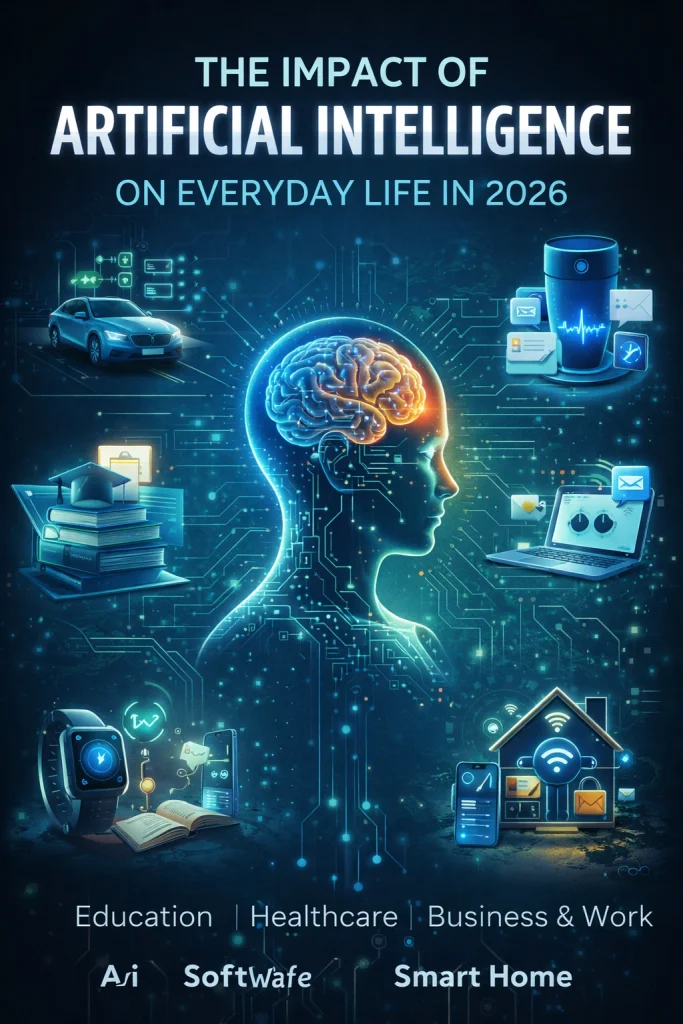
Artificial Intelligence (AI) has rapidly evolved from a futuristic concept into an integral part of everyday life. From smartphones and home automation to healthcare and transportation, AI is reshaping how individuals interact with technology and the world around them. It enables machines to perform tasks that typically require human intelligence, such as learning, reasoning, problem-solving, and decision-making. As AI continues to advance, its presence is becoming more seamless and deeply embedded in daily routines.
This article explores the impact of AI across various aspects of everyday life, highlighting both its benefits and challenges.
AI in Communication and Digital Interaction
Artificial Intelligence has significantly transformed how people communicate and interact digitally. Messaging platforms, email services, and social media networks use AI to enhance user experience through features like predictive text, spam filtering, and personalized content recommendations. Virtual assistants such as Siri and Google Assistant allow users to perform tasks using voice commands, making communication more efficient and hands-free.
AI-powered chatbots are now widely used in customer service, providing instant responses and improving user satisfaction. These systems can understand natural language and offer relevant solutions, reducing the need for human intervention. Additionally, AI helps translate languages in real-time, breaking down communication barriers across the globe. Overall, AI has made communication faster, smarter, and more accessible.
AI in Healthcare and Medicine
The healthcare sector has witnessed remarkable improvements due to the integration of AI technologies. AI systems can analyze large volumes of medical data to assist doctors in diagnosing diseases more accurately and at earlier stages. For instance, AI is used in detecting conditions such as cancer through medical imaging and predictive analysis.
Wearable devices powered by AI track vital health metrics like heart rate, sleep patterns, and physical activity, enabling individuals to monitor their health in real time. AI also supports drug discovery and development by identifying potential compounds and predicting their effectiveness. Furthermore, robotic-assisted surgeries and automated systems have improved precision and reduced recovery times. These advancements are making healthcare more efficient, accessible, and personalized.
AI in Education and Learning
Artificial Intelligence is revolutionizing education by creating more personalized and adaptive learning experiences. AI-powered platforms can analyze a student’s learning style, strengths, and weaknesses to provide customized content and recommendations. This helps learners progress at their own pace and improves overall understanding.
Online learning platforms use AI to automate grading, provide instant feedback, and suggest additional resources for improvement. Virtual tutors and intelligent learning systems are becoming more common, offering assistance outside traditional classroom settings. Additionally, AI helps educators identify students who may need extra support, enabling timely intervention. As a result, AI is making education more inclusive, efficient, and accessible to a wider audience.
AI in Transportation and Mobility
Transportation is another area where AI has made a significant impact. Navigation apps use AI to analyze traffic patterns and provide real-time route suggestions, helping users save time and fuel. Ride-sharing services rely on AI algorithms to match drivers with passengers and optimize pricing.
One of the most notable advancements is the development of autonomous or self-driving vehicles. These vehicles use AI to interpret data from sensors, cameras, and radar systems to navigate roads safely. While fully autonomous cars are still under development, many vehicles already include AI-powered features such as lane assistance, adaptive cruise control, and automatic braking. AI is also improving public transportation systems by enhancing scheduling and reducing delays. Overall, it is making travel safer and more efficient.
AI in Smart Homes and Daily Convenience
AI has brought a new level of convenience to everyday life through smart home technologies. Devices such as smart speakers, thermostats, and security systems use AI to learn user preferences and automate household tasks. For example, smart thermostats can adjust temperature settings based on usage patterns, while smart lighting systems can turn on or off automatically.
Voice-controlled assistants allow users to manage appliances, set reminders, and access information instantly. AI-powered home security systems can detect unusual activity and alert homeowners in real time. Additionally, smart refrigerators and kitchen appliances can suggest recipes and track food inventory. These innovations are simplifying daily routines and enhancing comfort and efficiency at home.
AI in Business and Work Environments
Artificial Intelligence is transforming workplaces by automating repetitive tasks and improving productivity. Businesses use AI for data analysis, customer insights, and decision-making processes. AI tools can process vast amounts of information quickly, helping organizations identify trends and make informed decisions.
In customer service, AI-powered chatbots and virtual assistants provide support 24/7, improving efficiency and reducing operational costs. AI is also used in recruitment to screen resumes and identify suitable candidates. Additionally, automation tools are changing the nature of work by reducing the need for manual labor in certain tasks. While this increases efficiency, it also raises concerns about job displacement and the need for reskilling. Overall, AI is reshaping how businesses operate and how people work.
Challenges and Ethical Concerns of AI
Despite its numerous benefits, AI also presents several challenges and ethical concerns. One major issue is data privacy, as AI systems rely heavily on large amounts of personal data. Ensuring that this data is collected and used responsibly is critical.
Another concern is bias in AI algorithms, which can lead to unfair or discriminatory outcomes if not properly addressed. Additionally, the increasing automation of jobs raises concerns about unemployment and economic inequality. There is also the question of accountability when AI systems make decisions that impact human lives. As AI continues to evolve, it is essential to establish clear regulations and ethical guidelines to ensure its responsible use.
The Future of AI in Everyday Life
The future of Artificial Intelligence holds immense potential, with continuous advancements expected in various fields. AI is likely to become even more integrated into daily life, offering smarter and more intuitive solutions. Innovations such as advanced robotics, improved natural language processing, and enhanced machine learning models will further expand its capabilities.
In the coming years, AI could play a key role in addressing global challenges such as climate change, healthcare accessibility, and education inequality. However, balancing innovation with ethical considerations will be crucial to ensure sustainable development. As society adapts to these changes, AI will continue to shape the way people live, work, and interact with technology.
Conclusion
Artificial Intelligence is no longer a distant concept but a powerful force influencing everyday life. Its applications across communication, healthcare, education, transportation, and business have brought significant improvements in efficiency, convenience, and accessibility. At the same time, it presents challenges that require careful consideration and responsible management.
Understanding the impact of AI is essential for individuals and organizations alike, as it enables them to adapt to a rapidly changing technological landscape. As AI continues to evolve, it will undoubtedly play an even greater role in shaping the future, making it one of the most transformative technologies of the modern era.