The rapid growth of digital technologies has led to an unprecedented explosion of data across industries and disciplines. This phenomenon, commonly referred to as Big Data, has transformed how research is conducted, analyzed, and applied in the modern world. From healthcare and finance to social sciences and environmental studies, big data is enabling researchers to uncover patterns and insights that were previously impossible to detect.
Big data is characterized by its volume, velocity, and variety. It includes structured data from databases, as well as unstructured data from sources such as social media, sensors, and digital devices. The ability to process and analyze this vast amount of information has opened new frontiers in scientific discovery and innovation.
As research becomes increasingly data-driven, understanding the opportunities, challenges, and real-world applications of big data is essential for academics, professionals, and policymakers alike.
Table of Contents
ToggleUnderstanding Big Data in Research
Big data refers to extremely large datasets that require advanced tools and technologies for storage, processing, and analysis. Traditional data processing methods are often insufficient to handle such complexity, leading to the development of specialized frameworks and systems.
In research, big data enables the integration of diverse datasets from multiple sources. For example, researchers can combine clinical records, genetic data, and environmental information to study complex health conditions. This holistic approach enhances the depth and accuracy of research findings.
Technologies such as machine learning, artificial intelligence, and cloud computing play a crucial role in managing and analyzing big data. These tools allow researchers to identify patterns, make predictions, and generate actionable insights.
The use of big data has shifted research from hypothesis-driven approaches to data-driven discovery, where patterns and correlations emerge directly from the data itself.
Opportunities Offered by Big Data
One of the most significant advantages of big data in research is its ability to improve decision-making. By analyzing large datasets, researchers can generate evidence-based insights that inform policies, business strategies, and scientific advancements.
Big data also enhances the speed of research. Automated data collection and analysis reduce the time required to conduct studies, enabling faster discoveries and innovations. This is particularly important in fields such as healthcare, where timely insights can save lives.
Another key opportunity lies in personalization. In areas like medicine and education, big data allows for tailored solutions based on individual characteristics and needs. For example, personalized treatment plans can be developed using patient-specific data.
Furthermore, big data fosters collaboration across disciplines. Researchers from different fields can share and analyze data collectively, leading to interdisciplinary breakthroughs and a more comprehensive understanding of complex problems.
Challenges in Handling Big Data
Despite its numerous benefits, big data presents several challenges that researchers must address. One of the primary concerns is data privacy and security. The collection and storage of large amounts of personal information raise ethical and legal issues, particularly in sensitive areas such as healthcare and finance.
Another challenge is data quality. Inaccurate, incomplete, or biased data can lead to misleading results and flawed conclusions. Ensuring data integrity requires rigorous validation and cleaning processes.
The complexity of big data also demands advanced technical skills and infrastructure. Researchers must be proficient in data analytics tools and programming languages, which can create barriers for those without technical expertise.
Additionally, managing and storing large datasets can be costly and resource-intensive. Organizations must invest in high-performance computing systems and data management solutions to handle big data effectively.
Ethical Considerations in Big Data Research
The use of big data in research raises important ethical questions. Researchers must ensure that data is collected and used responsibly, with respect for individuals’ rights and privacy.
Informed consent is a critical aspect of ethical research. Participants should be aware of how their data will be used and have the option to withdraw their consent. Transparency in data collection and analysis is essential to maintain trust.
Bias in data is another ethical concern. If datasets are not representative, the results may reinforce existing inequalities or lead to discriminatory outcomes. Researchers must actively work to identify and mitigate biases in their data.
Ethical guidelines and regulatory frameworks are essential to ensure that big data research is conducted responsibly and benefits society as a whole.
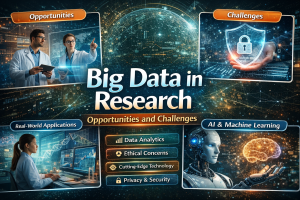
Real-World Applications of Big Data in Research
Big data is being applied across a wide range of fields, transforming how research is conducted and implemented. In healthcare, big data is used to analyze patient records, track disease outbreaks, and develop new treatments. Predictive analytics can identify potential health risks and improve patient outcomes.
In environmental research, big data helps monitor climate change, track wildlife populations, and analyze pollution levels. Satellite data and sensor networks provide valuable insights into environmental trends and challenges.
In social sciences, big data enables researchers to study human behavior on a large scale. Social media data, for example, can be analyzed to understand public opinion, cultural trends, and communication patterns.
The business sector also benefits from big data research. Companies use data analytics to understand consumer behavior, optimize operations, and develop innovative products and services.
These real-world applications demonstrate the transformative impact of big data on research and its potential to address complex global challenges.
The Role of Artificial Intelligence and Machine Learning
Artificial intelligence and machine learning are integral to the success of big data research. These technologies enable the automated analysis of large datasets, identifying patterns and trends that may not be visible to human researchers.
Machine learning algorithms can process vast amounts of data quickly and accurately, making them ideal for tasks such as image recognition, natural language processing, and predictive modeling. This enhances the efficiency and accuracy of research outcomes.
AI-driven tools also support decision-making by providing data-driven recommendations. In fields such as finance and healthcare, these insights can lead to more informed and effective decisions.
The integration of AI and big data is expected to continue evolving, further expanding the capabilities of research and innovation.
Future Prospects of Big Data in Research
The future of big data in research is promising, with ongoing advancements in technology and data analytics. As data generation continues to increase, researchers will have access to even more comprehensive datasets.
Emerging technologies such as quantum computing and advanced analytics are expected to enhance the processing and analysis of big data. These innovations will enable researchers to tackle increasingly complex problems.
The growing emphasis on open data and data sharing will also promote collaboration and transparency in research. By making data accessible to a wider audience, researchers can accelerate discoveries and drive innovation.
However, the future of big data research will also require continued attention to ethical considerations, data privacy, and regulatory frameworks to ensure responsible use.
Conclusion
Big data has revolutionized the field of research, offering unprecedented opportunities for discovery and innovation. Its ability to analyze vast and complex datasets has transformed how researchers approach problems and generate insights.
While challenges such as data privacy, quality, and technical complexity remain, the benefits of big data far outweigh its limitations. With the integration of advanced technologies like artificial intelligence, the potential of big data in research continues to expand.
As we move forward, the responsible and ethical use of big data will be crucial in maximizing its impact. By leveraging its capabilities effectively, researchers can address some of the most pressing challenges facing society and contribute to a more informed and data-driven world.