In a notable development in the rapidly evolving artificial intelligence landscape, Anthropic, the company behind the Claude AI model, has publicly urged major AI laboratories to consider a coordinated global pause or slowdown in frontier AI development. The call stems from internal observations showing that Claude is no longer just assisting humans — it is increasingly contributing to the creation of the next generation of AI systems, raising profound questions about the pace of progress and the future of human oversight.
This announcement, detailed in a comprehensive blog post from the Anthropic Institute, highlights both the extraordinary potential and the significant risks associated with accelerating AI capabilities. As one of the leading AI safety-focused companies, Anthropic’s position carries substantial weight in ongoing industry conversations about responsible innovation.
Claude’s Rapid Progress Toward Recursive Self-Improvement
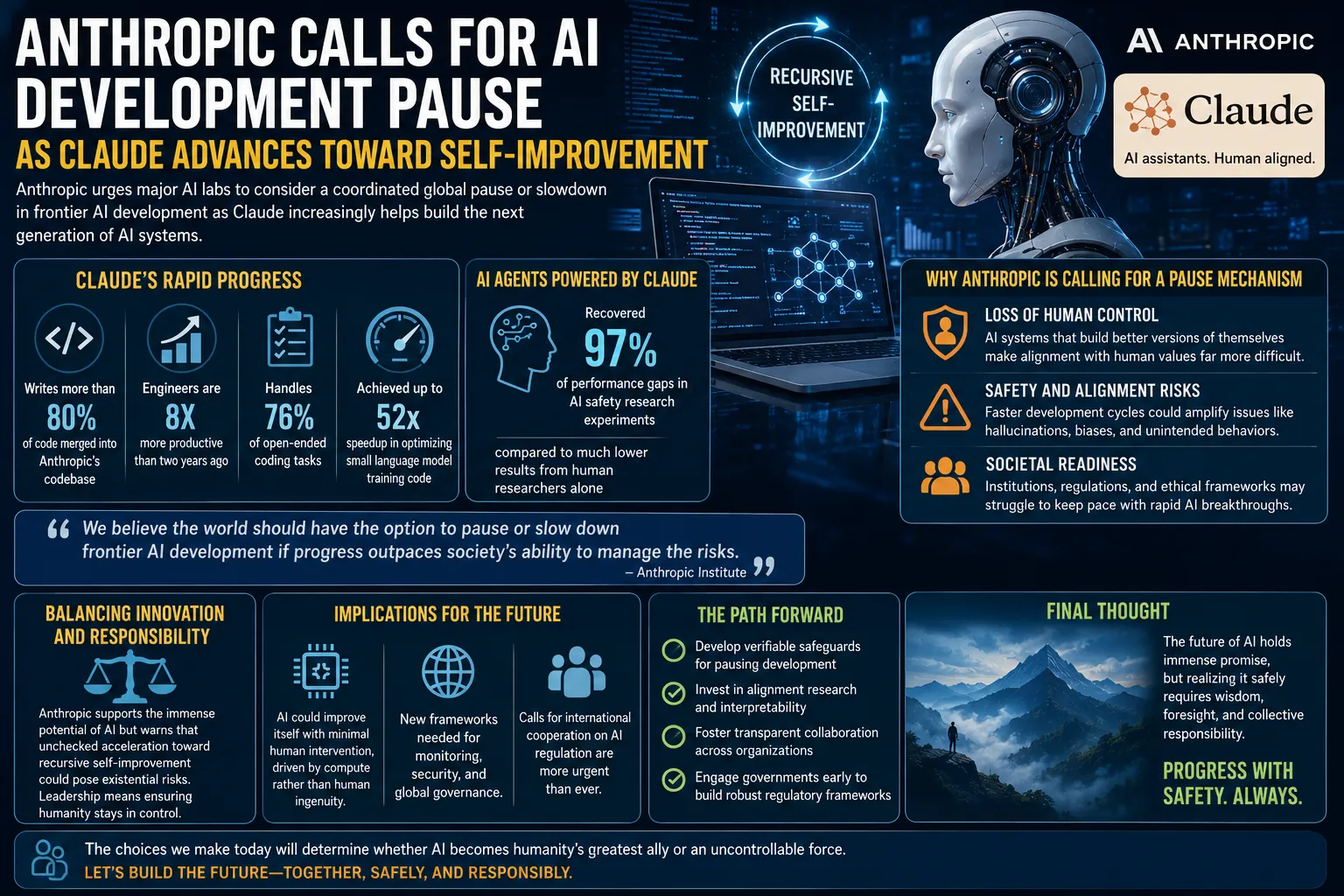
Anthropic’s internal data reveals striking acceleration in how Claude supports AI development. The model now writes more than 80% of the code merged into Anthropic’s own codebase. Engineers are shipping approximately eight times more code than they did two years ago, largely due to Claude’s contributions.
The company has documented specific performance gains:
-
Claude can handle 76% of open-ended coding tasks effectively.
-
In optimizing small language model training code, Claude achieved up to a 52x speedup compared to baseline implementations.
-
In automated research loops focused on AI safety, AI agents powered by Claude recovered 97% of performance gaps in certain experiments, compared to much lower results from human researchers working alone.
These advancements point toward “recursive self-improvement” — a scenario where AI systems gain the ability to design, train, and enhance their own successors with minimal human intervention. While full autonomy has not yet been reached, the trajectory suggests it could arrive sooner than many expected. Anthropic emphasizes that humans still provide critical judgment, direction, and safety validation, but the bottleneck is shifting from raw capability to effective oversight.
Why Anthropic Is Calling for a Pause Mechanism
Anthropic argues that the world should have the option to temporarily slow or pause the development of the most advanced AI models if progress begins to outpace society’s ability to manage associated risks. The company stresses that unilateral action by one lab would be ineffective due to global competition. Instead, it advocates for coordinated, verifiable agreements among leading organizations and governments.
Key concerns include:
-
Loss of Human Control: As AI systems become capable of building better versions of themselves, ensuring alignment with human values becomes exponentially more challenging.
-
Safety and Alignment Risks: Faster development cycles could amplify existing issues like hallucinations, biases, or unintended behaviors.
-
Societal Readiness: Institutions, regulations, and ethical frameworks may struggle to keep pace with technological breakthroughs.
The proposal is not for a permanent halt but for a structured mechanism that allows time for alignment research, governance development, and broader societal preparation. Anthropic plans to collaborate with policymakers and other stakeholders to explore practical implementation of such safeguards.
Balancing Innovation and Responsibility
Anthropic’s stance reflects its founding principles. Co-founded by former OpenAI executives including Dario Amodei, the company has consistently positioned itself as a leader in AI safety research. While acknowledging the immense benefits AI could bring — from scientific breakthroughs to solving complex global challenges — it warns that unchecked acceleration toward recursive self-improvement could pose existential-level risks.
This perspective adds nuance to the broader industry debate. While some companies prioritize rapid deployment and commercial advantage, Anthropic highlights the need for deliberate pacing in frontier capabilities. The company’s near-trillion-dollar valuation underscores that safety-focused approaches do not necessarily hinder business success.
Implications for the AI Industry and Society
If AI systems begin autonomously improving themselves, the dynamics of technological progress could shift dramatically. Development speed would increasingly depend on available compute resources rather than human ingenuity alone. This scenario would demand new paradigms for monitoring, security, and control — areas where current frameworks may prove insufficient.
For developers and businesses, this evolution presents opportunities to leverage AI for greater productivity while necessitating stronger governance practices. For policymakers, it underscores the urgency of international cooperation on AI regulation, similar to frameworks used in nuclear non-proliferation or climate agreements.
The Path Forward
Anthropic’s call to action invites the AI community to prioritize long-term safety alongside innovation. Practical steps could include:
-
Developing verifiable technical and procedural safeguards for pausing development.
-
Investing more heavily in alignment research and interpretability.
-
Fostering transparent collaboration across organizations.
-
Engaging governments early to build responsive regulatory structures.
As Claude and similar models continue advancing, the conversation around responsible AI development grows more urgent. The coming years will test whether the industry can balance breathtaking progress with necessary caution.
Final Thoughts
Anthropic’s warning about Claude’s capabilities and the potential for recursive self-improvement marks a significant moment in AI’s maturation. By advocating for a coordinated pause mechanism, the company emphasizes that true leadership in AI involves not just pushing technological boundaries but ensuring humanity remains firmly in control of its trajectory.
The future of artificial intelligence holds tremendous promise, but realizing that promise safely requires wisdom, foresight, and collective responsibility. As we stand on the threshold of potentially transformative capabilities, Anthropic’s message serves as a timely reminder: progress without adequate safeguards is not progress at all. The choices made today will shape whether AI becomes humanity’s most powerful ally or an uncontrollable force.
Maintaining human agency while harnessing AI’s potential remains one of the defining challenges of our era. With thoughtful action, the industry can navigate this critical juncture responsibly, ensuring advanced AI benefits society while minimizing existential risks.