A child’s educational journey is one of the most important aspects of their overall development. While schools, teachers, and educational resources play a significant role, research consistently shows that parental involvement remains one of the strongest factors influencing academic success. Children whose parents actively engage in their learning tend to demonstrate better academic performance, stronger motivation, improved behavior, and higher educational aspirations.
However, supporting a child’s education does not mean constantly supervising homework or placing excessive pressure on grades. Effective parental involvement evolves as children grow. The needs of a preschooler differ greatly from those of a teenager preparing for higher education. Understanding how to provide age-appropriate support can help parents create a positive learning environment that encourages lifelong success.
Early Childhood: Building the Foundation for Learning
Educational success begins long before a child enters a classroom. During the early years, children develop essential cognitive, social, emotional, and communication skills that form the basis of future learning.
Parents can support early development by engaging in regular conversations, reading stories aloud, singing songs, and encouraging curiosity. Language development is particularly important during this stage because strong communication skills contribute significantly to later academic achievement. Simple activities such as naming objects, asking questions, and discussing everyday experiences help expand vocabulary and comprehension.
Equally important is fostering foundational skills such as memory, attention, imitation, and fine motor development. Activities like drawing, building blocks, puzzles, and imaginative play strengthen these abilities while making learning enjoyable.
Rather than focusing solely on teaching letters and numbers, parents should prioritize creating a rich learning environment that encourages exploration and problem-solving. Children who develop confidence and curiosity early often adapt more easily to formal education.
Elementary School Years: Establishing Strong Learning Habits
As children enter elementary school, academic expectations increase. This is the stage where parents can help establish habits that support long-term educational success.
Creating a consistent daily routine is one of the most effective strategies. Regular schedules for homework, meals, sleep, and recreational activities provide structure and help children develop self-discipline. Adequate sleep and balanced nutrition also contribute significantly to concentration, memory, and classroom performance.
Parents should take an active interest in what their child is learning. Asking about school activities, discussing lessons, and reviewing assignments demonstrate that education is valued at home. Research indicates that parental expectations and positive involvement are strongly associated with higher academic achievement.
Reading remains one of the most valuable activities during the elementary years. Encouraging independent reading while continuing to read together helps improve vocabulary, comprehension, critical thinking, and creativity. Parents can further support learning by exposing children to educational experiences outside the classroom, such as museums, science centers, libraries, and cultural events.
At this stage, it is important to praise effort rather than simply focusing on results. Recognizing perseverance, improvement, and problem-solving abilities helps children develop a growth mindset. When children learn that success comes through practice and persistence, they become more resilient when facing challenges.
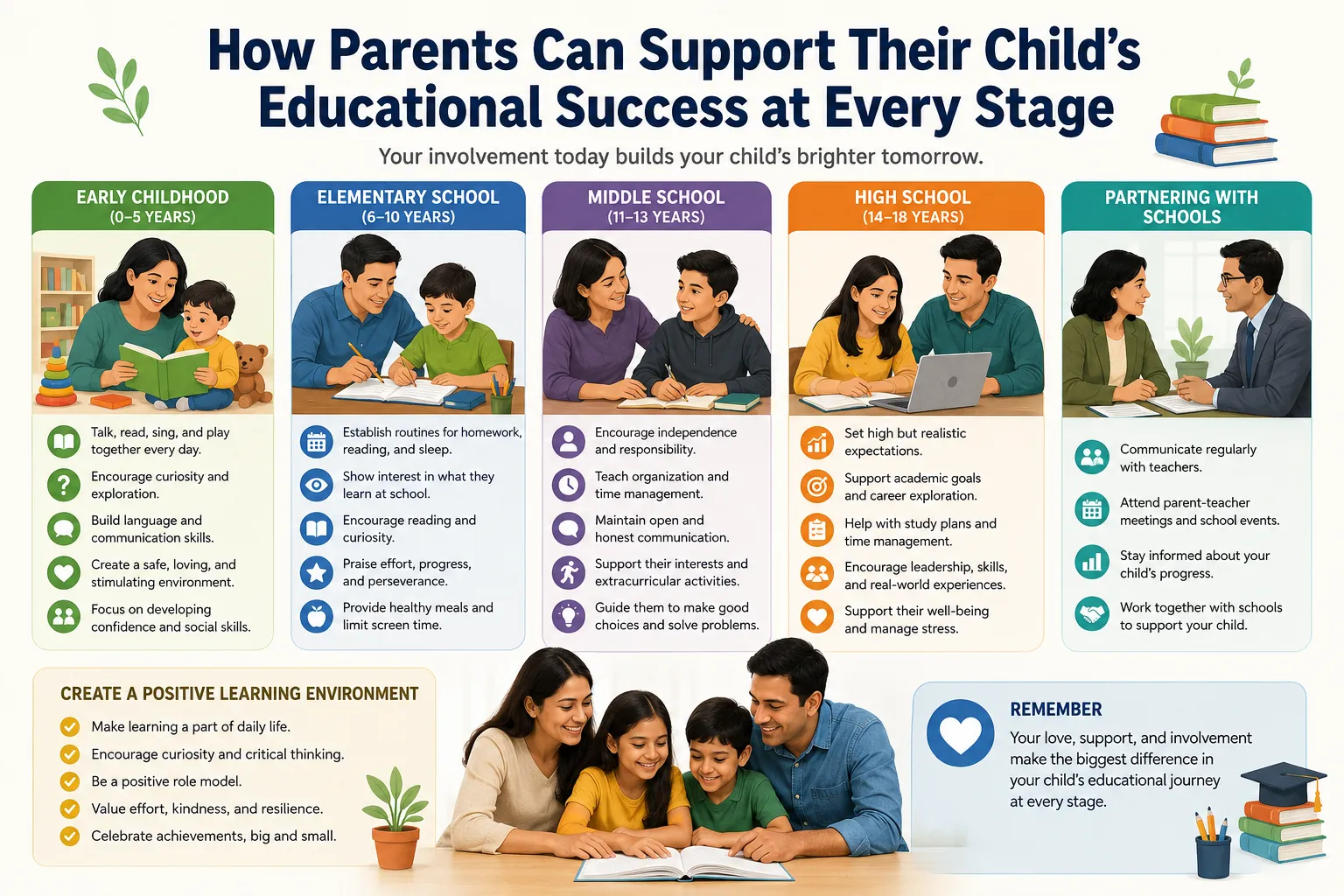
Middle School: Supporting Independence and Responsibility
The transition to middle school often brings significant academic and emotional changes. Students encounter more complex subjects, increased workloads, and greater social influences. During this period, parental support remains essential, although it should gradually shift toward encouraging independence.
Parents can help by teaching organizational skills such as using planners, managing assignments, and setting priorities. Learning how to balance academic responsibilities with extracurricular activities prepares students for future challenges.
Open communication becomes increasingly important during adolescence. Instead of focusing solely on grades, parents should discuss learning experiences, goals, interests, and challenges. Regular conversations help identify potential difficulties before they become major obstacles.
Middle school students benefit from having reasonable autonomy while still receiving guidance. Parents should avoid micromanaging every assignment and instead encourage children to take ownership of their learning. Offering support when needed while allowing them to solve problems independently helps build confidence and responsibility.
Participation in sports, arts, clubs, and community activities should also be encouraged. These experiences develop teamwork, leadership, time management, and social skills that contribute to both academic and personal growth.
High School: Preparing for Future Opportunities
High school is a critical period that often shapes future educational and career pathways. Students face increased academic demands while making important decisions regarding higher education, vocational training, and career aspirations.
Parents can support success by maintaining realistic yet high expectations. Research suggests that parental expectations are among the most influential aspects of parental involvement. When parents communicate confidence in their child’s abilities and emphasize the importance of education, students are more likely to set ambitious goals for themselves.
Career exploration should become a regular topic of discussion. Parents can help students identify strengths, interests, and potential career paths while encouraging exploration rather than imposing personal preferences. Exposure to various professions through conversations, internships, volunteering, or mentorship opportunities can broaden a student’s perspective.
Academic support during high school often involves guidance rather than direct instruction. Parents can help students create study plans, prepare for examinations, and manage deadlines. Monitoring progress remains important, but students should increasingly take responsibility for their decisions and performance.
Mental health and emotional well-being also deserve attention. High school students frequently experience stress related to academics, peer relationships, and future planning. Maintaining a supportive and understanding environment helps students navigate these pressures more effectively.
Partnering with Teachers and Schools
Regardless of a child’s age, strong communication between parents and educators contributes significantly to educational success. Teachers provide valuable insights into academic performance, behavior, strengths, and areas needing improvement.
Attending parent-teacher meetings, responding to school communications, and participating in school events demonstrate commitment to a child’s education. Collaboration allows parents and teachers to address challenges early and develop strategies that support learning both at school and at home.
Rather than viewing education as solely the school’s responsibility, successful families recognize it as a partnership involving students, parents, teachers, and communities.
Creating a Positive Learning Environment at Home
A supportive home environment benefits children at every educational stage. This does not require expensive resources or advanced educational expertise. Small daily actions often have the greatest impact.
Parents can create an atmosphere that values learning by encouraging curiosity, asking thoughtful questions, discussing current events, and modeling lifelong learning behaviors. Children often imitate what they observe. When they see parents reading, learning new skills, and showing enthusiasm for knowledge, they are more likely to develop similar attitudes.
It is equally important to balance academic expectations with emotional support. Children need to know that their worth is not determined solely by grades. A focus on effort, character, resilience, and personal growth promotes healthy motivation and long-term success.
Conclusion
Supporting a child’s educational success is an ongoing process that evolves throughout childhood and adolescence. From nurturing language development in early childhood to guiding career exploration during high school, parents play a powerful role in shaping academic outcomes. The most effective support comes from consistent involvement, positive expectations, open communication, and a genuine interest in learning.
While every child’s journey is unique, one principle remains universal: children thrive when they know their parents believe in them, support their efforts, and remain actively engaged in their educational growth. By adapting their involvement to each stage of development, parents can help their children build the skills, confidence, and motivation needed for lifelong success.