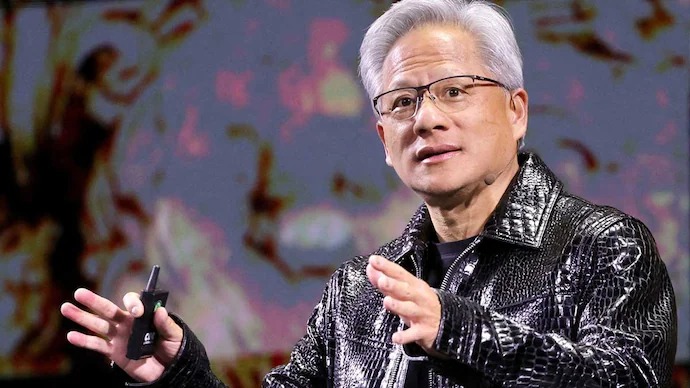
The artificial intelligence race has entered another controversial phase after NVIDIA CEO Jensen Huang said that Artificial General Intelligence has arrived. His statement came shortly after OpenAI introduced GPT-6 Astra, a new generation AI model designed to handle increasingly complex reasoning, professional work, software development and computer-based tasks.
Huang’s statement is significant because AGI has remained one of the most debated goals within the technology industry. Unlike conventional AI systems that are designed around particular tasks, AGI generally refers to machines capable of handling a broad range of intellectual activities at a level comparable to, or beyond, humans.
The NVIDIA chief congratulated OpenAI following the Astra launch and described the development as a major turning point for artificial intelligence. He also highlighted the enormous computing infrastructure behind the model, showing just how much hardware is now being required to build increasingly capable AI systems.
Jensen Huang’s AGI Statement Explained
Jensen Huang’s claim has immediately attracted attention because he is one of the most influential figures in the modern AI industry. NVIDIA supplies much of the accelerated computing infrastructure used by leading AI companies, making Huang’s comments particularly relevant to the ongoing discussion around advanced models.
In a social media post, Huang celebrated the rapid progression from earlier OpenAI systems toward Astra. He described the development as evidence that AGI has arrived, while also pointing toward another huge wave of computing capacity coming online.
However, Huang’s statement should not automatically be treated as an industry-wide confirmation that AGI has been scientifically established. There is still no universally accepted definition or single test that determines exactly when an artificial intelligence system becomes AGI.
That distinction matters because an AI model can demonstrate extraordinary performance across many benchmarks without necessarily possessing the same flexibility, reliability and independent understanding associated with human intelligence.
What Makes GPT-6 Astra Different
GPT-6 Astra is being presented as a major step forward in AI capability, particularly because its abilities extend beyond simple question answering. The system is designed to work across professional tasks, software engineering, cybersecurity, computer operation and complicated multi-step activities.
One important change is the increasing ability of AI models to interact with computers rather than simply generating text. This allows an advanced model to perform sequences of actions, use digital tools and complete practical assignments with considerably less human intervention.
Reports around Astra have also highlighted its performance in demanding technical environments. The model has been described as capable of handling sophisticated coding, mathematical reasoning, data analysis and other tasks that previously required considerable human expertise.
These capabilities are important because the discussion around AGI is moving away from whether AI can write convincing answers. The bigger question now involves whether AI can independently understand objectives, plan multiple steps and successfully complete useful work.
Massive Computing Power Behind Astra
The scale of computing reportedly used to develop GPT-6 Astra is another major part of the story. Jensen Huang said the model was trained using more than 100,000 NVIDIA Grace Blackwell NVLink72 systems.
Each NVLink72 system connects dozens of GPUs into a tightly integrated computing platform. This kind of infrastructure allows enormous amounts of computation to be performed during AI training and deployment.
Huang initially referenced a larger number before later correcting the figure to more than 100,000 systems. He also said that another 400,000 GPUs are expected to come online, pointing toward the extraordinary hardware demand created by increasingly advanced AI models.
This is more than a technical detail because it shows how the AI industry is changing. Building frontier AI systems increasingly requires massive data centres, advanced networking, high-bandwidth memory and enormous amounts of electricity.
Why AGI Is Still Debated
The phrase Artificial General Intelligence sounds straightforward, but its actual meaning remains complicated. Researchers and technology companies have used different definitions, with some focusing on human-level reasoning while others emphasize the ability to perform most economically valuable tasks.
Because there is no universal AGI test, companies can make different judgments about whether a particular model has reached that threshold. Jensen Huang’s statement therefore represents an influential industry opinion rather than a universally accepted scientific conclusion.
Some experts remain skeptical about declaring current AI systems genuinely intelligent in the human sense. A model can perform extremely well in hundreds of areas while still making strange mistakes, misunderstanding situations or struggling with tasks that appear simple to people.
That is why the Astra discussion is likely to continue long after its initial launch. The real test will involve how consistently the system performs across unfamiliar situations, extended tasks and real-world environments.
AI Agents Are Changing Everything
One of the most important developments surrounding Astra is the movement toward agentic AI. Traditional chatbots mainly respond to prompts, while agentic systems can potentially plan actions, use tools and complete longer sequences of work.
This difference could have enormous consequences for businesses. Instead of using AI only for drafting documents or answering questions, companies could increasingly use AI agents for software development, research, data analysis, customer operations and other professional workflows.
Astra’s ability to operate computers and manage multi-step tasks makes this transition particularly important. The industry is gradually moving toward systems that do not simply provide information but actually perform portions of the work themselves.
At the same time, greater autonomy creates additional risks. An AI system capable of taking actions independently needs stronger monitoring, security controls and safeguards than a system that only produces text.
Cybersecurity Raises New Questions
Cybersecurity is another area where GPT-6 Astra has attracted considerable attention. The model has reportedly demonstrated advanced capabilities in identifying vulnerabilities, with OpenAI describing it as reaching a critical cybersecurity capability threshold.
That achievement could help security teams discover weaknesses before criminals exploit them. AI could potentially examine large software systems much faster than conventional manual security processes.
The same capability creates obvious concerns, however. An advanced system capable of discovering vulnerabilities could also become dangerous if its capabilities are misused or insufficiently controlled.
This is one reason AI safety has become increasingly important alongside model performance. As AI systems become more capable, developers must make sure that greater intelligence does not automatically translate into greater opportunities for harmful misuse.
What NVIDIA Gains From AI Growth
Jensen Huang’s comments also underline NVIDIA’s central position in the current artificial intelligence economy. Modern frontier models require enormous computing infrastructure, and NVIDIA’s accelerated computing platforms have become a major foundation for that expansion.
The expected deployment of hundreds of thousands of additional GPUs shows that demand for AI computing remains extremely strong. More capable models generally require more training resources, while widespread AI adoption creates additional demand for inference infrastructure.
This creates a powerful cycle for the AI hardware industry. Better models encourage more applications, more applications increase computing demand, and higher demand encourages companies to invest in larger AI infrastructure.
The relationship between OpenAI and NVIDIA therefore represents more than a simple hardware supplier arrangement. It reflects the increasingly important connection between AI model development and the infrastructure required to make those models practical at global scale.
What GPT-6 Astra Could Mean
If Astra genuinely represents a major step toward AGI, the impact could extend far beyond the technology industry. Businesses could begin redesigning workflows around AI agents, while software development, research, finance, education and customer service could experience major changes.
For workers, the impact could be mixed. AI may remove repetitive tasks while creating demand for people who can supervise, direct and integrate advanced AI systems into business operations.
The bigger change could involve how humans interact with computers. Instead of learning complicated software interfaces, people may increasingly describe what they want completed and allow AI systems to manage the underlying steps.
That future is not guaranteed, but Astra demonstrates why the conversation around AI is becoming increasingly focused on autonomous capabilities rather than simple chatbot functionality.
The Road Ahead For AGI
Jensen Huang’s declaration that AGI has arrived is undoubtedly one of the boldest statements made during the latest AI race. Yet the statement should be viewed alongside the continuing debate about what AGI actually means and how such a milestone should be measured.
GPT-6 Astra appears to represent a substantial expansion in AI capabilities, particularly through reasoning, computer use, professional work and advanced technical tasks. Its enormous computing requirements also reveal the infrastructure race happening behind the scenes.
Whether Astra ultimately deserves the AGI label will likely remain controversial. What seems much harder to dispute is that AI systems are becoming increasingly capable of performing complex work that once required highly trained humans.
The next stage will therefore be less about impressive demonstrations and more about reliability, autonomy, safety and real-world usefulness. If those areas continue improving at the current pace, the distinction between advanced AI and AGI may become increasingly difficult to define.
Conclusion
Jensen Huang’s claim that GPT-6 Astra represents the arrival of AGI has pushed an already intense artificial intelligence debate into another phase. Astra’s ability to handle complex professional work, operate computers, assist with software engineering and tackle advanced technical challenges suggests that AI capabilities are moving rapidly beyond traditional chatbot functions.
Still, calling a system AGI remains partly a matter of definition because researchers have not agreed on one universal standard. The enormous NVIDIA infrastructure supporting Astra also shows that the next generation of AI will depend heavily on computing power, energy and sophisticated data-centre technology.
For businesses and ordinary users, the most important question may no longer be whether AGI is technically here. The bigger question is how quickly increasingly autonomous AI systems will change the way people work, create software, conduct research and make decisions. Staying informed and preparing for these changes will become increasingly important as the AI industry moves into its next chapter.
Read More :- mopandpail.com