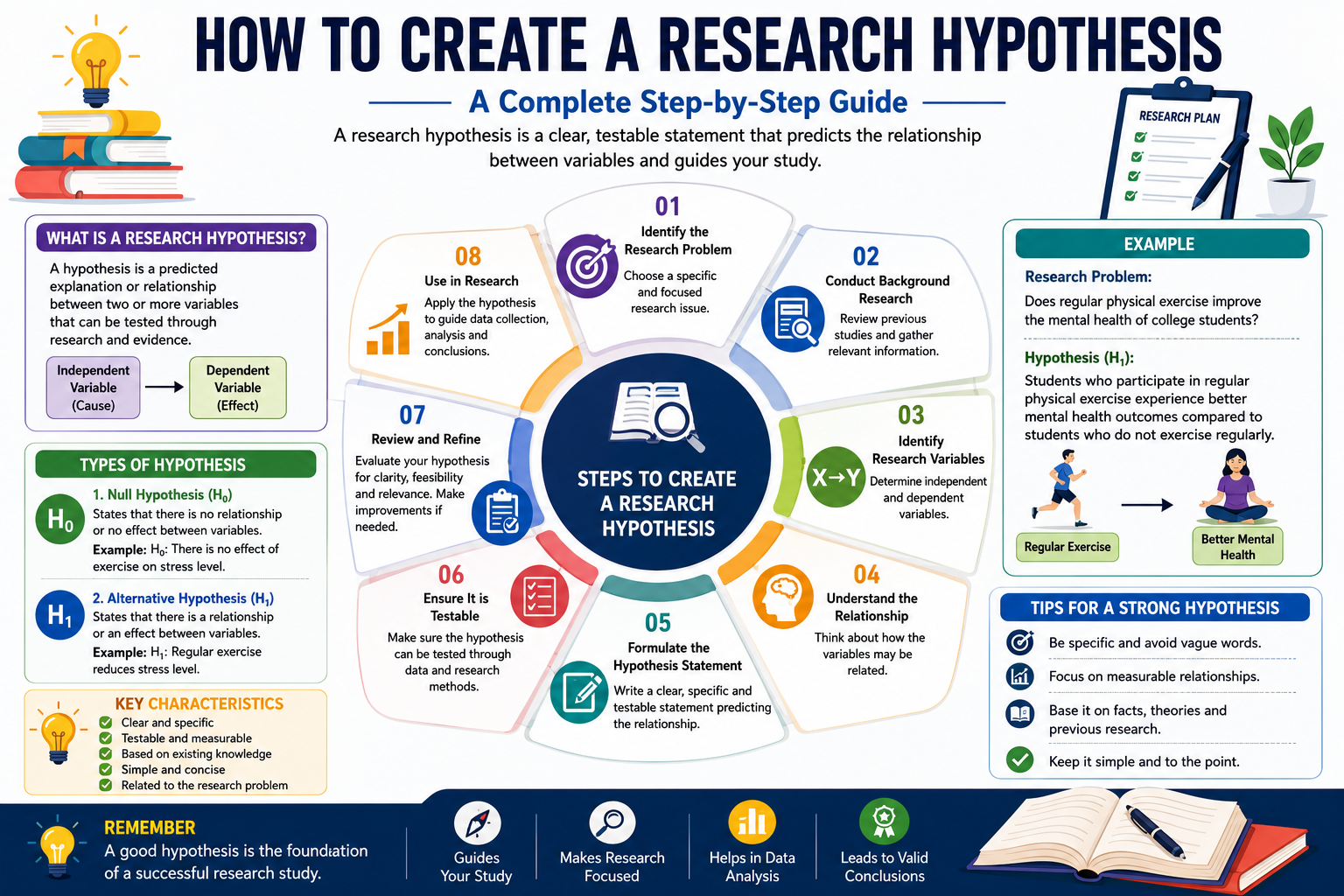
A research hypothesis is one of the most important elements of any research study because it provides a clear direction for investigation. It is a statement that predicts a possible relationship between different factors or variables that a researcher wants to study. A hypothesis helps researchers understand what they are trying to prove, measure, or explore through their research.
Creating a research hypothesis requires careful thinking, background knowledge, and an understanding of the research problem. A well-written hypothesis is not just an assumption or personal opinion; it is a scientifically developed statement based on existing information, observations, previous studies, and logical reasoning.
Whether the research is conducted in education, healthcare, business, psychology, technology, or social sciences, a properly developed hypothesis helps researchers collect relevant data and reach meaningful conclusions. This guide explains how to create a research hypothesis, its importance, different types, characteristics, and the complete process of developing an effective hypothesis.
What Is a Research Hypothesis?
A research hypothesis is a proposed explanation or prediction about the relationship between two or more variables. It describes what a researcher expects to discover during the study and provides a foundation for testing ideas through scientific methods.
In simple words, a hypothesis is an educated prediction that can be examined using research methods and evidence.
For example, a researcher may want to study whether exercise affects mental health among students. The research question could be:
“Does regular physical exercise improve the mental health of college students?”
Based on this question, the researcher can create a hypothesis:
“Students who participate in regular physical exercise experience better mental health outcomes compared to students who do not exercise regularly.”
In this example, exercise is the factor being studied, while mental health improvement is the expected result. The hypothesis creates a connection between these two variables and allows the researcher to collect data for evaluation.
Importance of Creating a Research Hypothesis
A research hypothesis plays a major role in improving the quality and effectiveness of a research study. It helps researchers develop a structured approach instead of collecting information without a clear purpose.
Provides a Clear Research Direction
A hypothesis gives researchers a specific goal to focus on. Without a hypothesis, a study may become too broad and difficult to manage. By defining what relationship needs to be examined, researchers can concentrate on collecting relevant information and analyzing specific outcomes.
For example, instead of studying the general impact of technology, a researcher can focus on how artificial intelligence tools influence students’ learning performance. This makes the research more precise and meaningful.
Helps in Selecting Research Methods
A properly created hypothesis helps researchers decide which research methods are suitable for their study. Depending on the hypothesis, researchers can choose surveys, experiments, interviews, observations, or statistical analysis methods.
For example, if a researcher wants to study whether a new teaching method improves student performance, an experiment or comparison study may be more appropriate than simple observation.
Supports Data Analysis and Interpretation
A hypothesis provides a framework for analyzing collected information. After gathering data, researchers can compare their findings with the original prediction and determine whether the hypothesis is supported or rejected.
This process helps transform raw information into meaningful research conclusions.
Improves Research Organization
A clear hypothesis keeps the entire research process organized. It connects the research problem, objectives, methodology, data collection, and final conclusions in a logical sequence.
Steps to Create a Research Hypothesis
Creating an effective research hypothesis requires a systematic approach. Researchers should follow several important steps to develop a statement that is clear, measurable, and scientifically valuable.
Step 1: Identify the Research Problem
The first step in creating a research hypothesis is identifying a specific research problem. A researcher should clearly understand what issue, question, or situation needs investigation.
A research topic is usually broad in the beginning, so it needs to be narrowed down into a specific problem.
For example:
A broad topic could be:
“The impact of technology on education.”
This topic covers many areas and may be difficult to study. It can be refined into a more specific research problem:
“How does online learning influence academic performance among university students?”
A focused research problem makes it easier to develop a clear and testable hypothesis.
Step 2: Conduct Background Research
Before writing a hypothesis, researchers need to study existing information related to their topic. Reviewing previous studies, theories, and available research helps in understanding what is already known and what areas still require investigation.
Background research helps researchers identify important factors, possible relationships between variables, and research gaps.
For example, while studying online learning, previous research may show that digital education affects student engagement and performance. This information can help researchers create a more meaningful hypothesis.
A strong hypothesis should always be connected with existing knowledge rather than being created without evidence.
Step 3: Identify Research Variables
Understanding variables is an essential part of creating a research hypothesis. Variables are the factors that researchers measure, observe, or analyze during a study.
The two main types of variables are independent variables and dependent variables.
Independent Variable
An independent variable is the factor that influences or affects another variable. It is usually the cause or condition being studied by researchers.
For example, in a study about exercise and health, exercise habits are the independent variable because they may influence health outcomes.
Other examples of independent variables include teaching methods, diet plans, advertising strategies, and technology usage.
Dependent Variable
A dependent variable is the result or outcome that researchers measure. It changes depending on the independent variable.
In the exercise example, mental health improvement would be the dependent variable because it is the expected outcome influenced by exercise.
Clearly identifying variables helps researchers create a hypothesis that can be tested accurately.
Step 4: Develop a Research Question
A research question helps transform a general idea into a focused investigation. It defines what the researcher wants to discover.
A good research question should be specific, clear, and connected to measurable factors.
For example:
Research Question:
“Does sleep duration affect academic performance among students?”
Research Hypothesis:
“Students who get sufficient sleep regularly achieve better academic performance compared to students who sleep fewer hours.”
The research question provides the foundation for creating a logical prediction.
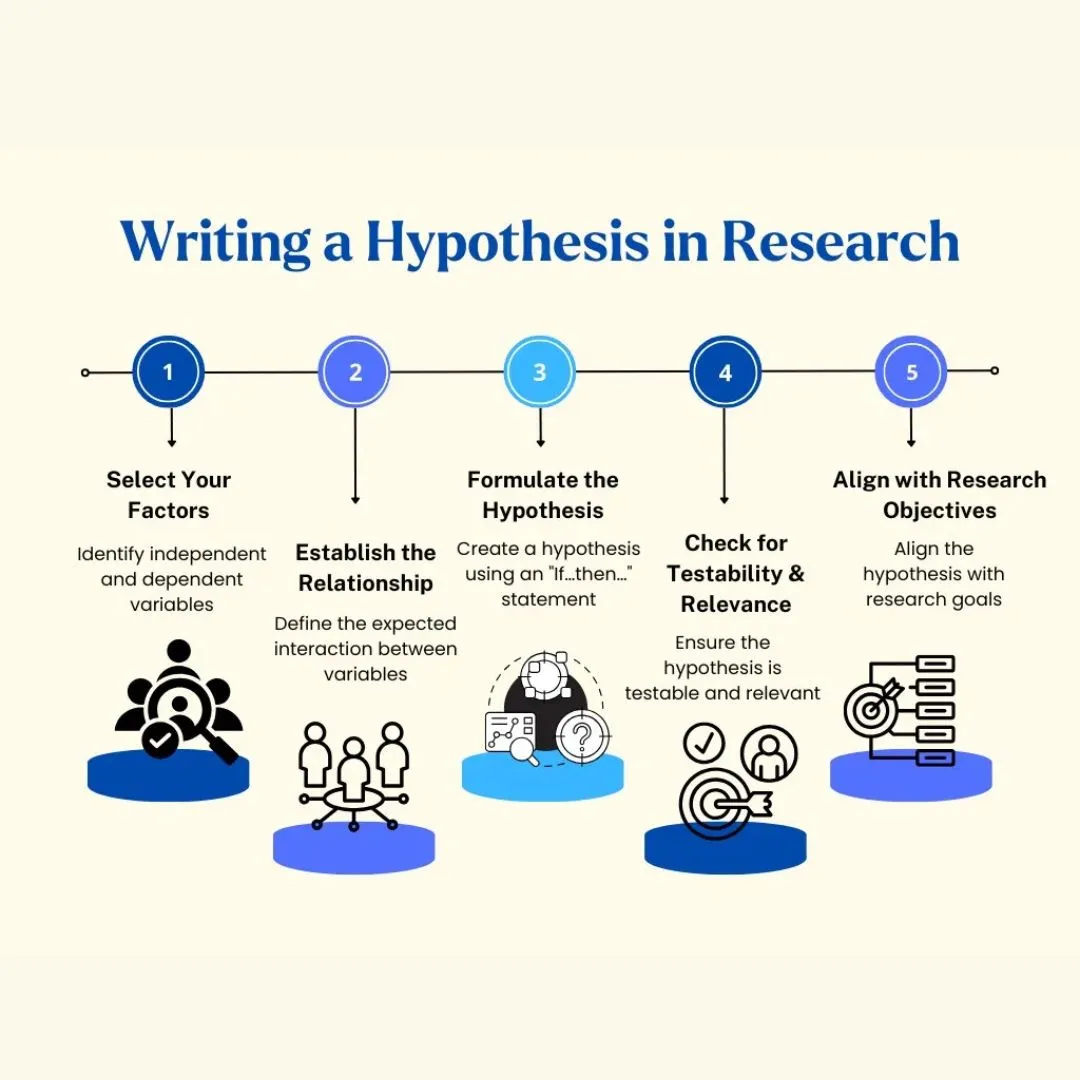
Step 5: Create a Testable Prediction
A research hypothesis must be testable, meaning researchers should be able to collect data and evaluate whether the statement is correct or incorrect.
A statement like:
“Technology is useful.”
is too general because it cannot be measured easily.
A better hypothesis would be:
“Students who use educational technology platforms regularly show improved learning outcomes compared to students who do not use such platforms.”
This statement identifies specific factors and allows researchers to test the relationship between them.
Step 6: Write the Hypothesis Clearly
A good research hypothesis should be written in simple and understandable language. It should clearly explain the expected relationship between variables.
Many researchers use an “If-Then” structure while creating a hypothesis.
For example:
“If students increase their study hours, then their examination performance will improve.”
This format clearly explains the expected cause-and-effect relationship.
A well-written hypothesis should avoid complicated words and unnecessary information because clarity is essential in research.
Types of Research Hypothesis
Different research studies require different types of hypotheses depending on their objectives and methods.
Null Hypothesis
A null hypothesis states that there is no significant relationship or difference between the variables being studied.
It represents the idea that any observed difference may occur due to chance rather than a real effect.
For example:
“There is no significant difference in academic performance between students using online learning and traditional classroom learning.”
Researchers test the null hypothesis to determine whether evidence exists to reject it.
Alternative Hypothesis
An alternative hypothesis suggests that a relationship or difference exists between variables.
It represents the expected outcome that researchers want to investigate.
For example:
“Students using online learning platforms achieve better academic performance compared to students using traditional classroom methods.”
Directional Hypothesis
A directional hypothesis predicts the specific direction of the relationship between variables.
It explains whether one factor will increase or decrease another factor.
For example:
“Increasing physical activity reduces stress levels among adults.”
This hypothesis predicts that more exercise will lead to lower stress.
Non-Directional Hypothesis
A non-directional hypothesis suggests that a relationship exists between variables but does not predict the exact direction.
For example:
“There is a relationship between social media usage and mental health.”
It does not explain whether social media improves or negatively affects mental health.
Characteristics of a Good Research Hypothesis
A strong research hypothesis should have several important qualities that make it effective and reliable.
A good hypothesis should be clear and specific so that researchers understand exactly what they are studying. It should avoid vague statements and clearly define the relationship between variables.
A hypothesis must also be testable. Researchers should be able to collect data and use research methods to evaluate whether the prediction is correct.
It should be based on existing knowledge, previous studies, and logical reasoning rather than personal beliefs.
A good hypothesis should include measurable variables because researchers need to evaluate results using evidence.
Finally, a strong hypothesis should be relevant to the research objective and contribute meaningful information to the field of study.
Common Mistakes While Creating a Research Hypothesis
Many researchers make mistakes while developing hypotheses, especially when they are new to research.
One common mistake is creating a hypothesis without conducting background research. A hypothesis should always be supported by existing information and understanding of the topic.
Another mistake is making the hypothesis too broad. General statements are difficult to test because they do not clearly define variables.
Researchers should also avoid using unclear terms. Every variable should have a clear meaning so that the study can be measured accurately.
A hypothesis should not represent personal opinions or assumptions. It should be based on evidence and logical reasoning.
Examples of Research Hypothesis
Education Research Example
Research Topic:
Impact of digital learning tools on student performance.
Hypothesis:
Students who regularly use digital learning platforms achieve better academic results compared to students who use traditional learning methods only.
Health Research Example
Research Topic:
Effect of physical activity on stress management.
Hypothesis:
Regular physical activity helps reduce stress levels among adults.
Business Research Example
Research Topic:
Effect of customer reviews on purchasing decisions.
Hypothesis:
Positive online customer reviews increase customers’ willingness to purchase products.
Conclusion
Creating a research hypothesis is a fundamental step that helps researchers develop focused, organized, and meaningful studies. A well-designed hypothesis connects the research problem with measurable variables and provides a clear direction for investigation.
To create an effective research hypothesis, researchers should identify a specific problem, conduct background research, understand variables, develop a testable prediction, and write the statement clearly.
A strong hypothesis improves research accuracy, supports scientific investigation, and helps researchers generate valuable insights. By following a structured approach, students and professionals can create hypotheses that strengthen their research quality and contribute meaningful knowledge to their respective fields.