Academic research is evolving rapidly as new technologies, interdisciplinary collaborations, and global challenges reshape the way knowledge is produced and applied. Universities and research institutions are increasingly focusing on innovative approaches that combine digital tools, scientific advancements, and societal needs. In 2026, several emerging research trends are transforming academic studies, influencing how scholars conduct research, analyze data, and solve complex problems.
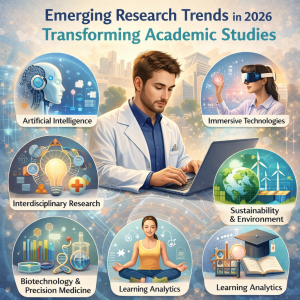
Advancements in artificial intelligence, biotechnology, immersive learning technologies, sustainability research, and data analytics are playing a crucial role in shaping the future of academia. These developments are not only improving the efficiency of research but also expanding opportunities for collaboration across disciplines. Understanding these emerging trends helps researchers, educators, and students adapt to the changing academic landscape and contribute to meaningful innovation.
Table of Contents
ToggleArtificial Intelligence and Data-Driven Research
Artificial intelligence has become one of the most influential forces in modern academic research. Universities are increasingly integrating AI tools into research processes to analyze large datasets, automate repetitive tasks, and generate insights that would otherwise take years to discover. AI technologies are also supporting predictive analytics and improving decision-making in various academic fields.
AI-driven systems can assist researchers by identifying patterns in complex data and suggesting new hypotheses for investigation. In education and research environments, intelligent systems are also being used to personalize learning and assist with complex problem-solving. These tools are transforming traditional research methods into data-driven approaches that improve accuracy and efficiency.
Interdisciplinary and Collaborative Research
Modern academic challenges often require knowledge from multiple disciplines, leading to a strong emphasis on interdisciplinary research. Universities are encouraging collaborations between fields such as engineering, medicine, social sciences, and environmental studies. This collaborative approach allows researchers to address complex global issues like climate change, public health, and sustainable development more effectively.
Interdisciplinary research also promotes innovation by combining different perspectives and methodologies. International conferences and collaborative research programs are helping scholars exchange knowledge and develop new ideas that bridge traditional academic boundaries. These collaborations strengthen academic networks and increase the impact of research outcomes on society.
Biotechnology and Precision Medicine
Biotechnology is another major research trend transforming academic studies in 2026. Advances in gene editing technologies and molecular biology are enabling scientists to develop targeted treatments for diseases and improve agricultural productivity. Techniques involving advanced gene editing allow researchers to modify genetic material with greater precision, accelerating medical and pharmaceutical innovations.
Researchers are also exploring synthetic biology, which involves designing biological systems to produce medicines, fuels, and other valuable products. The growing field of microbiome research is helping scientists understand how microorganisms influence human health. These developments are expanding opportunities for collaboration between universities, healthcare institutions, and biotechnology companies.
Immersive Technologies in Research and Education
Immersive technologies such as virtual reality, augmented reality, and extended reality are transforming how research and academic learning are conducted. These technologies allow students and researchers to simulate complex environments, conduct virtual experiments, and explore scientific concepts in interactive ways.
For example, virtual laboratories enable researchers to test hypotheses without the risks and costs associated with physical experiments. Similarly, immersive simulations can help students explore historical sites, scientific models, or engineering designs in a realistic digital environment. These tools enhance understanding, improve engagement, and open new possibilities for experiential learning in academic studies.
Sustainability and Environmental Research
Global concerns about climate change, resource depletion, and environmental degradation have led to increased research in sustainability and green technologies. Universities are prioritizing studies that focus on renewable energy, recycling innovations, and sustainable resource management.
One promising area of research involves advanced recycling technologies that can break down plastics and recover valuable materials from waste. Researchers are also developing environmentally friendly materials and exploring ways to reduce carbon emissions through innovative engineering solutions. Sustainability research not only addresses environmental challenges but also supports the development of circular economies and responsible resource use.
Learning Analytics and Educational Data Science
Learning analytics has become an important field within academic research, focusing on the analysis of educational data to improve learning outcomes. Researchers are using advanced analytical tools to examine how students learn, interact with digital platforms, and respond to different teaching methods.
Through data analysis, educators can identify patterns in student performance and develop personalized strategies to support learning. Learning analytics also helps institutions design better curricula, enhance student engagement, and predict academic success. By integrating data science into education, universities are creating more effective and adaptive learning environments for students worldwide.
Ethical and Human-Centered Research Approaches
As technological advancements reshape academic research, ethical considerations are becoming increasingly important. Researchers are focusing on responsible innovation, ensuring that scientific discoveries benefit society while minimizing potential risks. Topics such as artificial intelligence ethics, data privacy, and responsible biotechnology are gaining attention in academic studies.
Human-centered research emphasizes the importance of considering social, cultural, and ethical implications when developing new technologies. Universities are encouraging scholars to integrate ethical frameworks into research projects and collaborate with policymakers, communities, and industry leaders. This approach helps ensure that technological progress aligns with societal values and promotes sustainable development.
Conclusion
The academic landscape in 2026 is being transformed by a range of emerging research trends that are reshaping how knowledge is created and applied. Advances in artificial intelligence, interdisciplinary collaboration, biotechnology, immersive technologies, sustainability research, and educational data science are opening new possibilities for innovation and discovery.
These trends highlight the growing importance of integrating technology with human creativity and ethical responsibility. As researchers continue to explore new frontiers, universities and research institutions must adapt to these changes by promoting collaboration, investing in advanced technologies, and supporting responsible research practices. By embracing these emerging trends, academia can continue to contribute meaningful solutions to global challenges and drive progress in science, education, and society.