Artificial Intelligence (AI) has become one of the most influential technological developments of the modern era. Its impact extends far beyond industries such as healthcare, finance, and manufacturing. In recent years, AI has significantly transformed the field of academic research by improving the way researchers collect data, analyze information, and generate insights. As the volume of scientific literature and research data continues to grow rapidly, traditional research methods often struggle to keep pace with the increasing complexity and scale of information.
AI technologies provide researchers with powerful tools to process vast amounts of data, identify patterns, and accelerate discovery. From automating repetitive tasks to enabling complex data analysis, AI is reshaping how scholars approach research problems across disciplines. As universities, research institutions, and scientific organizations adopt AI-driven tools, academic research is becoming faster, more efficient, and more collaborative.
The Growing Role of Artificial Intelligence in Research
Artificial Intelligence has gradually become an essential component of modern research environments. Many academic fields generate large volumes of data that require sophisticated tools for interpretation and analysis. AI algorithms can process this data quickly and accurately, allowing researchers to uncover insights that would be difficult to detect manually.
In disciplines such as medicine, climate science, economics, and social sciences, AI assists researchers in modeling complex systems and predicting outcomes. Machine learning models can analyze datasets containing millions of variables, enabling scientists to explore relationships between different factors. As a result, AI enhances the ability of researchers to generate new knowledge and develop innovative solutions to complex problems.
Furthermore, AI tools help scholars manage the overwhelming amount of academic literature published every year, making it easier to identify relevant studies and stay updated with the latest findings.
Accelerating Literature Review and Knowledge Discovery
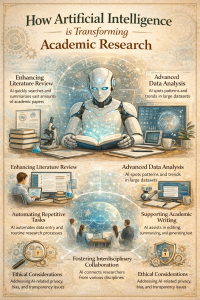
One of the most time-consuming aspects of academic research is conducting a comprehensive literature review. Researchers must examine numerous academic papers, books, and reports to understand existing knowledge and identify research gaps. AI-powered tools have significantly improved this process by automating the search and analysis of scholarly content.
Natural language processing technologies allow AI systems to read, categorize, and summarize large collections of academic articles. These systems can identify key themes, highlight relevant studies, and recommend important research papers based on a researcher’s topic of interest. This capability saves significant time and effort during the early stages of research.
Additionally, AI tools can detect connections between different studies and suggest new research directions. By identifying patterns across multiple publications, AI helps researchers discover emerging trends and interdisciplinary opportunities that may not be immediately obvious.
Enhancing Data Analysis and Pattern Recognition
Data analysis is a fundamental part of academic research, especially in fields that rely heavily on statistical methods and large datasets. AI technologies, particularly machine learning algorithms, have greatly enhanced the ability of researchers to analyze complex data.
Machine learning models can identify patterns, correlations, and anomalies within large datasets. For example, in biomedical research, AI systems analyze genetic information and medical records to uncover relationships between genes, diseases, and treatments. In environmental research, AI models analyze climate data to predict weather patterns and assess environmental changes.
By automating many aspects of data analysis, AI reduces the time required to process large datasets and improves the accuracy of results. Researchers can focus more on interpreting findings and developing theoretical insights rather than spending excessive time on manual data processing.
Automating Repetitive Research Tasks
Academic research often involves numerous repetitive and time-intensive tasks. These tasks may include data collection, formatting references, organizing research materials, and preparing documentation. AI tools are increasingly capable of automating these routine processes, allowing researchers to devote more time to creative and analytical aspects of their work.
For instance, AI-powered software can automatically organize research notes, categorize documents, and manage bibliographic references. Some tools assist with transcription, translation, and data labeling, which are common tasks in many research projects.
Automation not only saves time but also reduces the likelihood of human error. By handling repetitive tasks efficiently, AI enables researchers to maintain higher productivity and focus on more complex research questions.
Supporting Academic Writing and Editing
Artificial Intelligence has also begun to support researchers during the academic writing process. AI-based writing assistants can help improve grammar, clarity, and readability in scholarly manuscripts. These tools analyze sentence structure and language usage to suggest improvements that enhance the overall quality of writing.
In addition to grammar and style recommendations, AI systems can assist with summarizing research findings, generating outlines, and organizing complex information. Some AI-powered tools help researchers check for plagiarism and ensure proper citation practices, which are essential for maintaining academic integrity.
While AI does not replace human expertise and critical thinking, it provides valuable assistance that streamlines the writing and editing process. Researchers can produce well-structured manuscripts more efficiently while maintaining high academic standards.
Enabling Interdisciplinary Collaboration
Modern research challenges often require expertise from multiple disciplines. Problems such as climate change, global health, and technological innovation involve complex systems that cannot be fully understood within a single field of study. Artificial Intelligence supports interdisciplinary collaboration by connecting researchers from diverse academic backgrounds.
AI platforms can analyze research databases across various disciplines and identify potential collaborations based on shared research interests. These tools help scholars discover experts in related fields and facilitate partnerships that lead to innovative research projects.
By bridging gaps between disciplines, AI encourages knowledge exchange and fosters a more collaborative research environment. Interdisciplinary collaboration often leads to groundbreaking discoveries that address real-world problems more effectively.
Ethical Considerations and Challenges
Despite its many advantages, the use of Artificial Intelligence in academic research also raises important ethical and practical concerns. One key issue is data privacy and security. Many research projects involve sensitive data, such as personal information or confidential medical records. Ensuring that AI systems handle this data responsibly is essential.
Another challenge involves the transparency and reliability of AI algorithms. Researchers must understand how AI models generate results and ensure that these models do not introduce bias into research findings. Biased datasets or poorly designed algorithms can lead to misleading conclusions.
Additionally, there are concerns about the overreliance on AI tools. While AI can assist researchers, human judgment, critical thinking, and scientific expertise remain essential components of the research process. Maintaining a balance between technological assistance and scholarly responsibility is crucial for ethical research practices.
The Future of AI in Academic Research
The role of Artificial Intelligence in academic research is expected to expand significantly in the coming years. Advances in machine learning, natural language processing, and data science will continue to improve the capabilities of AI-driven research tools. These developments will allow researchers to analyze even larger datasets and explore more complex research questions.
AI may also contribute to the development of autonomous research systems capable of designing experiments, generating hypotheses, and conducting simulations. Such technologies could dramatically accelerate scientific discovery across fields such as medicine, physics, and environmental science.
Furthermore, AI-driven platforms may enhance global research collaboration by connecting scholars from different regions and institutions. As access to advanced research tools becomes more widespread, AI has the potential to democratize knowledge creation and make research opportunities more accessible worldwide.
Conclusion
Artificial Intelligence is rapidly transforming academic research by improving efficiency, expanding analytical capabilities, and enabling new forms of collaboration. From accelerating literature reviews to automating repetitive tasks and enhancing data analysis, AI provides researchers with powerful tools that support every stage of the research process.
At the same time, the integration of AI into research environments requires careful attention to ethical considerations, transparency, and responsible use of technology. While AI offers remarkable advantages, human expertise and critical thinking remain essential to ensuring the accuracy and integrity of scientific work.
As AI technologies continue to evolve, they will play an increasingly important role in shaping the future of academic research. By combining advanced computational tools with human creativity and curiosity, researchers can unlock new discoveries and address some of the most pressing challenges facing society today.