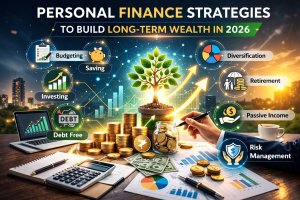
Building long-term wealth in 2026 requires more than simply earning a high income. It demands disciplined financial habits, smart investing, risk management, and a strategic understanding of evolving economic conditions. With rising living costs, digital investment platforms, inflation concerns, and rapidly changing markets, individuals must adopt structured personal finance strategies to secure financial independence and stability.
Below are proven, research-backed strategies financial experts consistently recommend for long-term wealth creation. Each section explains the concept clearly and practically to help individuals apply it effectively.
1. Create a Clear Financial Plan with Defined Goals
Long-term wealth building begins with a written financial plan. Without defined goals, saving and investing become inconsistent and reactive.
A strong financial plan includes short-term goals (emergency fund, debt repayment), mid-term goals (home purchase, business funding), and long-term goals (retirement, generational wealth). Financial planners emphasize setting SMART goals — specific, measurable, achievable, relevant, and time-bound. Clarity improves discipline and reduces impulsive financial decisions. In 2026, with access to digital budgeting tools and financial apps, tracking goals and adjusting strategies has become easier than ever. A clear roadmap turns income into intentional wealth-building.
2. Build and Maintain an Emergency Fund
Financial stability depends on preparedness for unexpected events such as medical emergencies, job loss, or economic downturns.
Experts generally recommend maintaining three to six months’ worth of essential expenses in a liquid and easily accessible account. This safety net prevents reliance on high-interest debt during crises. In uncertain economic environments, emergency funds protect long-term investments from premature withdrawal. The purpose is not growth but stability and peace of mind. A well-funded emergency reserve forms the foundation upon which wealth-building strategies can safely operate.
3. Master Budgeting and Cash Flow Management
Wealth creation depends more on disciplined cash flow management than on income alone.
A structured budget tracks earnings, fixed expenses, variable spending, and savings contributions. Popular frameworks such as the 50/30/20 rule (needs, wants, savings) continue to guide financial planning effectively. Monitoring cash flow helps identify unnecessary spending leaks and redirect funds toward investments. In 2026, digital banking and automated expense tracking tools make budgeting more precise and efficient. When spending aligns with long-term priorities, wealth accumulation becomes consistent and sustainable.
4. Eliminate High-Interest Debt Strategically
Debt can either support financial growth or significantly hinder wealth creation.
High-interest liabilities such as credit card debt reduce investment capacity and compound negatively over time. Financial advisors recommend prioritizing repayment using methods like the avalanche strategy (highest interest first) or snowball strategy (smallest balance first for psychological momentum). Reducing debt improves credit scores and increases financial flexibility. In a rising interest-rate environment, minimizing costly debt is one of the most impactful wealth-building decisions individuals can make.
5. Invest Early and Harness the Power of Compounding
Time remains one of the most powerful wealth-building tools.
Compounding allows investments to generate returns, which then produce additional returns over time. The earlier individuals begin investing, the more significant the compounding effect becomes. Diversified portfolios typically include equities, bonds, index funds, exchange-traded funds (ETFs), and other asset classes based on risk tolerance. Long-term investing, rather than short-term speculation, has historically delivered more stable growth. In 2026, automated investing platforms and systematic investment plans (SIPs) make consistent investing accessible to more people than ever.
6. Diversify Investments to Manage Risk
Diversification reduces exposure to volatility and protects portfolios from concentrated risk.
A balanced asset allocation spreads investments across industries, geographies, and asset types. This helps cushion losses if one sector underperforms. Experts emphasize that diversification is not just about owning many assets, but about owning assets that respond differently to market changes. As global markets remain interconnected, strategic diversification is critical. Investors who balance growth assets with stable income-generating investments tend to build sustainable wealth over time.
7. Maximize Retirement Contributions
Retirement planning is a central pillar of long-term wealth creation.
Contributing consistently to retirement accounts such as employer-sponsored plans or individual retirement schemes provides tax advantages and long-term growth potential. Many financial experts advise contributing at least enough to receive employer matching benefits when available. Tax-efficient investing increases overall returns by minimizing avoidable tax burdens. In 2026, as life expectancy increases, retirement planning requires larger and more consistent contributions to ensure financial independence later in life.
8. Develop Multiple Income Streams
Relying solely on a single source of income increases financial vulnerability.
Wealth builders often diversify income through side businesses, freelancing, dividends, rental properties, royalties, or digital products. The digital economy has expanded opportunities for remote and scalable income streams. Additional income can accelerate debt repayment and investment contributions. Over time, passive income sources create financial flexibility and reduce dependence on active employment. Building multiple streams requires effort initially but significantly strengthens long-term wealth prospects.
9. Invest in Skills and Financial Education
Human capital is often the most valuable long-term asset.
Continuous skill development improves earning potential and career resilience. In 2026’s competitive and technology-driven economy, upgrading professional skills increases income stability and growth opportunities. Financial literacy is equally important — understanding taxes, insurance, investments, and risk management leads to better decision-making. Individuals who prioritize education consistently make smarter investment and savings choices, compounding both income and knowledge over time.
10. Protect Wealth with Insurance and Estate Planning
Wealth creation must be paired with wealth protection.
Insurance — including health, life, disability, and property coverage — safeguards financial progress from unexpected setbacks. Without protection, years of savings can be erased by unforeseen expenses. Estate planning, including wills and beneficiary designations, ensures that assets are distributed according to personal wishes. As individuals accumulate wealth, structured planning becomes essential. Risk management is not about pessimism; it is about preserving long-term financial stability.
11. Stay Disciplined During Market Volatility
Emotional decision-making often undermines long-term financial success.
Market fluctuations are normal, and reacting impulsively to short-term downturns can lead to losses. Long-term wealth builders follow structured investment strategies and rebalance portfolios periodically rather than chasing trends. Maintaining discipline during uncertainty preserves compounding growth. Behavioral finance research consistently shows that patience and consistency outperform reactive investing. In 2026’s fast-paced digital trading environment, emotional control is a critical financial skill.
Conclusion
Building long-term wealth in 2026 requires a balanced approach that integrates planning, discipline, diversification, and continuous learning. From budgeting and emergency savings to investing, retirement planning, and risk protection, each component plays a vital role in financial success.
Wealth is not created through quick wins or speculative risks, but through consistent habits compounded over time. Individuals who develop strong financial systems, diversify intelligently, manage risk, and remain disciplined during uncertainty position themselves for sustainable prosperity. In an evolving global economy, the fundamentals of personal finance remain timeless — spend wisely, invest early, diversify thoughtfully, and protect what you build.