In today’s hyper-connected digital landscape, businesses of all sizes face growing threats from cybercriminals. Data breaches have become increasingly frequent and sophisticated, targeting sensitive customer information, financial records, intellectual property, and operational systems. The financial, legal, and reputational consequences of a breach can be devastating. As a result, organizations are investing heavily in cybersecurity technologies designed to prevent, detect, and respond to cyber threats effectively.
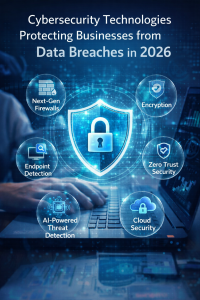
Modern cybersecurity is no longer limited to antivirus software or basic firewalls. It involves layered defenses, advanced threat intelligence, artificial intelligence, encryption protocols, and proactive monitoring systems. Below is a comprehensive overview of the most important cybersecurity technologies protecting businesses from data breaches in 2026.
Advanced Firewalls and Network Security
Firewalls remain a foundational component of cybersecurity infrastructure. Modern next-generation firewalls (NGFWs) go beyond traditional traffic filtering by inspecting data packets in real time and identifying malicious patterns.
These advanced systems include intrusion prevention capabilities, application awareness, and deep packet inspection. By analyzing both inbound and outbound traffic, they help block unauthorized access and suspicious activities before they reach critical systems. Network segmentation further enhances protection by isolating sensitive data and limiting lateral movement in case of a breach. Together, these technologies create a strong first line of defense against cyberattacks.
Endpoint Detection and Response (EDR)
With the rise of remote work and mobile devices, endpoints such as laptops, smartphones, and tablets have become major attack surfaces. Endpoint Detection and Response (EDR) solutions monitor and analyze endpoint activities continuously to identify suspicious behavior.
Unlike traditional antivirus software that relies mainly on signature-based detection, EDR uses behavioral analysis to detect previously unknown threats. It provides real-time visibility, automated threat containment, and forensic investigation capabilities. By quickly isolating compromised devices, businesses can prevent malware from spreading across networks and reduce potential damage.
Multi-Factor Authentication (MFA)
Stolen credentials remain one of the most common causes of data breaches. Multi-Factor Authentication (MFA) significantly reduces this risk by requiring users to verify their identity using two or more authentication factors.
These factors may include something the user knows (password), something they have (security token or mobile device), or something they are (biometric verification). Even if passwords are compromised, MFA creates an additional security barrier. In 2026, many organizations have adopted MFA as a standard requirement for accessing corporate systems, cloud platforms, and financial data.
Encryption Technologies
Encryption plays a critical role in protecting sensitive information both in transit and at rest. Data encryption converts readable information into coded text that can only be accessed with the correct decryption key.
Modern encryption protocols secure communication channels such as email, file transfers, and cloud storage. End-to-end encryption ensures that only authorized parties can access the transmitted data. Strong encryption reduces the impact of breaches by making stolen data unusable to attackers. Businesses handling financial, healthcare, or personal information particularly rely on encryption to meet regulatory compliance standards.
Security Information and Event Management (SIEM)
Security Information and Event Management (SIEM) systems collect and analyze security data from across an organization’s IT environment. These platforms aggregate logs from servers, applications, firewalls, and endpoints to provide centralized visibility.
SIEM tools use correlation rules and analytics to detect unusual patterns that may indicate a cyber threat. By providing real-time alerts and detailed reports, they enable security teams to respond quickly to potential breaches. SIEM solutions also support compliance reporting and incident investigations, making them essential for enterprise-level security operations.
Artificial Intelligence and Machine Learning in Cybersecurity
Artificial Intelligence (AI) and Machine Learning (ML) have transformed modern cybersecurity strategies. These technologies analyze vast amounts of data to identify anomalies and predict potential threats.
AI-driven systems learn from past incidents and continuously improve their detection capabilities. They can identify zero-day attacks and advanced persistent threats that traditional systems might miss. Automation powered by AI reduces response times and minimizes human error. As cyberattacks grow more complex, AI-based defenses provide adaptive and proactive protection.
Cloud Security Solutions
As businesses increasingly migrate to cloud environments, securing cloud infrastructure has become a top priority. Cloud security technologies include cloud access security brokers (CASBs), secure configuration management, and workload protection platforms.
These tools monitor cloud activities, enforce security policies, and prevent unauthorized access to cloud-based resources. They also ensure compliance with industry standards and data protection regulations. With hybrid and multi-cloud environments becoming common, integrated cloud security solutions are essential to prevent data exposure and misconfigurations.
Zero Trust Architecture
Zero Trust is a modern security framework based on the principle of “never trust, always verify.” Unlike traditional perimeter-based security models, Zero Trust assumes that threats can exist both inside and outside the network.
Every user, device, and application must be continuously authenticated and authorized before accessing resources. Micro-segmentation and strict access controls limit exposure and reduce attack surfaces. By verifying identity at every step, Zero Trust significantly lowers the risk of unauthorized access and data breaches.
Data Loss Prevention (DLP) Systems
Data Loss Prevention (DLP) technologies are designed to detect and prevent unauthorized sharing or transfer of sensitive information. These systems monitor emails, file transfers, and user activities to identify potential data leaks.
DLP solutions can block suspicious actions or alert administrators when sensitive data is at risk. They are particularly useful in preventing insider threats and accidental data exposure. By classifying and tracking sensitive data, businesses can maintain better control over their information assets.
Regular Security Audits and Vulnerability Management
While advanced technologies provide strong protection, regular security audits and vulnerability scanning remain crucial. Vulnerability management tools identify weaknesses in software, systems, and configurations.
By applying timely patches and updates, organizations can close security gaps before attackers exploit them. Penetration testing further evaluates system defenses by simulating real-world attacks. Continuous assessment ensures that security measures remain effective against evolving threats.
Employee Awareness and Training Technologies
Human error is a significant factor in many data breaches. Phishing attacks, social engineering, and weak password practices often exploit employee behavior.
Security awareness training platforms educate employees about recognizing threats and following best practices. Simulated phishing exercises test readiness and reinforce learning. By combining technological defenses with informed employees, businesses create a more resilient security culture.
Conclusion
Cybersecurity technologies protecting businesses from data breaches have evolved into sophisticated, multi-layered systems. From advanced firewalls and EDR solutions to AI-powered threat detection and Zero Trust frameworks, modern defenses address both external and internal threats. Encryption, SIEM platforms, cloud security tools, and DLP systems further strengthen organizational resilience.
However, technology alone is not enough. Continuous monitoring, regular updates, vulnerability management, and employee training are equally important. In 2026, proactive cybersecurity is not optional—it is a strategic necessity. Businesses that invest in comprehensive security frameworks are better equipped to safeguard sensitive data, maintain customer trust, and ensure long-term operational stability in an increasingly digital world.