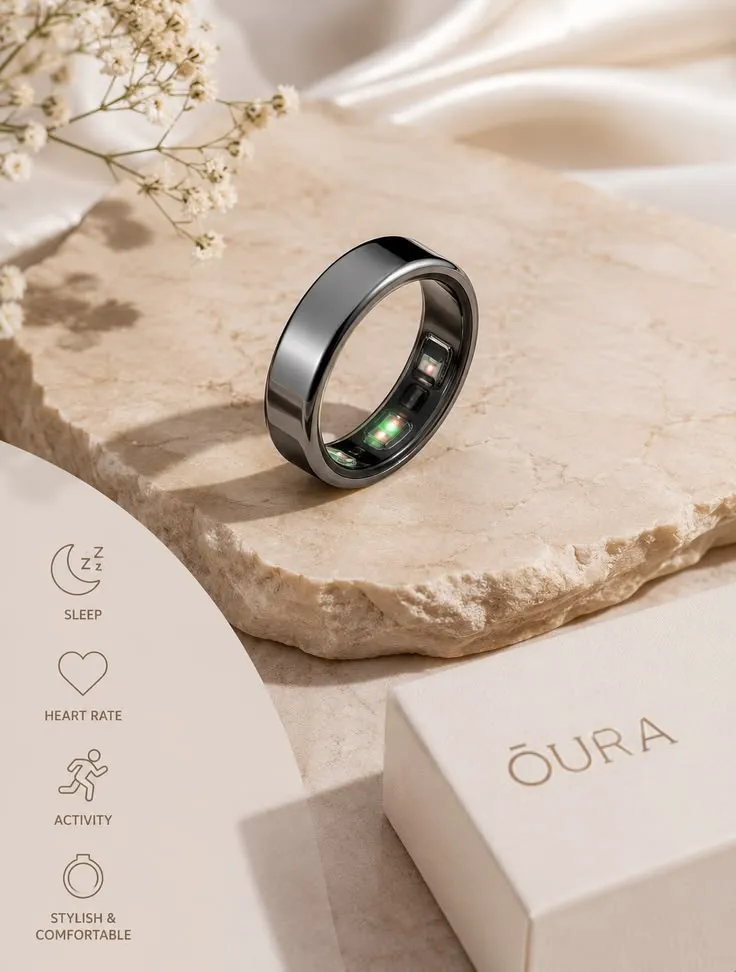
Smart rings have become popular tools for continuous health tracking, measuring sleep, activity, heart rate variability, temperature and recovery. For many users, the Oura Ring sits discreetly on a finger and delivers data without the bulk of a wrist-worn device. Yet rapid body changes can create an unexpected practical problem: the ring that once fit perfectly may suddenly feel loose.
This issue has grown more noticeable as GLP-1 receptor agonist medications become widely used for weight management and metabolic health. These treatments often produce substantial fat loss over months. One user’s experience captures the tension clearly. After selecting a ring with the company’s sizing kit, significant weight loss left the device spinning and slipping. The ring continued to record data with technical precision, yet it no longer matched the new shape of the finger.
How Oura Supports GLP-1 Users
Oura has responded to the rise of these medications by introducing dedicated features. GLP-1 Insights brings together dosing schedules, side-effect logging, weight tracking and core biometrics such as sleep, activity, readiness and stress into a single longitudinal view. Members can record weekly injections or daily pills, note symptoms such as nausea or changes in appetite, and log body weight over time. The app surfaces check-in reminders on dose days and places the information alongside continuous sensor data.
The feature is designed for people already using or preparing to start GLP-1 therapy. It is available in multiple markets including the United States, United Kingdom, European Union countries, Canada, Australia, India and others, and works with Oura Ring Gen3 and later models. Oura has also partnered with platforms that support access to these medications, offering free sizing kits in some cases to help new users begin with a correct fit.
These tools aim to give members a clearer picture of how medication, habits and physiological signals interact. They do not provide medical advice or dosing recommendations and are intended to complement, not replace, clinical care.
The Practical Challenge of Changing Finger Size
A well-fitting ring is essential for accurate readings. Optical sensors that measure blood flow require consistent skin contact. When a ring becomes loose, it can rotate, lose contact or produce noisier signals. Users report that significant weight loss often leaves the original size too large within weeks or months.
Oura rings are not resizable. They are manufactured in fixed whole sizes, and the company provides a free plastic sizing kit so customers can test multiple options before purchase. Official guidance for those whose fingers change is practical rather than structural. Wearers can move the ring to a different finger that still offers a secure fit, use a ring adjuster, or order a new size. Support teams may review individual cases, but a full exchange is not automatic.
Choosing the right finger matters from the start. The index finger is generally recommended because it tends to provide stable contact and larger blood vessels that support clearer pulse readings. The middle and ring fingers are workable alternatives. The thumb and pinky are usually discouraged because of movement patterns and vascular differences. Because finger circumference varies, the size that works on one finger may not suit another.
Why This Matters for Long-Term Tracking
Health wearables are most valuable when they remain wearable. A device that no longer fits comfortably risks being left in a drawer, interrupting the continuous data stream that makes longitudinal insights useful. For people on GLP-1 therapy, whose weight, energy levels, sleep and recovery may shift markedly, consistent tracking can help identify patterns between medication, lifestyle and biometrics.
The mismatch between a static hardware size and a changing body highlights a broader design consideration for the wearable industry. As more people experience rapid body composition changes through medication, surgery or intensive lifestyle programmes, form-factor products that sit tightly against the skin will face the same issue. Clothing and conventional jewellery are expected to be replaced as bodies change; health trackers that rely on precise fit may need clearer pathways for resizing or exchange.
Balancing Innovation and Real-World Use
Oura’s GLP-1 features represent a thoughtful effort to meet users where they are. Combining medication logs with continuous physiological data can support more informed conversations with clinicians and help individuals notice how daily habits influence their progress. At the same time, the physical reality of a loosening ring serves as a reminder that hardware and software must evolve together.
Users beginning a weight-loss journey with a smart ring are advised to consider possible future size changes when selecting their initial fit, to keep the sizing kit for reference, and to monitor comfort and signal quality as their body changes. Moving the ring to another finger or using an adjuster can extend its useful life. When a new size becomes necessary, the data continuity already collected remains available in the app.
The value of wearing health data on a finger lies in its unobtrusiveness and consistency. When the body that wears the ring changes significantly, the device must still feel like a natural part of daily life rather than a relic of an earlier shape. Addressing that practical gap will help ensure that the insights these tools generate remain accessible throughout the full course of a health transformation.
Read more – Bestmenuideas.com