Medieval manuscripts have long been valued for their texts, artistry, and historical insight. Recent research has shown they also function as unexpected biological archives. An international team of scientists has recovered genetic material from the sheeppox virus preserved in the animal skins used to make centuries-old parchment. Combined with DNA from Bronze Age sheep remains, these findings reconstruct more than 3,500 years of the pathogen’s evolution and demonstrate that the disease has threatened livestock herds for millennia.
Parchment as a Biological Time Capsule
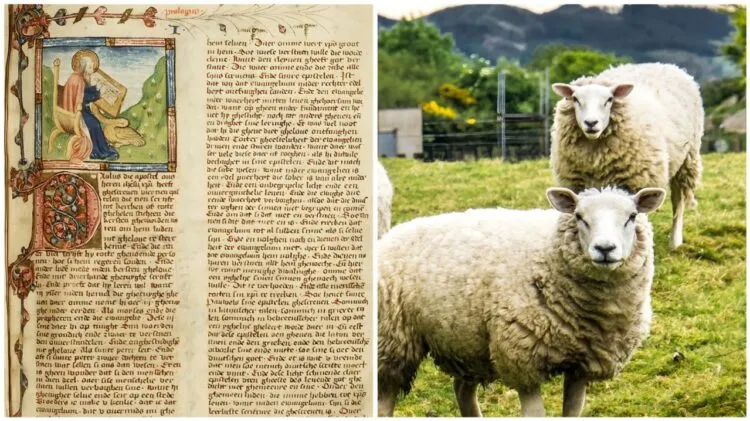
Parchment is produced from the specially treated skins of sheep, goats, or cattle. Because the process preserves organic material, the finished pages can retain DNA from the animals that supplied the hides, including traces of pathogens present at the time of death. Researchers led by a team at University College Dublin extracted and sequenced this ancient DNA from dozens of medieval documents across Britain and continental Europe.
Among the manuscripts examined were the York Gospels, a high-status illuminated book dating to around the year 1000, along with the Corpus Glossary, portions of the Trinity Gospels, the Lambeth Bible, and other codices produced between the eighth and fifteenth centuries. In several cases, multiple pages from the same volume yielded sheeppox virus DNA. This pattern indicates that animals infected with the virus were routinely used in parchment production during periods of outbreak.
The sampling method itself was non-invasive. Scientists gently rubbed the surfaces of the pages and recovered genetic material from the resulting eraser residue. Even after centuries of handling and storage in libraries and monasteries, enough intact viral DNA remained for analysis. The discovery expands the range of materials that can preserve pathogen genomes and opens the possibility that archives worldwide hold similar biological records of past animal disease.
Tracing the Virus into the Bronze Age
To push the timeline further back, the team turned to archaeological remains. Sheep teeth recovered from Bronze Age pastoralist settlements in the Eurasian steppe provided the oldest evidence. One sample from a site in Kazakhstan dates to between 1875 and 1645 BCE. Another from the Altai region of Russia dates to between 1336 and 1130 BCE. These dental remains preserved viral DNA from animals that lived more than 3,000 years ago.
Together, the parchment and archaeological genomes form a continuous record spanning roughly 3,700 years. The researchers recovered 21 novel ancient sheeppox genomes. By comparing these sequences with modern viral genomes, they estimated that the major lineages of the capripoxvirus family—sheeppox virus, goatpox virus, and lumpy skin disease virus—diverged between 11,500 and 3,700 years ago. This period overlaps with the intensification of animal domestication and the large-scale movement of sheep from the steppe into Europe.
Impact on Livestock and Human Societies
Sheeppox is a highly contagious disease that causes fever, skin lesions, and high mortality, particularly among young animals. Outbreaks can devastate flocks, reducing wool, meat, and milk production and threatening the food security of pastoral communities. Historical written accounts of the disease appear as early as the first century CE, but genetic evidence now shows the pathogen was already circulating among domestic sheep in the Bronze Age.
The presence of viral DNA in high-status medieval manuscripts suggests that outbreaks were common enough that infected animals regularly entered the parchment supply chain. The virus was also detected on pages made from calfskin and goatskin. Researchers interpret this either as rare instances of cross-species infection or as contamination that occurred during the parchment-making process itself.
Unlike some other poxviruses that have undergone substantial genetic change, the sheeppox virus genome appears relatively stable over the past several millennia. Key gene inactivation events observed in modern strains are already present in the earliest ancient genomes. This stability may indicate that important adaptations to the sheep host occurred early in the virus’s evolutionary history.
Scientific and Practical Significance
The study demonstrates the value of interdisciplinary collaboration. Geneticists, historians, virologists, protein chemists, and conservators worked together to extract biological information from cultural artifacts without damaging them. The approach shows that materials long studied for their textual and artistic content can simultaneously yield data on the health of past animal populations.
Understanding the long-term evolutionary trajectory of sheeppox has practical relevance. The disease continues to affect flocks in parts of the world and can cause severe economic losses. Ancient genomes provide a deeper baseline for studying how the virus adapts to its host and how its genetic makeup has remained consistent over time. Such information may eventually contribute to improved strategies for monitoring and controlling outbreaks.
A New Window on the Past
The recovery of sheeppox DNA from medieval gospels and Bronze Age remains transforms how researchers view both the history of livestock disease and the materials that preserve it. Manuscripts once seen solely as repositories of written knowledge now also serve as records of biological events that shaped agricultural life across Eurasia. The same skins that carried sacred texts and legal documents also carried the genetic signature of a pathogen that has shadowed domestic sheep for thousands of years.
By combining ancient DNA from parchment and archaeological teeth, scientists have established that sheeppox has been a persistent threat for at least three and a half millennia. The findings highlight the interconnected histories of animals, pathogens, and human societies, and they illustrate how careful study of everyday materials from the past can reveal unexpected insights into the long struggle between livestock and disease.
Read more – Thepowerfuldua.com , yandex-games.org