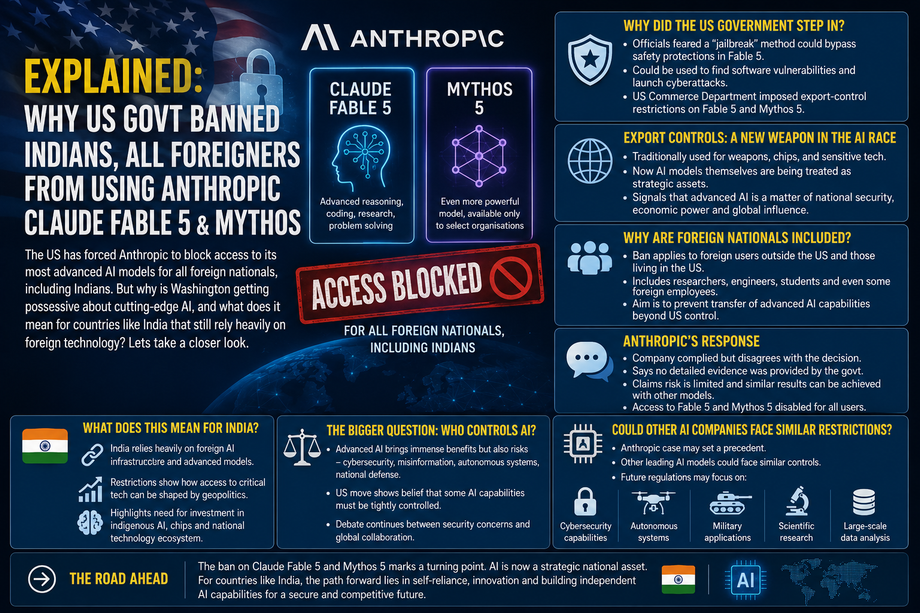
The global artificial intelligence race has entered a new and highly controversial phase. In a move that has sparked intense debate across the technology industry, the United States government has ordered AI company Anthropic to restrict access to its most advanced AI models—Claude Fable 5 and Mythos 5—for foreign nationals, including Indians. The directive has effectively forced Anthropic to disable access to these models globally while it complies with the order.
The decision marks one of the strongest examples yet of AI technology being treated as a strategic national security asset rather than merely a commercial product.
The development has raised important questions about the future of global AI access, technological sovereignty, and the growing competition among nations to control the world’s most powerful computing technologies.
What Are Claude Fable 5 and Mythos 5?
Anthropic recently introduced Claude Fable 5, the first publicly accessible model from its new Mythos class of AI systems. According to the company, Fable 5 represents one of its most capable AI models, designed to perform exceptionally well in software engineering, scientific research, advanced reasoning, and complex knowledge work.
These models attracted significant attention because of their advanced capabilities in identifying software vulnerabilities, analyzing large amounts of information, and solving highly complex technical problems. Anthropic had already implemented safety restrictions before releasing Fable 5 to the public, citing concerns about potential misuse in cybersecurity and other sensitive areas.
Why Did the US Government Step In?
The US government’s primary concern appears to be national security.
According to reports, officials became concerned about a method that could potentially bypass some of Fable 5’s safety protections. This process, commonly known as “jailbreaking,” refers to techniques that allow users to circumvent built-in restrictions and obtain responses that the AI would normally refuse to provide.
Authorities reportedly feared that such capabilities could be exploited to identify software vulnerabilities and potentially support sophisticated cyberattacks. As a result, the US Commerce Department imposed export-control restrictions on both Fable 5 and Mythos 5.
The move reflects a growing belief within Washington that advanced AI systems should be treated similarly to sensitive military technologies, semiconductor chips, or strategic defense equipment.
Export Controls: A New Weapon in the AI Race
Export controls have traditionally been used to limit access to technologies considered critical to national security.
In recent years, the United States has imposed restrictions on advanced semiconductor exports, particularly to countries viewed as strategic competitors. The latest Anthropic directive expands this approach by targeting AI models themselves rather than the hardware used to run them.
This is a significant shift.For the first time, one of the world’s most advanced AI systems is effectively being treated as an export-controlled technology. The decision signals that governments increasingly view cutting-edge AI as a strategic resource capable of influencing economic competitiveness, cybersecurity, defense capabilities, and geopolitical power.
Why Are Foreign Nationals Included?
One of the most controversial aspects of the directive is its broad scope.Reports indicate that the restriction applies not only to users outside the United States but also to foreign nationals residing within the country. This includes researchers, engineers, students, and even some foreign employees working for Anthropic itself.
From the government’s perspective, restricting access based on nationality helps prevent the transfer of advanced AI capabilities beyond US control. Officials appear concerned that highly capable models could eventually be used by foreign governments, organizations, or individuals in ways that conflict with American security interests.Critics, however, argue that such restrictions may undermine international collaboration and scientific progress.
Anthropic’s Response
Anthropic has complied with the directive but has publicly expressed disagreement with the decision.The company stated that the government did not provide detailed evidence supporting its concerns. Anthropic argued that the reported jailbreak vulnerability was narrow, limited in scope, and involved identifying only a small number of previously known software vulnerabilities. The company further claimed that similar results could already be achieved using other publicly available AI systems.
According to Anthropic, the decision represents an overly broad response to a relatively limited technical issue. Nevertheless, the company has temporarily disabled access to Fable 5 and Mythos 5 for all users to ensure compliance with the government order.
What Does This Mean for India?
For India, the decision highlights a growing challenge in the global technology landscape.India has become one of the world’s largest markets for AI adoption, software development, and digital innovation. However, much of the advanced AI infrastructure used by Indian businesses, researchers, and startups remains dependent on foreign companies.
The restriction demonstrates how access to critical technologies can be influenced by geopolitical considerations beyond India’s control.If advanced AI systems become increasingly subject to export restrictions, countries that rely heavily on foreign AI providers may face limitations in research, innovation, and technological competitiveness.The development could strengthen calls for greater investment in domestic AI research, indigenous large language models, semiconductor manufacturing, and national AI infrastructure.
The Bigger Question: Who Controls AI?
The controversy surrounding Fable 5 and Mythos 5 reflects a broader debate about the future governance of artificial intelligence.
As AI systems become more capable, governments around the world are struggling to balance innovation with security. While advanced AI can drive scientific discovery, healthcare improvements, and economic growth, it can also create risks related to cybersecurity, misinformation, autonomous systems, and national defense.
The US decision suggests that policymakers increasingly believe certain AI capabilities should be tightly controlled.
Supporters argue that restrictions are necessary to prevent misuse of powerful technologies. Critics warn that excessive controls could fragment the global AI ecosystem and create technological divisions between countries.
Could Other AI Companies Face Similar Restrictions?
Industry experts believe the Anthropic case could set an important precedent.
If governments determine that advanced AI systems present national security risks, similar controls could eventually be applied to other leading AI models developed by major technology companies.
Future regulations may focus on:
-
Advanced cybersecurity capabilities
-
Autonomous decision-making systems
-
Military-related applications
-
Scientific research capabilities
-
Large-scale data analysis tools
As AI continues to evolve, policymakers are likely to face increasing pressure to define which technologies should remain open and which should be restricted.
The Road Ahead
The suspension of access to Fable 5 and Mythos 5 marks a turning point in the global AI industry. What was once considered a commercial software product is now being treated as a strategic national asset.
For countries like India, the episode serves as a reminder of the importance of technological self-reliance and domestic innovation. Dependence on foreign AI infrastructure may become increasingly challenging if access to advanced systems is shaped by geopolitical priorities.
While the immediate impact is limited to two Anthropic models, the broader implications extend far beyond a single company. The decision highlights the growing intersection of artificial intelligence, national security, and international competition—a trend that is likely to shape the future of technology for years to come.