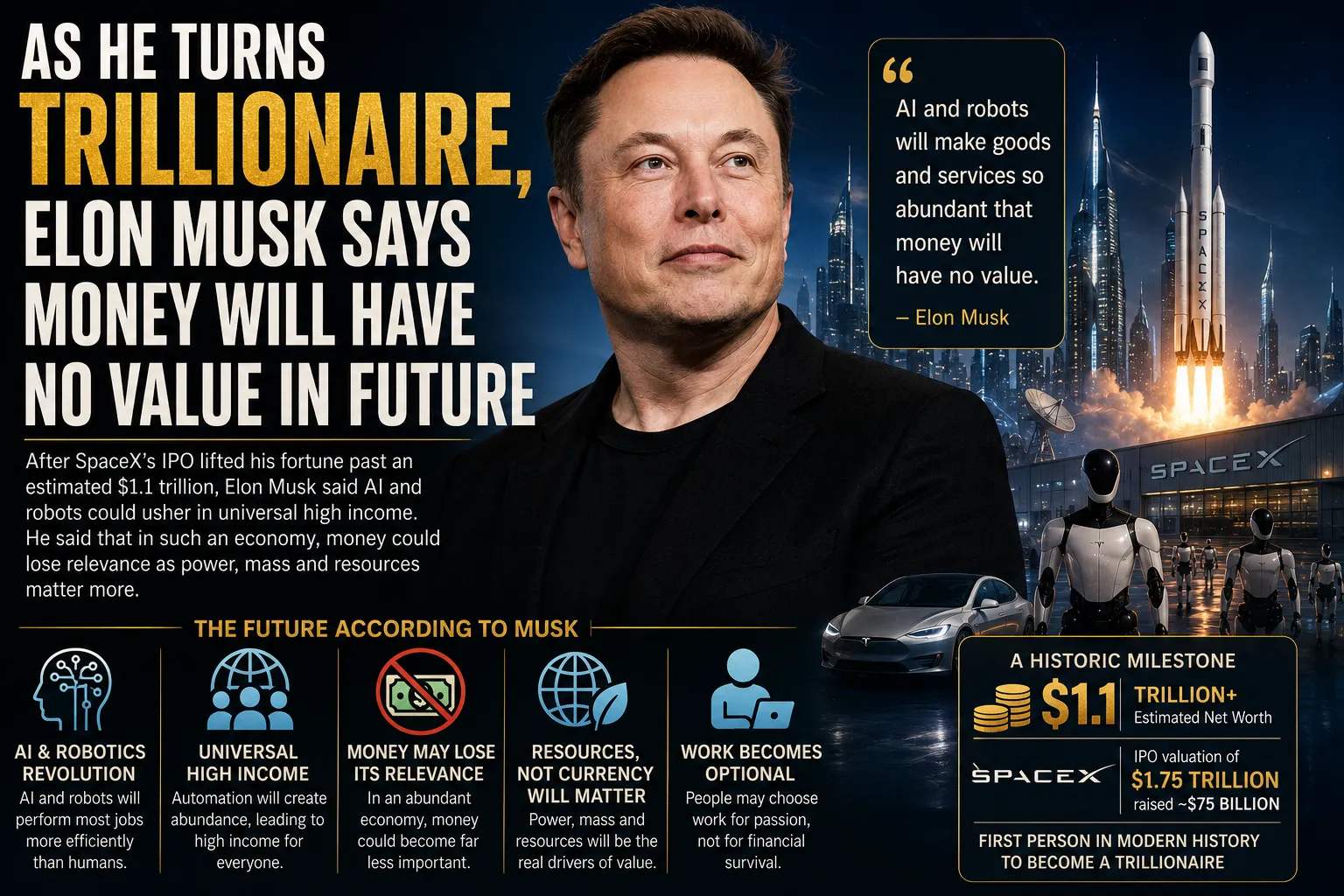
The world of technology, finance, and innovation reached a historic milestone when Elon Musk’s net worth crossed the trillion-dollar mark following the record-breaking public offering of SpaceX. The achievement has made Musk the first person in modern history to reach trillionaire status, further cementing his position as one of the most influential figures in business and technology.
However, what attracted almost as much attention as the financial milestone itself was Musk’s vision of the future. According to the billionaire entrepreneur, advances in artificial intelligence (AI), robotics, and automation could eventually create an economy where money becomes far less important than it is today. In such a world, abundance rather than scarcity would define economic life, potentially changing the way people work, earn, and consume.
His comments have reignited debates about the future of capitalism, employment, wealth distribution, and the role of technology in society.
The Historic Rise to Trillionaire Status
Elon Musk’s fortune surged after SpaceX completed what is widely regarded as the largest initial public offering (IPO) in history. The company reportedly raised approximately $75 billion and achieved a valuation of around $1.75 trillion, making it one of the most valuable publicly traded companies in the world. Most of Musk’s wealth now comes from his substantial ownership stake in SpaceX, alongside his holdings in Tesla, Neuralink, xAI, and other ventures.
The achievement represents more than personal wealth accumulation. It reflects investor confidence in technologies that could shape the future, including space exploration, satellite communications, artificial intelligence, and robotics.
For years, analysts speculated about who would become the world’s first trillionaire. While many expected it to happen eventually, few predicted it would arrive so quickly. The rapid increase in the valuations of Musk-led companies accelerated that timeline dramatically.
Musk’s Vision: A World of Abundance
Despite becoming the wealthiest person in history, Musk has repeatedly argued that money may not remain the primary measure of prosperity in the future.
His prediction is based on the belief that AI and advanced robotics will eventually become capable of producing most goods and services at extremely low costs. If machines can perform nearly all forms of labor efficiently, the supply of products and services could become abundant enough that traditional economic limitations begin to fade.
According to Musk, humanity could enter an era of “universal high income,” where people have access to the resources they need regardless of traditional employment. Unlike the concept of universal basic income, which focuses on providing a minimum level of financial support, universal high income implies a much higher standard of living supported by highly productive automated systems.
In such an environment, Musk suggests that money itself could become less relevant because the primary challenge would no longer be producing goods but distributing resources efficiently.
Why Musk Believes Work Could Become Optional
One of the most controversial aspects of Musk’s prediction is his belief that work may become optional within the next few decades.
As AI systems become increasingly capable of handling intellectual tasks and robots take over physical labor, many traditional jobs could disappear. Musk has argued that people may eventually choose to work for personal fulfillment rather than financial necessity. Activities such as art, research, sports, entrepreneurship, and creative pursuits could become more important than conventional employment.
This vision differs significantly from today’s economic structure, where income is largely tied to labor. If automation reaches the levels Musk predicts, society may need entirely new systems for distributing wealth and resources.
Supporters of this view argue that technology has historically increased productivity and improved living standards. They believe AI could unlock another major leap forward, similar to the Industrial Revolution but on a much larger scale.
The Role of Artificial Intelligence and Robotics
Musk’s outlook is closely linked to the rapid advancement of AI technologies.
Over the past few years, AI systems have demonstrated remarkable capabilities in areas such as language processing, software development, scientific research, healthcare, and content creation. At the same time, robotics companies are making significant progress in developing machines capable of performing increasingly complex physical tasks.
Tesla’s Optimus humanoid robot project is one example of Musk’s belief that robots could eventually perform a large portion of human labor. Combined with advanced AI models, these machines could transform industries ranging from manufacturing and logistics to healthcare and household services.
If productivity rises dramatically while production costs decline, economic abundance becomes a more realistic possibility. In theory, essential goods such as food, housing, transportation, and healthcare could become significantly more affordable than they are today.
Critics Question the Optimism
Not everyone agrees with Musk’s vision.
Economists and technology experts have long debated whether automation creates as many opportunities as it eliminates. While technological advancements often generate new industries and jobs, they can also lead to significant disruptions for workers whose skills become obsolete.
Critics argue that AI-driven productivity gains could increase wealth concentration rather than reduce it. If ownership of AI systems and robots remains concentrated among a small number of corporations and investors, the benefits may not be distributed evenly across society.
Others point out that economic systems are shaped by political decisions, regulations, and social institutions—not just technology. Even if AI creates abundance, questions remain about how resources would be allocated and who would control the technologies responsible for producing them.
Some experts also caution that predictions about fully automated economies remain speculative. While AI capabilities continue to improve rapidly, many tasks still require human judgment, creativity, emotional intelligence, and adaptability.
Could Money Really Become Irrelevant?
The idea that money could lose its value may sound radical, but it is rooted in a simple economic principle.
Money exists primarily because resources are scarce. When goods and services are limited, societies use currency to allocate those resources efficiently. If technological progress were to eliminate scarcity for most essential needs, the role of money could change dramatically.
However, many economists believe scarcity would continue to exist in some form. Land, natural resources, luxury experiences, and unique human-created products would likely remain valuable regardless of technological progress.
As a result, money may not disappear entirely. Instead, its role could evolve as automation reshapes the global economy.
What This Means for the Future
Whether Musk’s predictions prove accurate or not, they highlight the growing influence of AI and robotics on the global economy. Businesses, governments, and individuals are already preparing for a future where automation plays a larger role in everyday life.
The challenge will be ensuring that technological progress benefits society broadly rather than creating deeper economic inequalities. Policymakers around the world are increasingly discussing issues such as workforce retraining, AI regulation, digital infrastructure, and income support systems.
As the first trillionaire in history, Musk has both the platform and the resources to shape these conversations. His vision of a world where money becomes less important may still be years or decades away, but it reflects a broader debate about how technology will transform human civilization.
Conclusion
Elon Musk’s rise to trillionaire status marks a historic moment in global business, but his comments about the future may prove even more significant. By suggesting that AI and robotics could create a world of abundance where money loses much of its importance, Musk is challenging traditional assumptions about work, wealth, and economic value.
While experts remain divided on whether such a future is achievable, there is little doubt that artificial intelligence and automation will play a central role in shaping the decades ahead. Whether that future leads to greater prosperity for everyone or introduces new economic challenges will depend on how societies choose to manage one of the most transformative technological revolutions in history.