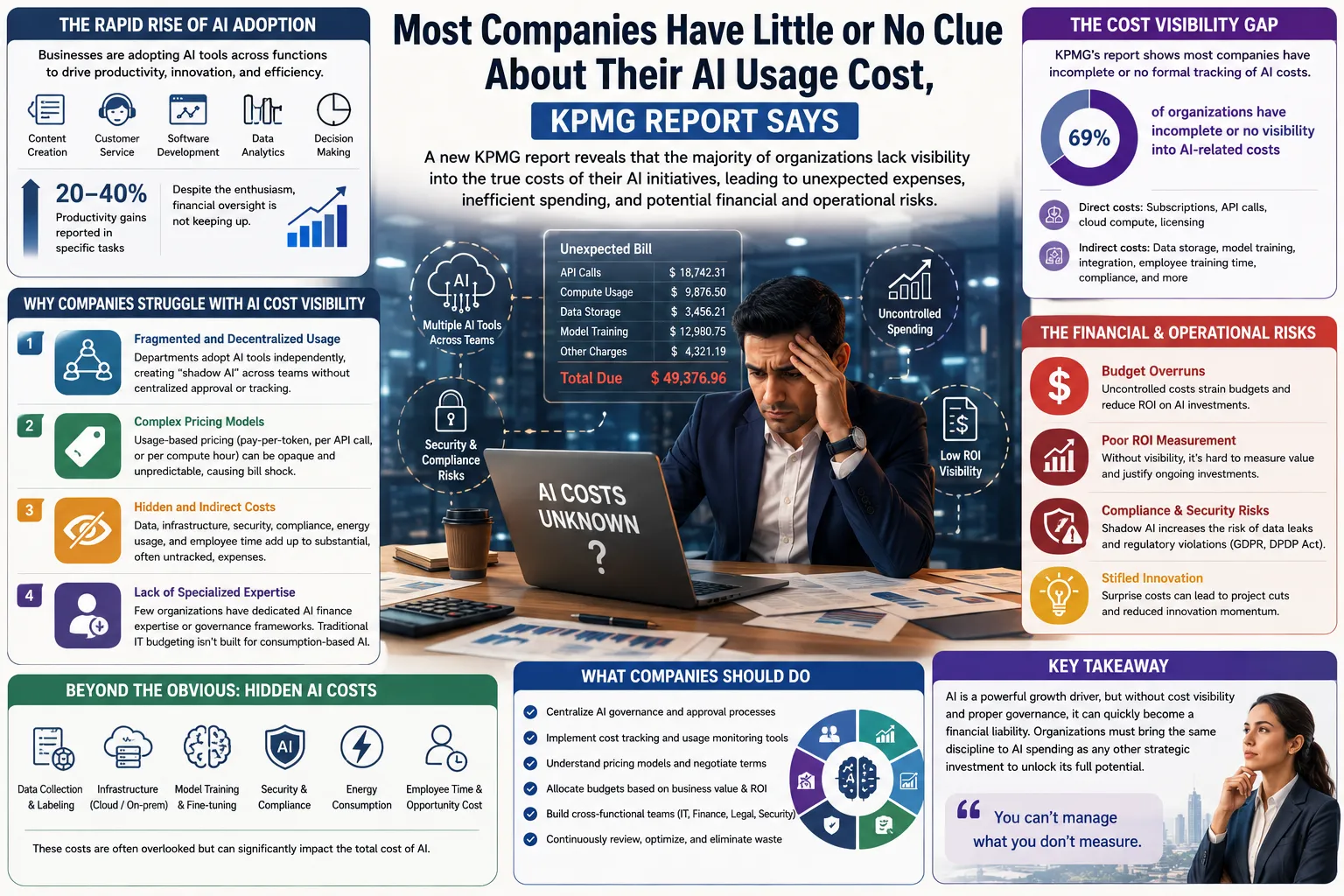
As artificial intelligence transforms business operations across industries, companies are investing heavily in AI tools to boost productivity, innovation, and efficiency. From generative AI platforms for content creation to machine learning models for predictive analytics, the adoption rate has been remarkably fast. However, a concerning gap has emerged: most organizations have limited visibility into the true costs of their AI initiatives. According to a recent KPMG report, many companies lack comprehensive understanding of how they are being charged for AI tools, leading to unexpected expenses, inefficient spending, and potential financial risks.
This disconnect between rapid adoption and cost awareness represents one of the biggest challenges in enterprise AI deployment today. As organizations scale their AI usage, the need for better financial governance has never been more urgent.
The Rapid Rise of AI Adoption
Businesses worldwide have embraced AI at an unprecedented pace. Tools like ChatGPT, Claude, Gemini, and various enterprise platforms are now integrated into marketing, customer service, software development, data analysis, and decision-making processes. Many companies report productivity gains of 20-40% in specific tasks, driving aggressive investment.
Yet, this enthusiasm often outpaces financial oversight. KPMG’s findings reveal that a significant majority of organizations have incomplete or no formal tracking mechanisms for AI-related expenditures. This includes direct costs such as subscription fees, API calls, and cloud compute resources, as well as indirect expenses like data storage, model training, integration, and employee training time.
Why Companies Struggle with AI Cost Visibility
Several factors contribute to this widespread lack of awareness:
1. Fragmented and Decentralized Usage
Many departments adopt AI tools independently, creating “shadow AI” — unauthorized or unmonitored usage across teams. Marketing might use one generative tool, while engineering experiments with another, without centralized approval or tracking. This decentralized approach makes it difficult to consolidate spending data.
2. Complex Pricing Models
AI services often use usage-based pricing (pay-per-token, per API call, or per compute hour), which can be opaque and unpredictable. Costs can spike dramatically during high-usage periods or when scaling models. Many finance teams are unfamiliar with these nuanced billing structures, leading to bill shock at month-end.
3. Hidden and Indirect Costs
Beyond obvious subscription fees, companies incur substantial hidden expenses: data labeling and preparation, infrastructure for running models on-premise or in the cloud, security and compliance measures, energy consumption for training large models, and the opportunity cost of employee time spent on AI experimentation.
4. Lack of Specialized Expertise
Few organizations have dedicated AI finance analysts or robust governance frameworks. Traditional IT budgeting processes are often ill-equipped to handle the dynamic, consumption-based nature of modern AI tools.
The Financial and Operational Risks
The consequences of poor AI cost management extend beyond surprise invoices. Companies risk overspending, which can strain budgets and reduce ROI on AI investments. In extreme cases, uncontrolled costs may lead to project cancellations or reduced innovation momentum.
Moreover, without proper visibility, organizations struggle to measure the actual return on investment. While some AI tools deliver clear value, others may provide marginal benefits that don’t justify their expense. This makes strategic decision-making difficult and can result in continued investment in underperforming initiatives.
Data privacy, security, and compliance risks also rise with unchecked AI usage. Shadow AI increases the chance of sensitive data being processed through unauthorized platforms, potentially violating regulations like GDPR or India’s DPDP Act.
Steps Toward Better AI Cost Management
Forward-thinking companies are beginning to address these challenges through structured approaches:
-
Establish AI Governance Frameworks: Create cross-functional teams involving finance, IT, legal, and business units to approve, monitor, and optimize AI tool usage.
-
Implement Cost Tracking Tools: Deploy specialized platforms that provide real-time visibility into AI spending across different services and departments.
-
Adopt FinOps Practices for AI: Apply cloud financial management principles specifically tailored to AI workloads, including regular cost reviews and optimization strategies.
-
Conduct Regular Audits: Perform quarterly AI usage audits to identify redundant tools, optimize prompts for efficiency (reducing token usage), and eliminate shadow AI.
-
Build Internal Capabilities: Invest in training finance teams on AI economics and encourage departments to build business cases before adopting new tools.
-
Negotiate Enterprise Agreements: Larger organizations can secure volume discounts and predictable pricing through direct negotiations with AI providers.
The Path Forward
As AI becomes deeply embedded in business operations, cost transparency will separate successful implementations from costly experiments. Companies that treat AI as a strategic investment — rather than an unchecked expense — will gain significant competitive advantages.
The KPMG report serves as a timely wake-up call. Organizations must move beyond pilot projects and experimentation toward mature, financially disciplined AI strategies. This includes setting clear KPIs for AI initiatives, regularly evaluating total cost of ownership, and fostering a culture of accountability around technology spending.
For Indian businesses, where AI adoption is accelerating rapidly across sectors like IT services, banking, healthcare, and manufacturing, this issue is particularly relevant. With growing pressure to demonstrate ROI to stakeholders and investors, better cost governance could determine which companies thrive in the AI era.
Final Thoughts
The excitement around artificial intelligence is well-founded, but unchecked enthusiasm without financial oversight can lead to wasteful spending and missed opportunities. As highlighted in the KPMG report, most companies still have limited understanding of their AI usage costs — a situation that demands urgent attention.
By developing robust governance, investing in visibility tools, and fostering cross-functional collaboration, businesses can harness AI’s transformative power while maintaining financial discipline. The organizations that succeed will be those that view AI not just as a technological breakthrough, but as a strategic asset requiring careful financial stewardship.
In the coming years, the ability to manage AI costs effectively may prove as important as the technology itself. Companies that act now to bring transparency and control to their AI spending will be better positioned to realize sustainable value from their investments and maintain a competitive edge in an increasingly AI-driven world.