Choosing a research topic is one of the most important early decisions in any academic project. A well-selected topic sustains motivation, guides the literature search, shapes the methodology, and determines whether the final work makes a meaningful contribution. A weak or poorly scoped topic often leads to frustration, superficial analysis, or an inability to complete the project within available constraints. This guide outlines practical, widely recommended steps and criteria for selecting a strong research topic suitable for students and early-career researchers.
Why the Topic Matters
The research topic sets the boundaries for everything that follows. It influences the questions asked, the sources consulted, the data collected, and the conclusions drawn. Topics that align with genuine interest are more likely to receive sustained effort. Those that address a clear gap or practical problem stand a better chance of producing useful results. Conversely, topics that are too broad, too narrow, or disconnected from available resources frequently stall. Investing time at the selection stage prevents costly redirection later.
Core Characteristics of a Strong Research Topic
Academic guidance consistently highlights several key qualities. A strong topic should be interesting to the researcher, as personal engagement supports persistence through challenges. It must be relevant to the field or to a real-world issue, contributing to ongoing conversations rather than repeating settled knowledge. Novelty does not require a completely original discovery; it can mean applying existing ideas in a new context, testing them with different populations, or refining earlier findings.
Feasibility is equally critical. The topic must be manageable within the available time, skills, data access, ethical approvals, and material resources. Ethical considerations require that the research can be conducted without harm and in accordance with institutional standards. Clarity and focus help keep the project on track; a precise topic is easier to investigate thoroughly than a vague or sprawling one.
A useful framework for evaluation is to ask whether the topic is feasible, interesting, novel, ethical, and relevant. Topics that satisfy most or all of these criteria are more likely to succeed.
Step 1: Begin with Interests and Existing Knowledge
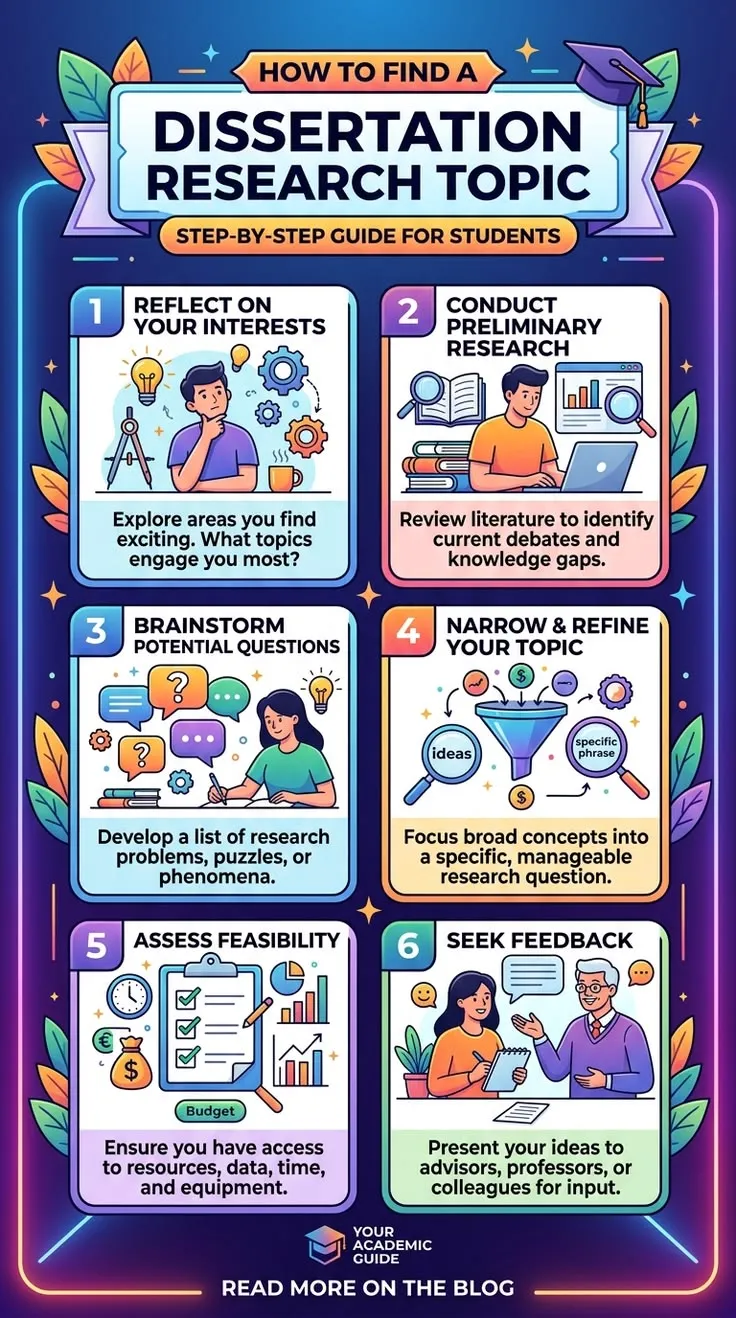
Start by listing subjects, questions, or problems that genuinely engage you. Reflect on coursework that sparked curiosity, current events related to your discipline, practical problems observed in professional or community settings, or gaps noticed while reading. Consider your strengths—methodological skills, language abilities, or prior experience—as these will support successful execution.
Avoid choosing a topic solely because it seems impressive or popular if it holds little personal interest. Sustained research demands consistent effort, and intrinsic motivation is a reliable predictor of completion.
Step 2: Explore the Existing Literature
Once potential areas of interest emerge, conduct preliminary reading. Review recent journal articles, review papers, and key books to understand what is already known. Pay attention to the conclusions and recommendations for future research that authors often provide. These suggestions frequently point to unresolved questions, contradictory findings, or underexplored contexts.
Literature exploration serves two purposes: it reveals whether a topic has already been extensively covered and it helps identify specific gaps where a new contribution is possible. Take notes on recurring themes, methodological approaches, and open questions. This background work also clarifies the scope of available sources and whether sufficient material exists to support a thorough study.
Step 3: Narrow the Scope
Broad topics such as “climate change,” “social media,” or “education” are nearly impossible to address adequately in a single paper or thesis. Narrowing transforms a general area into a focused, researchable question. Techniques include limiting the population, geographic region, time period, or specific aspect of the phenomenon.
Ask clarifying questions: Who is involved? What precise issue is under examination? Where and when does it occur? What relationship or outcome is of interest? Turning a broad subject into a specific research question or hypothesis provides direction and makes the subsequent literature search more efficient. The topic should remain broad enough to allow adequate sources and data, yet narrow enough for depth rather than superficial coverage.
Step 4: Test Feasibility and Practical Constraints
Before finalizing a topic, assess practical realities. Consider the time available until the deadline, access to participants or data, required equipment or software, language skills, travel needs, and the likelihood of obtaining ethical approval. A compelling idea that cannot be investigated within existing constraints will lead to difficulty later.
Discuss preliminary ideas with supervisors, instructors, or experienced colleagues. They can often identify feasibility issues, suggest refinements, or point to related work already underway. Their feedback helps align the topic with disciplinary expectations and available support.
Step 5: Formulate a Clear Research Question
A strong topic usually crystallizes into one or more precise research questions or a testable hypothesis. Clear questions guide the choice of methods and keep the analysis focused. They also make it easier to determine when the research objectives have been met. Revisiting and refining the question as more literature is reviewed is a normal and productive part of the process.
Common Pitfalls to Avoid
Several recurring mistakes undermine topic selection. Choosing an excessively broad subject leads to shallow treatment. Selecting a topic with little personal interest reduces motivation. Ignoring the existing literature can result in unintentional duplication or an unfeasible project. Overly narrow topics may yield insufficient sources or data. Finally, neglecting ethical or practical constraints can halt progress after significant investment of time.
Flexibility remains important. Early ideas often require adjustment once preliminary research reveals new information. Willingness to refine or even change direction based on evidence is a strength rather than a setback.
Aligning Topic with Assignment or Program Requirements
For coursework, ensure the topic satisfies the assignment guidelines regarding scope, methodology, and expected length. For theses or dissertations, confirm that it fits within the program’s expectations and the supervisor’s area of expertise. A topic that aligns with both personal interest and institutional requirements has the highest chance of smooth progress.
Moving from Topic to Project
Once a promising topic is identified, document the rationale, the specific questions, and the anticipated contribution. This early clarity supports proposal writing, literature review planning, and methodological decisions. Periodic review of the topic against the original criteria helps maintain focus as the project develops.
Selecting a strong research topic is a deliberate process rather than a moment of sudden inspiration. By beginning with genuine interests, examining existing knowledge, narrowing the focus, testing feasibility, and formulating clear questions, students and researchers create a solid foundation for meaningful work. A well-chosen topic sustains effort, invites rigorous inquiry, and increases the likelihood that the finished research will be both manageable and valuable. Taking the time to choose carefully is one of the most effective investments in the success of any research endeavor.
Read more – casinopeers.com