Artificial Intelligence (AI) has become one of the most transformative technologies of our time. From voice assistants and recommendation systems to medical diagnostics and self-driving cars, AI powers many tools we use daily. Yet, for beginners, the question remains: How does artificial intelligence actually work? This guide breaks down the fundamentals in simple, clear terms without requiring any technical background.
What Is Artificial Intelligence?
At its core, Artificial Intelligence refers to computer systems designed to perform tasks that typically require human intelligence. These tasks include learning from experience, recognising patterns, understanding language, solving problems, and making decisions.
Unlike traditional software that follows strict, pre-written rules (if-this-then-that logic), modern AI systems can adapt and improve based on data. They don’t just execute commands — they learn, generalise, and sometimes even surprise their creators with unexpected capabilities.
The Foundation: Data Is Everything
AI systems rely heavily on data. Think of data as the “learning material” for AI. Just as humans learn by observing the world, AI models learn by analysing massive amounts of information — text, images, numbers, videos, or sensor readings.
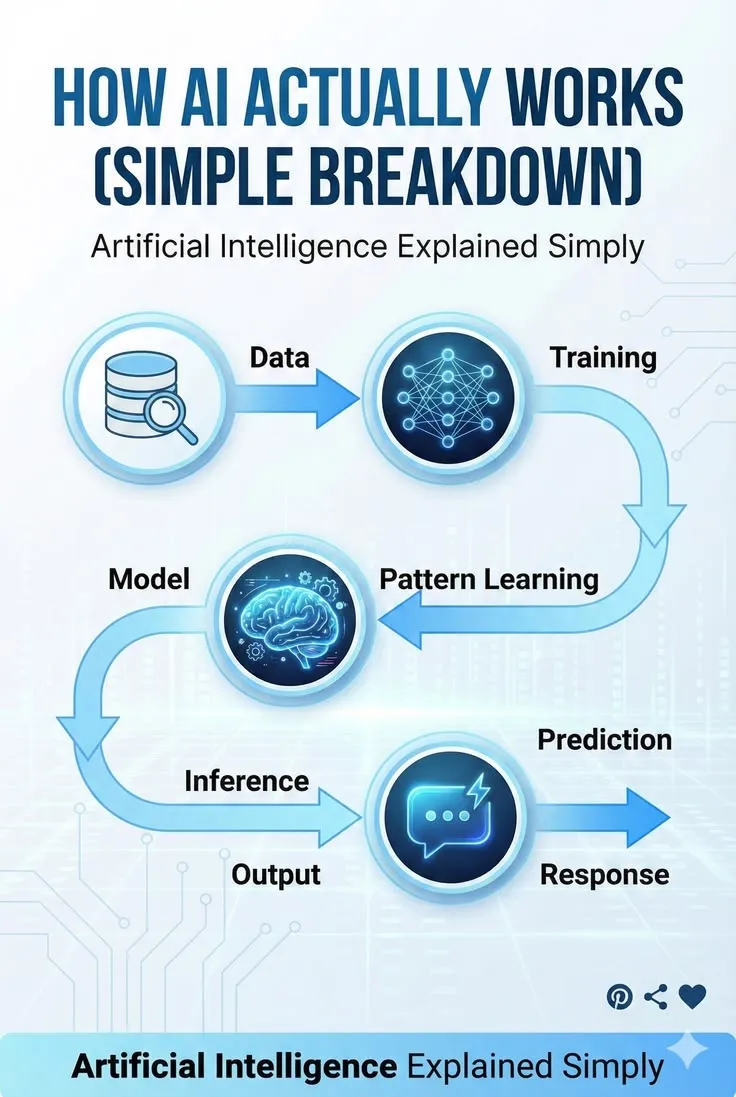
The process usually follows three main steps:
-
Data Collection: AI needs high-quality, relevant data. For example, to build a system that recognises cats in photos, developers feed it thousands of labelled cat and non-cat images.
-
Training: The system processes this data to identify patterns and relationships.
-
Inference (Prediction): Once trained, the AI applies what it has learned to new, unseen data to make predictions or decisions.
Machine Learning: The Heart of Modern AI
Most current AI capabilities come from Machine Learning (ML), a subset of AI. In traditional programming, humans write every rule. In machine learning, the system learns rules automatically from data.
There are three main types of machine learning:
-
Supervised Learning: The model learns from labelled examples. For instance, showing it thousands of emails marked as “spam” or “not spam” so it can classify new emails.
-
Unsupervised Learning: The model finds hidden patterns in unlabelled data, such as grouping customers with similar buying habits.
-
Reinforcement Learning: The system learns through trial and error, receiving rewards for good actions and penalties for bad ones — similar to training a dog with treats. This powers applications like game-playing AI and robotics.
Neural Networks and Deep Learning
The most powerful form of machine learning today is Deep Learning, which uses Artificial Neural Networks inspired by the human brain.
A neural network consists of layers of interconnected “neurons” (mathematical functions). Data enters the input layer, passes through hidden layers that extract increasingly complex features, and produces an output.
-
Early layers might detect simple patterns (like edges in an image).
-
Deeper layers combine these to recognise complex objects (like faces or entire scenes).
Deep Learning simply means using neural networks with many layers (sometimes hundreds). This depth allows the system to handle complex, unstructured data like natural language, images, and audio. It powers tools such as ChatGPT, image generators, and facial recognition systems.
During training, the network adjusts millions (or billions) of internal parameters called weights to minimise errors. This process, known as backpropagation, helps the model gradually improve its accuracy.
Key Technologies Behind AI
-
Natural Language Processing (NLP): Enables AI to understand and generate human language.
-
Computer Vision: Allows machines to interpret visual information from the world.
-
Generative AI: Creates new content — text, images, music, or code — based on patterns learned from training data.
Large Language Models (LLMs) like those behind popular chatbots are trained on enormous datasets of internet text. They predict the most likely next word in a sequence, which surprisingly enables coherent conversation and problem-solving.
Limitations and Important Considerations
Despite impressive capabilities, current AI has clear boundaries:
-
It does not truly “understand” in the human sense — it excels at pattern matching and statistical prediction.
-
It can produce incorrect or biased outputs if trained on flawed data.
-
It requires enormous computational power and energy for training advanced models.
-
Ethical challenges around privacy, bias, job displacement, and misuse remain significant.
Real-World Applications
AI is already transforming industries:
-
Healthcare: Detecting diseases from medical scans.
-
Finance: Fraud detection and personalised banking.
-
Transportation: Autonomous vehicles and traffic optimisation.
-
Entertainment: Recommendation engines on streaming platforms.
-
Daily Life: Smart home devices, virtual assistants, and translation tools.
The Future of AI
As computing power grows and new techniques emerge, AI systems are becoming more efficient, multimodal (handling text, images, and audio together), and accessible. However, responsible development focusing on transparency, fairness, and human oversight will determine whether AI becomes a powerful force for good.
Getting Started with AI as a Beginner
You don’t need to become a programmer to understand or benefit from AI. Start by experimenting with everyday tools like chatbots, image generators, or productivity assistants. Focus on learning how to give clear instructions (prompt engineering) and critically evaluate outputs.
Understanding the basics — data, learning, neural networks, and prediction — demystifies AI and helps you appreciate both its potential and limitations.
Artificial Intelligence is not magic. It is sophisticated mathematics, massive data, and clever engineering working together to simulate aspects of human intelligence. As you continue exploring, you’ll discover that while AI can perform remarkable tasks, its true power lies in collaboration with human creativity, judgment, and values.
By grasping these fundamentals, you are better equipped to navigate an AI-powered future with confidence and curiosity.
Read more –mediyao.com/