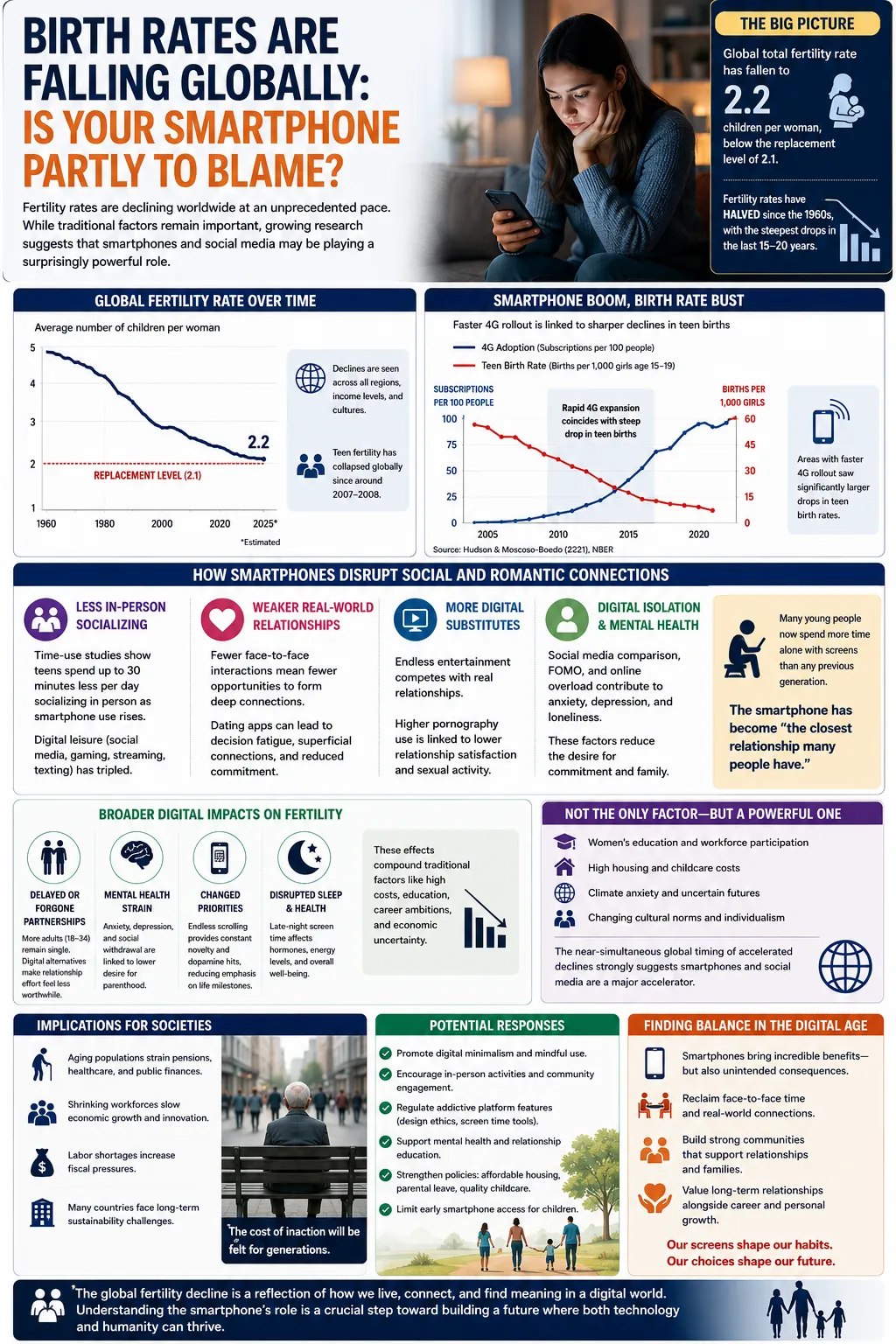
Across the world, fertility rates are declining at an unprecedented pace, raising alarms about aging populations, shrinking workforces, and long-term economic sustainability. The global total fertility rate has fallen to approximately 2.2 children per woman, well below the replacement level of 2.1 needed to maintain stable populations without migration. While traditional explanations — rising education and career ambitions for women, high childcare costs, economic uncertainty, and urbanization — remain valid, researchers are increasingly examining a modern culprit: smartphones and social media.
The timing of this global fertility crash aligns strikingly with the widespread adoption of smartphones and high-speed mobile internet. In country after country, birth rates began deviating downward from previous trends shortly after 4G networks expanded and affordable smartphones became ubiquitous. This correlation has prompted economists and social scientists to investigate how digital technology is reshaping human relationships, intimacy, and family formation.
The Scale of the Global Fertility Decline
Fertility rates have halved since the 1960s, but the most dramatic drops have occurred in the past 15–20 years. In many developed nations, rates hover between 1.3 and 1.6 children per woman. Even in regions previously known for higher birth rates, such as parts of Latin America, East Asia, and increasingly Africa, declines are accelerating. The phenomenon affects countries across income levels, cultures, and policy environments, suggesting factors beyond purely economic or educational influences.
Teen fertility, in particular, has collapsed globally since around 2007–2008. This drop spans diverse societies and cannot be fully explained by improved access to contraception or sex education alone. Researchers point to a fundamental shift in how young people interact.
How Smartphones Disrupt Social and Romantic Connections
A compelling body of research links smartphone adoption directly to reduced in-person socializing. Studies by economists Nathan Hudson and Hernan Moscoso-Boedo demonstrate that areas with faster 4G rollout experienced sharper declines in teen births. Time-use surveys reveal a clear pattern: as smartphone penetration rose, daily in-person socializing among teens dropped significantly — by as much as 30 minutes per day in some analyses — while digital leisure activities (social media, gaming, streaming, and texting) tripled.
This shift creates a coordination problem. When enough peers move online, the social network relocates to digital platforms. Being physically present becomes less rewarding because “everyone is on their phones anyway.” Unstructured, in-person interactions — the context in which most teen relationships and unintended pregnancies historically occurred — diminish dramatically.
For adults, the effects extend beyond teens. Hyper-engaging digital entertainment competes directly with real-world relationships. Dating apps promise convenience but often lead to decision fatigue, superficial connections, and reduced commitment. Social media fosters comparison, anxiety, and loneliness rather than genuine bonding. Increased consumption of pornography further substitutes for real intimacy, with studies showing correlations between higher usage and lower relationship satisfaction and sexual activity in couples.
Experts note that young people today spend more time alone with screens than previous generations. This digital isolation reduces opportunities for meeting partners, developing emotional skills for long-term relationships, and transitioning to family life. As one analysis put it, the smartphone has become “the closest relationship many people have.”
Broader Digital Impacts on Fertility
Beyond reduced socializing, several mechanisms link digital technology to lower birth rates:
-
Delayed or Forgone Partnerships: More adults, particularly in the 18–34 age group, remain single. Hyper-stimulating online alternatives make the effort of dating and maintaining relationships feel less worthwhile.
-
Mental Health Strain: Rising rates of anxiety, depression, and social withdrawal among heavy users correlate with lower desire for commitment and parenthood.
-
Changed Priorities: Endless scrolling provides constant novelty and dopamine hits, potentially reducing the perceived need for real-life milestones like marriage and children.
-
Disrupted Sleep and Health: Late-night screen time affects hormones, energy levels, and overall well-being, indirectly influencing reproductive health and family planning.
These effects compound traditional factors. Economic pressures make parenthood expensive, while digital culture makes single life more comfortable and entertaining. The result is a widening gap between desired and actual family sizes in many societies.
Not the Only Factor — But a Powerful One
Researchers are careful to note that smartphones are not the sole driver. Women’s education and workforce participation, high housing and childcare costs, climate anxiety, and shifting cultural norms toward individualism all play significant roles. However, the near-simultaneous global timing of accelerated declines strongly suggests technology as an important accelerator.
Unlike policy-driven factors, digital transformation spread rapidly and uniformly across borders, affecting behavior in ways that traditional demographic models failed to predict. The coordination equilibrium shifted: once a critical mass adopted smartphones, in-person social norms changed for everyone.
Implications for Societies and Policymakers
Falling birth rates pose serious challenges. Aging populations strain pension systems, healthcare, and economic growth. Countries from South Korea and Japan to Italy and increasingly India and China face labor shortages and fiscal pressures. Some governments offer financial incentives, parental leave expansions, and housing support, but these have shown limited success in reversing trends.
Addressing the digital dimension requires more than cash transfers. Potential responses include promoting digital minimalism, encouraging in-person social activities, regulating addictive platform features, and fostering community environments that facilitate natural relationship formation. Schools and parents limiting early smartphone access have shown promise in improving mental health and social development.
Ultimately, the fertility decline reflects deeper questions about modern life. Technology that connects us virtually often isolates us physically. As societies become richer in material comforts and digital stimulation, they appear poorer in the human connections that have historically driven family formation.
Finding Balance in the Digital Age
Smartphones and social media have delivered remarkable benefits — access to information, global connectivity, and new opportunities. However, their unintended consequences on fundamental human experiences deserve serious attention. Reclaiming space for face-to-face interaction, building stronger communities, and fostering a culture that values long-term relationships alongside career and personal growth may be essential to stabilizing fertility rates.
The evidence increasingly suggests that our screens are not neutral tools. They reshape how we spend time, form bonds, and envision our futures. As researchers continue to unpack these dynamics, individuals and societies face an important choice: allow digital habits to quietly reshape demographics, or consciously design technology and lifestyles that support human flourishing — including the decision to have and raise children.
The global fertility decline is more than an economic or policy issue. It is a reflection of how we live, connect, and find meaning in an increasingly digital world. Understanding the smartphone’s role is a crucial step toward addressing one of the defining demographic challenges of our time.
Read more –