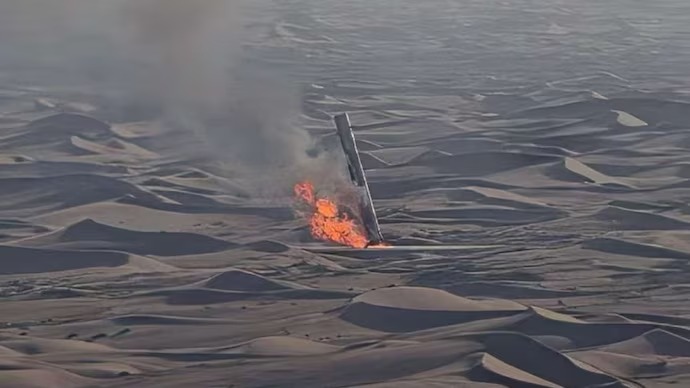
A Dramatic Ending During Zhuque-3 Recovery
China’s private space sector faced a major setback when LandSpace’s reusable Zhuque-3 rocket failed during its first recovery attempt in December 2025. The rocket successfully sent its second stage toward the planned orbit, but its first-stage booster encountered an abnormal combustion problem during the final landing sequence.
The incident quickly attracted attention because Zhuque-3 had been designed around reusable rocket technology, which is becoming increasingly important for lowering launch costs and supporting frequent missions. Video from the landing attempt showed the booster struggling during its final descent before hitting the recovery area in a dramatic fiery crash.
There is also an important update that changes the larger story around Zhuque-3 today. LandSpace successfully completed a land-based recovery of another Zhuque-3 first stage in August 2026, showing that the company learned from its earlier failure and continued developing the technology.
What Happened During The First Flight
The first Zhuque-3 flight took place on December 3, 2025, from the Dongfeng commercial space innovation pilot zone in northwestern China. The mission was designed to demonstrate both orbital launch capabilities and the difficult process of returning the first stage safely back toward Earth.
The rocket managed to complete several important parts of the mission successfully before the recovery problem appeared. Its second stage reached the designated orbit, meaning the launch vehicle demonstrated that its basic ascent and staging systems could perform as intended during the flight.
The problem came during the first-stage recovery sequence, which required the booster to control its descent, restart its engines, slow dramatically, and reach the landing area under controlled conditions. LandSpace said an anomalous combustion event prevented the booster from achieving a soft touchdown on the recovery pad.
Why The Final Landing Was Difficult
Rocket recovery looks simple when watched from a distance, but the final landing involves several extremely demanding operations happening within a very short period. The booster must manage speed, orientation, engine thrust, guidance commands, fuel behavior, and structural loads almost simultaneously.
During the Zhuque-3 attempt, the booster had already completed important parts of its return trajectory before reaching the final landing phase. According to reports discussing the flight, the vehicle performed its earlier descent operations successfully, but the final braking maneuver did not deliver the required deceleration.
That final engine burn works almost like an emergency brake for the descending rocket. The vehicle needs enough controlled thrust to reduce its remaining speed while keeping itself vertically aligned with the landing zone, leaving very little room for mistakes during those final moments.
The Landing Leg Was Not The Main Story
The phrase “landing leg catches fire” can make the incident sound like the landing hardware itself caused the entire failure. However, available reports indicate that the more important issue involved the booster’s propulsion and landing sequence rather than simply a broken landing leg.
Zhuque-3 was specifically designed with landing legs, grid fins, and a reaction-control system to support vertical recovery. Those components were part of LandSpace’s wider effort to develop a reusable launch vehicle capable of returning its first stage for future missions.
During the failed attempt, the booster reached the recovery area but could not complete the controlled soft landing. Reports described an abnormal combustion event during recovery, while later technical explanations focused attention on the final landing ignition and braking process.
Zhuque-3 Uses Methane And Oxygen
One interesting part of Zhuque-3 is its propulsion technology, because the rocket uses liquid oxygen and methane rather than traditional kerosene-based fuel. LandSpace has promoted the vehicle as a reusable launcher intended for lower-cost and higher-frequency space missions.
Methane has attracted significant interest across the modern commercial space industry because engineers see potential advantages for reusable rocket systems. Space companies around the world are investigating methane-powered engines while trying to build rockets that can launch, return, and fly again with limited refurbishment.
Zhuque-3 therefore represents more than one rocket company’s individual project. Its development is connected with China’s broader push toward commercial spaceflight, reusable launch vehicles, and large satellite constellation deployment capabilities.
LandSpace Continued After The Setback
The December 2025 failure did not end LandSpace’s Zhuque-3 program. Instead, the company continued working on recovery technology and later announced plans for another recovery attempt during 2026. The development team focused on improving landing procedures after studying information gathered during the first mission.
This is normal in reusable rocket development, where failed landing attempts can provide valuable engineering information. A vehicle can successfully reach orbit while still requiring substantial additional development before its booster can reliably return and land.
The first flight therefore demonstrated both progress and unfinished work. The company proved that Zhuque-3 could perform its orbital mission, while the recovery failure exposed the difficult part that still needed improvement.
The Bigger Competition In Reusable Rockets
Zhuque-3 has often been compared with reusable rockets developed by American companies because the basic objective is similar. Instead of throwing away an expensive booster after every launch, companies want to recover major rocket components and use them repeatedly.
SpaceX demonstrated the commercial potential of this approach through its Falcon 9 program, while other companies have also invested heavily in reusable launch technology. China is now developing similar capabilities through both government-backed programs and private aerospace companies.
The competition is important because reusable rockets can potentially reduce launch costs and support much higher launch frequencies. For satellite operators, lower launch expenses could make large constellations and repeated missions easier to manage over time.
The 2026 Recovery Changed The Picture
The most important development came in August 2026, when LandSpace successfully recovered a Zhuque-3 first stage on land. The company completed the controlled landing using deployable landing legs, marking China’s first successful land-based recovery of an orbital-class booster by a private company.
That successful landing is especially significant when viewed against the earlier December failure. The same general recovery concept that previously ended unsuccessfully was later demonstrated successfully, suggesting that engineering changes and additional testing helped improve the system.
The August mission also showed why a single failed rocket landing should not automatically be treated as the end of a reusable launch program. Reusable rocket development usually depends on repeated testing, detailed flight data, hardware improvements, and gradually increasing operational confidence.
Why This Matters For China’s Space Industry
China has been expanding its commercial space sector rapidly, with private companies developing launch vehicles, satellites, and supporting technologies. Zhuque-3 is one of the projects showing how Chinese private aerospace firms are attempting to compete in a market increasingly shaped by reusable launch systems.
The successful August 2026 recovery places LandSpace among a much smaller group of companies that have demonstrated controlled recovery of orbital-class rocket stages. Reuters reported that the recovered booster landed about 390 kilometers away from its launch point, highlighting the scale of the recovery operation.
LandSpace has also positioned Zhuque-3 for future high-frequency missions, with the company targeting repeated use of its first stage rather than treating every booster as disposable hardware. The company’s progress could therefore influence China’s wider commercial launch ambitions during the coming years.
What The Failed Landing Really Taught Engineers
The original Zhuque-3 landing failure demonstrated something important about reusable rockets that is easy to overlook. Reaching orbit is only one part of the challenge when a company wants to recover and reuse the launch vehicle afterward.
A booster returning from space must survive atmospheric reentry, maintain aerodynamic control, restart engines reliably, manage fuel and pressure conditions, and perform an extremely precise final braking maneuver. Every one of those systems must work together during a very short and unforgiving part of the flight.
The December failure provided LandSpace with valuable real-world information about those conditions. The company later used continued development and testing to reach the successful land recovery milestone achieved in August 2026.
Final Thoughts On Zhuque-3’s Rocky Start
The Zhuque-3 story is more complicated than a simple rocket crash headline suggests. Its first flight in December 2025 successfully demonstrated orbital performance, but an abnormal combustion problem prevented the first stage from completing a controlled recovery.
That failure exposed the technical difficulty of reusable rocket landings, especially during the final braking and touchdown sequence. Yet LandSpace continued improving the system, and its successful land-based booster recovery in August 2026 became a major milestone for China’s private space industry.
The biggest lesson is that reusable spaceflight develops through repeated testing rather than one perfect mission. Zhuque-3’s early setback and later recovery success show how quickly commercial rocket technology can evolve when companies use flight data to improve difficult systems. For readers following China’s growing space industry and reusable rocket race, continued Zhuque-3 missions will be worth watching closely, so stay informed with the latest developments.
Read More :- pixelperkes.com