Fashion weeks regularly produce images that travel far beyond the runway. On 28 September, the Montreal-based label Matières Fécales presented its Spring/Summer 2027 collection, titled The Ninety-Nine Percent, at Paris Fashion Week. The show quickly generated widespread attention for its dramatic makeup, unconventional silhouettes and politically charged staging. Amid the striking visuals, one detail resonated strongly with Indian audiences: several looks carried a clear connection to Banaras through handwoven and hand-embroidered textiles.
A Show Built Around Representation
Matières Fécales, founded by designers Steven Raj Bhaskaran and Hannah Rose Dalton, has built a reputation for avant-garde work that mixes theatricality with social commentary. Their previous collection had focused on the idea of the one per cent. This season inverted the frame. The Ninety-Nine Percent was conceived as a statement about the majority—those often excluded from traditional luxury narratives.
The production itself underscored the theme. The designers staged the show at Place de la République, a historic site of public assembly and protest in Paris, reportedly the first time a Paris Fashion Week presentation had taken place there. Ninety-nine models of colour walked in ninety-nine looks. Bhaskaran, who has spoken of drawing from his own background and the communities he grew up with, framed the casting and the setting as intentional rather than decorative. The collection moved through distinct passages, culminating in a couture-oriented section that brought together refined craft and deliberate disruption.
Where Banaras Enters the Picture
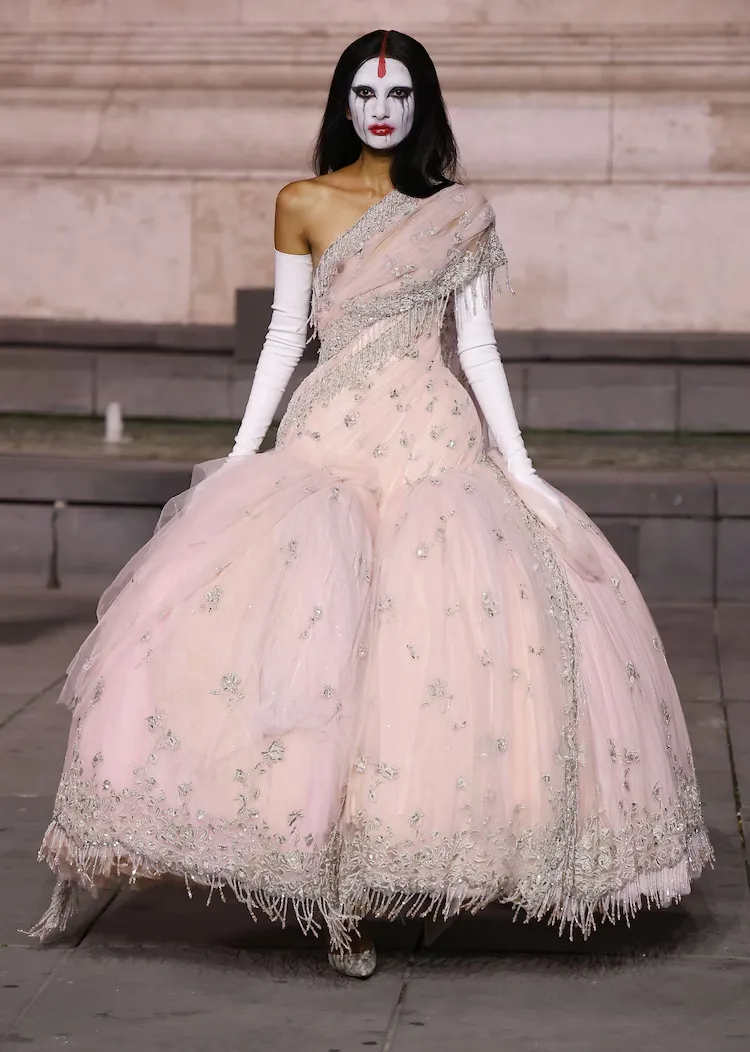
Within this larger narrative, saree-inspired construction and Indian textiles played a visible role. Designers used draping techniques associated with the saree across multiple looks, sometimes in recognisable forms and sometimes stretched into exaggerated or futuristic volumes. Crucially, certain fabrics were not merely inspired by Indian textiles—they were produced through collaboration with craftspeople in Banaras.
The Indian label Tilfi Banaras supplied handwoven and hand-embroidered material that was then reworked for the runway. One look featured a soft pink, saree-derived silhouette paired with a structured jacket. The fabric was handwoven and embroidered in Banaras; the hems were deliberately distressed, creating a tension between delicacy and abrasion. Another prominent piece involved a dramatic gown with a sculpted bodice, using crimson silk that carried custom-dyed rose-motif embroidery also executed through the Banaras workshop.
These garments sat within a broader finale section that mixed historical couture references—particularly 1950s ballgown volumes—with textiles and techniques drawn from outside the traditional European craft circuit. Alongside the Banaras pieces, the designers also incorporated handwoven cotton from Burkina Faso, further emphasising a dialogue between Parisian couture forms and artisanal production from other regions.
Craft Meets Disruption
What made the Banaras connection notable was not simply the use of Indian fabric, but the way it was treated. The textiles were not presented as exotic ornament or static heritage. They were cut, draped, partially destroyed and rebuilt into silhouettes that belonged to the designers’ own visual language—one that embraces abrasion, exaggeration and emotional intensity. The result was neither pure traditionalism nor pure deconstruction. It was a hybrid in which the technical excellence of Banarasi weaving and embroidery met a contemporary, confrontational aesthetic.
For viewers familiar with Banaras’s reputation for fine silk and intricate workmanship, the appearance of that craftsmanship inside such an unconventional show created a striking contrast. The same hands that produce bridal and ceremonial textiles were, in this instance, contributing to garments that walked a protest-associated square under theatrical lighting and dramatic makeup. That juxtaposition is part of what propelled the images into wider circulation.
Why the Images Travelled
The show’s overall visual language—intense makeup, unexpected proportions, a public and symbolic location—was already primed for social-media amplification. The presence of recognisable saree logic and the specific credit to Banaras craftsmanship gave Indian audiences an additional point of entry. In an industry that still often treats non-Western textiles as mood-board inspiration rather than credited collaboration, the visibility of Tilfi’s work mattered.
At the same time, the collection’s thematic framing invited readings that went beyond aesthetics. By placing craft from Varanasi and Burkina Faso inside a show explicitly concerned with the ninety-nine per cent, the designers suggested that technical beauty and cultural specificity need not be confined to elite or purely celebratory contexts. They could also participate in a conversation about power, belonging and who gets to occupy the centre of the fashion image.
A Broader Pattern
Collaborations between Western or globally visible designers and Indian textile traditions are not new. What distinguishes moments like this is the degree of integration and the willingness to let the craft appear inside a disruptive rather than purely reverential frame. When embroidery from Banaras appears on a distressed, volume-heavy gown rather than a conventional bridal silhouette, it expands the imaginative range of what that craft can do and where it can travel.
For the artisans and the Indian brand involved, such visibility carries both opportunity and responsibility. It can open new markets and creative dialogues. It also raises questions about how value is distributed, how techniques are protected, and how credit is assigned when local knowledge enters global spectacle.
After the Virality
Runway images have a short half-life. What lingers is the demonstration that highly specialised, place-based craftsmanship can hold its own inside even the most unconventional contemporary fashion statements. The Banaras textiles did not soften the show’s edge; they sharpened its complexity. In doing so, they reminded viewers that the story of a garment is rarely only about the designer’s concept. It is also about the hands that made the cloth, the traditions that shaped the technique, and the new contexts in which those traditions are asked to speak.
The viral looks from Matières Fécales’ Paris show will eventually be replaced by the next cycle of images. The fact that Banarasi weaving and embroidery formed part of that brief, intense conversation remains a useful marker—of craft’s continuing relevance, of the possibilities of cross-cultural making, and of the unexpected places in which a saree’s logic can still find form.
Read more – cricketscorerise.com