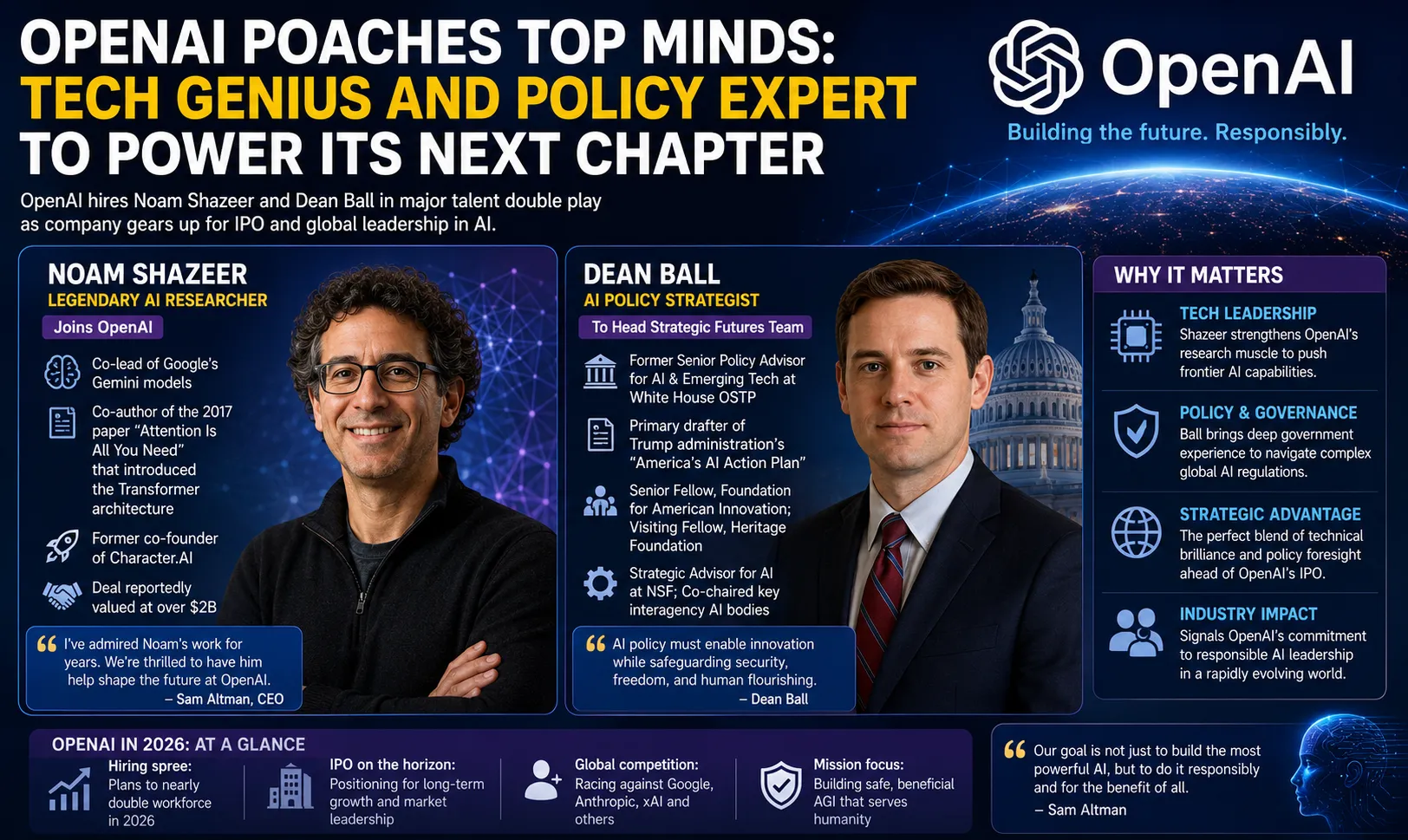
OpenAI continues to reshape the artificial intelligence landscape through aggressive talent acquisition. In a notable development, the company has brought on Dean Ball, a prominent AI policy scholar and former top White House adviser under the Trump administration, to lead its newly formed Strategic Futures team. This move follows closely on the heels of poaching Noam Shazeer, a legendary AI researcher and co-lead of Google’s Gemini models, marking one of the most high-profile talent double plays in recent industry memory. As OpenAI prepares for its anticipated initial public offering, these hires underscore a dual focus on cutting-edge technical advancement and sophisticated policy navigation in an increasingly regulated global environment.
Dean Ball is set to join OpenAI in early July 2026 as head of Strategic Futures, reporting directly to Chief Strategy Officer Jason Kwon. In this role, he will focus on shaping the company’s frontier AI policy, long-term strategic direction, and internal governance frameworks. Ball previously served as Senior Policy Advisor for Artificial Intelligence and Emerging Technology at the White House Office of Science and Technology Policy. There, he played a central role as the primary drafter of the Trump administration’s “America’s AI Action Plan,” a comprehensive document outlining priorities around innovation, infrastructure, and international competitiveness in AI.
His background extends beyond government service. Ball has held positions as a Senior Fellow at the Foundation for American Innovation and a Visiting Fellow at the Heritage Foundation. He has also contributed as a Strategic Advisor for AI at the National Science Foundation and co-chaired key interagency bodies, including the National AI Research Resource Pilot Steering Committee. Known for his forward-looking yet pragmatic approach rooted in American principles, Ball’s expertise positions him uniquely to help OpenAI engage with policymakers, address regulatory challenges, and foster responsible development of advanced AI systems.
Context of the Hires: Technical Brilliance Meets Policy Acumen
The timing of Ball’s appointment amplifies the impact of Noam Shazeer’s recent arrival. Shazeer, a transformative figure in modern AI, announced his move to OpenAI in mid-June 2026 after serving as Google’s Vice President of Engineering and co-lead on the Gemini project. A co-author of the seminal 2017 “Attention Is All You Need” paper that introduced the Transformer architecture—the foundation of today’s large language models—Shazeer’s career spans decades of pioneering work. He previously left Google in 2021 to co-found Character.AI before returning in a landmark deal reportedly valued at over $2 billion.
OpenAI CEO Sam Altman welcomed Shazeer enthusiastically, noting long-standing admiration for his contributions. Shazeer’s decision reflects the intense competition for top AI talent, with OpenAI positioning itself as the premier destination for researchers seeking to push the boundaries of frontier models. His expertise in scaling architectures and mixture-of-experts techniques is expected to strengthen OpenAI’s research capabilities significantly.
Together, these hires create a powerful synergy. While Shazeer bolsters technical leadership, Ball provides critical policy and governance depth. In an era where governments worldwide are scrutinizing AI development—focusing on safety, national security, export controls, and ethical implications—OpenAI’s ability to navigate complex regulatory waters is paramount. Ball’s experience drafting national AI strategy and engaging across federal agencies offers invaluable insight as the company scales.
Broader Implications for OpenAI and the AI Ecosystem
These acquisitions come as OpenAI accelerates toward an IPO, aiming to solidify its market position amid fierce rivalry from Google, Anthropic, xAI, and others. The company has been on a hiring spree, with plans to nearly double its workforce in 2026 to support ambitious goals around model development, product deployment, and enterprise adoption. High-caliber additions like Ball and Shazeer not only enhance capabilities but also send strong market signals about OpenAI’s momentum and attractiveness to elite professionals.
From a policy perspective, Ball’s role addresses growing demands for transparency and accountability in frontier AI. His work on the AI Action Plan emphasized innovation-friendly frameworks balanced with security considerations—principles that align with OpenAI’s stated mission of building safe, beneficial AGI. As debates intensify around issues like compute governance, model openness, and international collaboration, his leadership in “Strategic Futures” could help craft proactive stances that influence global standards.
The hires also highlight shifting dynamics in the U.S. AI talent market. Government alumni like Ball bring institutional knowledge that complements industry veterans. This cross-pollination between public service and private innovation is increasingly vital as AI intersects with national priorities in defense, economic competitiveness, and infrastructure. Ball’s pragmatic, principle-driven outlook may help bridge divides between Silicon Valley’s rapid iteration culture and Washington’s emphasis on measured risk management.
Challenges and Opportunities Ahead
While these moves strengthen OpenAI, they also reflect broader industry pressures. Talent retention remains a constant battle, as evidenced by Shazeer’s relatively brief return to Google. Compensation packages for top researchers and strategists have skyrocketed, with equity and impact potential often outweighing pure salary. OpenAI’s ability to integrate these stars effectively—fostering collaboration between technical and policy teams—will determine the long-term value of these investments.
For the wider AI community, such high-profile transitions accelerate progress but raise questions about concentration of expertise. Policymakers may view OpenAI’s growing influence with heightened scrutiny, particularly as regulatory frameworks evolve. Ball’s appointment could facilitate constructive dialogue, helping ensure that innovation proceeds responsibly while maintaining U.S. leadership in the global AI race.
Critics might argue that heavy reliance on former administration officials risks politicizing corporate strategy. However, Ball’s track record suggests a focus on evidence-based, innovation-maximizing policies rather than partisanship. His writings and public commentary emphasize adapting governance to technological realities without stifling breakthroughs.
Strategic Significance in a Competitive Landscape
OpenAI’s recent maneuvers position it favorably for the next phase of AI development. With advanced models demanding ever-greater resources and oversight, combining Shazeer’s architectural genius with Ball’s policy foresight creates a formidable advantage. This is particularly relevant as the company expands into enterprise tools, multimodal systems, and potentially autonomous research capabilities.
The hires also reflect CEO Sam Altman’s vision of building an organization that excels not just in research but in ecosystem leadership. As AI becomes foundational to economies and societies, companies must master both the science and the surrounding governance. OpenAI appears committed to this holistic approach.
Looking forward, these additions are likely to influence product roadmaps, safety protocols, and external partnerships. Ball’s team may help shape engagement with regulators in the U.S., EU, and beyond, while Shazeer contributes to breakthroughs that maintain technological edge. For investors and partners, the message is clear: OpenAI is doubling down on excellence across domains critical to long-term success.
In the rapidly evolving AI sector, talent remains the ultimate differentiator. By securing Dean Ball and Noam Shazeer in quick succession, OpenAI has reinforced its status as a magnet for visionary leaders. These strategic moves not only bolster immediate capabilities but also lay groundwork for sustained leadership as artificial intelligence continues to transform the world. The coming months will reveal how effectively the company harnesses this talent to deliver on its ambitious promises while navigating the complex interplay of innovation, policy, and public trust.