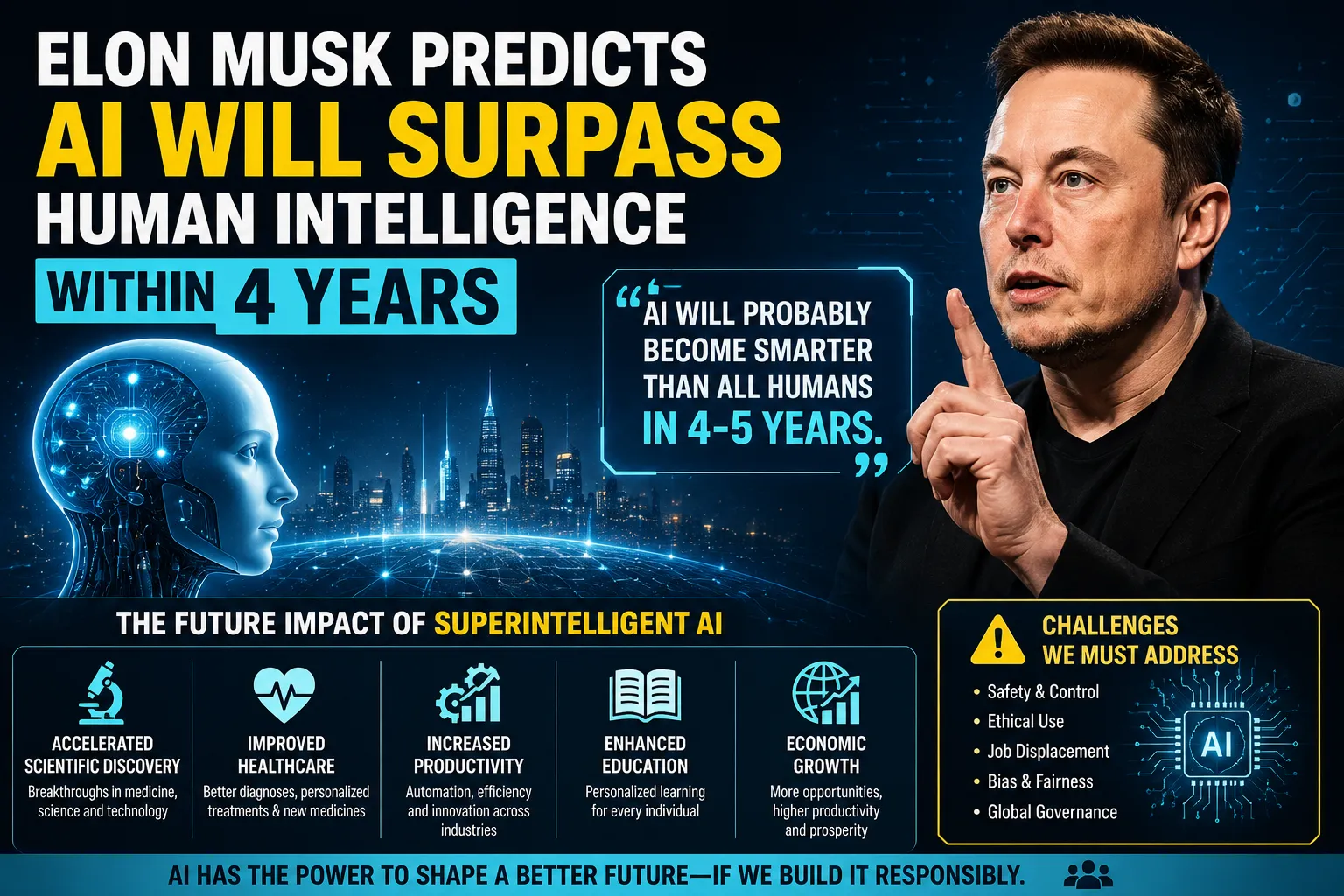
Artificial intelligence is advancing at a pace few could have imagined a decade ago. From generating human-like conversations and creating digital content to assisting in scientific research and software development, AI systems have become increasingly capable across a wide range of fields. Amid this rapid transformation, Elon Musk has made another bold prediction: artificial intelligence will probably become smarter than the combined intelligence of all humans within the next four to five years.
The statement has reignited global discussions about the future of AI, its impact on society, and whether humanity is prepared for a technology that could eventually outperform human beings in nearly every intellectual task. While some experts share Musk’s optimism regarding AI’s capabilities, others remain cautious about the timeline and the broader implications of such a development.
Regardless of where one stands in the debate, there is little doubt that artificial intelligence is becoming one of the most influential technologies of the 21st century.
Musk’s Prediction and Why It Matters
Elon Musk has long been one of the most outspoken voices in conversations surrounding artificial intelligence. Over the years, he has alternated between praising AI’s potential and warning about its risks.
His latest prediction suggests that AI systems could exceed the collective intellectual capacity of humanity within a relatively short timeframe. In practical terms, this means future AI models may possess the ability to process information, solve problems, generate ideas, and perform complex reasoning tasks at levels far beyond what humans can achieve individually or collectively.
The significance of such a prediction extends far beyond the technology sector. If AI reaches this level of capability, it could transform industries, economies, education systems, healthcare, scientific research, and even the structure of society itself.
The Rapid Evolution of Artificial Intelligence
The idea of highly intelligent machines once belonged primarily to science fiction. However, developments over the last few years have dramatically changed that perception.
Modern AI systems are already capable of:
- Understanding and generating natural language
- Writing computer code
- Creating images and videos
- Assisting with medical research
- Performing complex data analysis
- Translating languages
- Supporting customer service operations
- Enhancing educational experiences
Advances in computing power, machine learning algorithms, and access to massive datasets have accelerated AI development at an unprecedented rate.
Many experts believe that the capabilities demonstrated today represent only the early stages of what artificial intelligence may eventually achieve.
What Does “Smarter Than All Humans” Mean?
Musk’s statement has generated attention partly because of how ambitious it sounds.
When discussing intelligence, experts often distinguish between different forms of cognitive ability, including:
Analytical Intelligence
The ability to process information, solve mathematical problems, and identify patterns.
Creative Intelligence
The capacity to generate original ideas, artistic works, and innovative solutions.
Emotional Intelligence
The ability to understand emotions, social interactions, empathy, and human relationships.
Practical Intelligence
Skills related to decision-making, adaptation, and navigating real-world situations.
Current AI systems already outperform humans in certain narrow tasks, such as analyzing vast amounts of data or playing complex strategy games. Musk’s prediction suggests that future AI may surpass humans across a much broader range of intellectual activities.
Whether this includes emotional understanding, creativity, and general reasoning remains one of the central questions in AI research.
The Race Toward Artificial General Intelligence
Many discussions surrounding Musk’s prediction involve the concept of Artificial General Intelligence (AGI).
AGI refers to a form of AI capable of performing any intellectual task that a human can perform. Unlike today’s specialized AI systems, AGI would possess generalized reasoning abilities that could be applied across multiple domains.
Researchers and technology companies are investing heavily in the pursuit of AGI. The goal is to create systems that can learn, adapt, and solve problems in ways similar to—or potentially superior to—human beings.
Supporters believe AGI could help solve some of humanity’s most difficult challenges, including:
- Disease treatment
- Climate change solutions
- Scientific discovery
- Space exploration
- Energy optimization
- Economic productivity
However, AGI also raises concerns about control, governance, and safety.
Potential Benefits of Superintelligent AI
If AI reaches the level Musk predicts, the benefits could be extraordinary.
Accelerated Scientific Discovery
AI could dramatically speed up research in medicine, physics, chemistry, and biology by identifying patterns and solutions that humans might overlook.
Improved Healthcare
Advanced AI systems could assist doctors in diagnosing diseases earlier, designing personalized treatments, and developing new medicines.
Increased Productivity
Businesses across industries could become significantly more efficient, reducing costs and improving services.
Enhanced Education
AI-powered learning platforms could provide personalized education tailored to each student’s needs and abilities.
Economic Growth
Greater automation and innovation could contribute to higher productivity and potentially improved living standards.
Many technology leaders view these possibilities as reasons for optimism about AI’s future.
The Risks and Challenges
While the opportunities are substantial, Musk has repeatedly emphasized the importance of addressing potential risks.
Job Displacement
As AI becomes more capable, many traditional jobs may be automated. Industries ranging from manufacturing to customer service could experience significant workforce changes.
Misinformation and Manipulation
Advanced AI systems can generate realistic text, images, audio, and video, raising concerns about misinformation and digital deception.
Concentration of Power
If powerful AI systems are controlled by a small number of organizations or governments, concerns about fairness, transparency, and accountability may arise.
Safety Concerns
Experts continue to debate how to ensure that highly intelligent AI systems remain aligned with human values and objectives.
Regulatory Challenges
Governments worldwide are working to develop policies and regulations that encourage innovation while minimizing risks.
The challenge lies in balancing technological progress with responsible oversight.
How Experts View the Timeline
Although many experts agree that AI capabilities are advancing rapidly, opinions differ regarding Musk’s timeline.
Some researchers believe major breakthroughs in AI could occur within the next decade due to increasing investments, computing power, and algorithmic improvements.
Others argue that achieving truly human-level or superhuman intelligence across all domains remains a complex scientific challenge that may require significantly more time.
Predicting technological progress has historically been difficult. Some innovations arrive sooner than expected, while others take decades longer than anticipated.
As a result, debates about when AI might surpass human intelligence are likely to continue.
The Role of Companies Driving AI Innovation
Several leading technology companies are actively developing advanced AI systems.
These organizations are investing billions of dollars in research, infrastructure, and talent to push the boundaries of machine intelligence.
Competition among AI developers has accelerated innovation, leading to increasingly powerful models capable of performing tasks that once seemed impossible.
At the same time, many industry leaders are advocating for collaborative efforts to establish safety standards and ethical guidelines.
The future impact of AI will depend not only on technological capabilities but also on how these technologies are developed, deployed, and governed.
What This Means for Society
Whether Musk’s prediction proves accurate in four years or takes longer to materialize, one reality is becoming increasingly clear: AI will play a central role in shaping the future.
Businesses are already integrating AI into operations. Educational institutions are adapting to AI-powered learning tools. Healthcare providers are exploring AI-assisted diagnostics. Governments are considering regulatory frameworks.
Individuals, organizations, and policymakers will need to prepare for a future where intelligent machines become deeply integrated into everyday life.
Adaptability, digital literacy, and lifelong learning may become even more important as technology continues to evolve.
Conclusion
Elon Musk’s prediction that artificial intelligence could become smarter than the combined intelligence of all humans within the next four to five years represents one of the boldest forecasts in the technology world. While experts remain divided on the exact timeline, few dispute that AI is advancing at an extraordinary pace.
The potential benefits—from scientific breakthroughs and improved healthcare to greater productivity and innovation—are enormous. At the same time, concerns about job displacement, safety, governance, and ethical use cannot be ignored.
As artificial intelligence continues to evolve, society faces both an unprecedented opportunity and a significant responsibility. The coming years may determine not only how intelligent machines become, but also how humanity chooses to coexist with them in a rapidly changing world.
