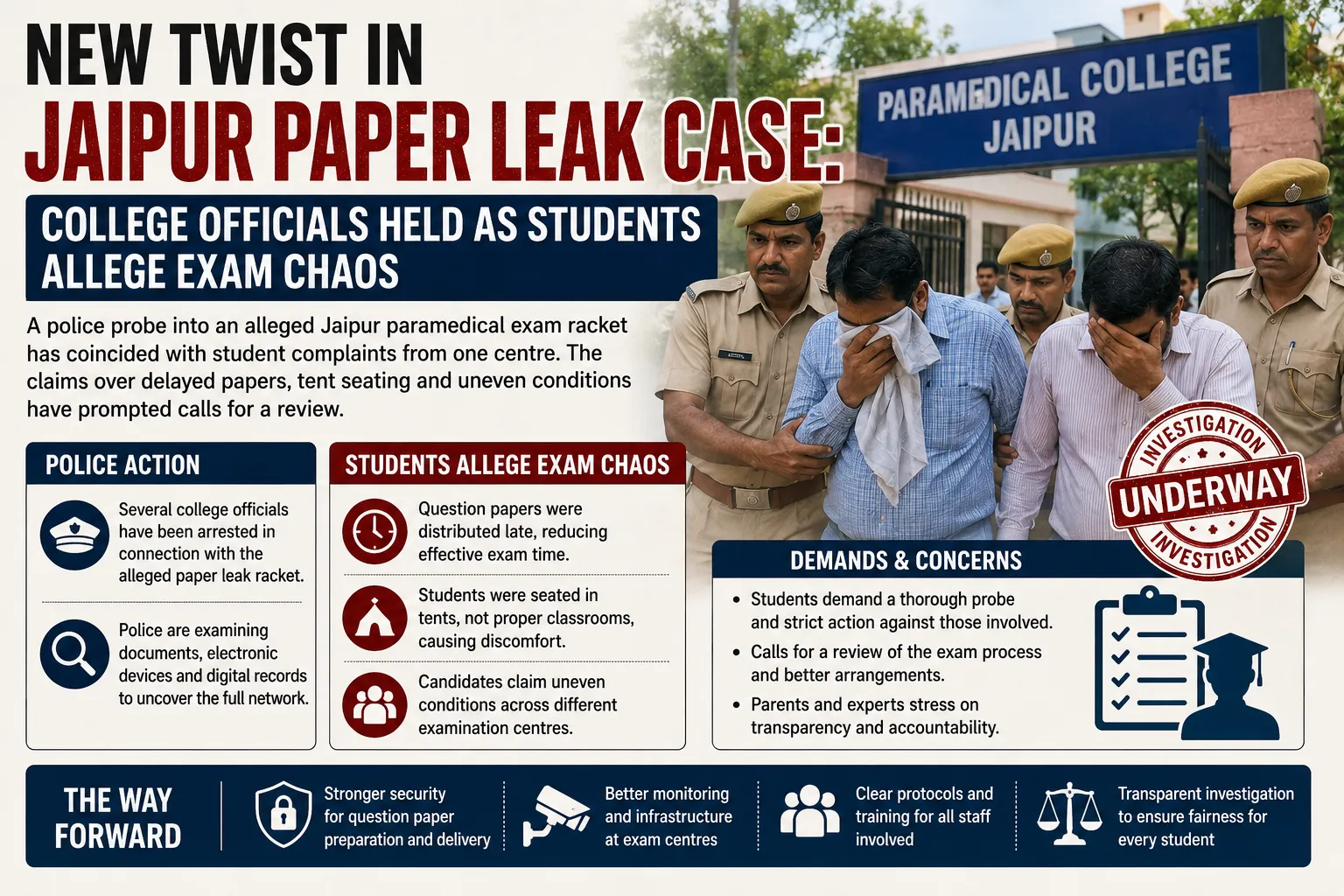
The alleged paper leak case involving a paramedical entrance examination in Jaipur has taken a significant turn after police arrested officials associated with a private college during their ongoing investigation into the suspected examination racket. At the same time, students who appeared for the examination at one of the designated centres have raised serious concerns about the conduct of the exam, alleging delayed distribution of question papers, inadequate seating arrangements, and inconsistent examination conditions.
The developments have intensified public scrutiny of the examination process and renewed calls for greater transparency and accountability in competitive examinations. Students, parents, and education experts argue that entrance examinations play a crucial role in determining academic and professional futures, making fairness and credibility essential to maintaining public trust.
While investigators continue to examine allegations of organized malpractice, education authorities are also facing questions regarding examination management and the need for stronger safeguards to prevent irregularities.
Police Investigation Takes a New Turn
The investigation into the alleged paper leak gathered momentum after law enforcement agencies detained and questioned several individuals believed to be connected to the examination process.
According to officials involved in the investigation, college authorities are examining whether confidential examination material was accessed or shared illegally before the examination. The arrests form part of a broader probe aimed at identifying the individuals responsible for any potential breach of examination security.
Police have reportedly collected electronic devices, documents, communication records, and other evidence as part of their investigation. Digital forensic experts may also assist in verifying whether question papers were circulated before the scheduled examination.
Authorities have emphasized that the investigation remains ongoing and that all allegations will be examined based on available evidence before any final conclusions are reached.
Students Report Problems at Examination Centre
Alongside the police investigation, students who appeared for the examination have reported several operational issues at one examination centre.
Many candidates claimed that the distribution of question papers was delayed, reducing the effective time available for completing the examination. Others alleged that candidates were seated inside temporary tents rather than conventional examination halls, raising concerns about comfort and concentration.
Students also questioned whether examination conditions remained uniform across different centres.
Competitive examinations rely on standardized conditions to ensure fairness. Any significant variation in seating arrangements, examination timing, supervision, or environmental conditions may create concerns regarding equal opportunity for all candidates.
Although authorities have not confirmed every allegation, the complaints have prompted demands for a thorough review of examination arrangements.
Why Examination Integrity Matters
Competitive entrance examinations determine admission into professional education programs and often shape long-term career opportunities.
For thousands of students, months or even years of preparation culminate in a single examination. Any allegation involving paper leaks, administrative lapses, or unfair practices therefore has far-reaching consequences.
Maintaining examination integrity requires strict confidentiality during question paper preparation, secure transportation, controlled distribution, trained invigilators, and standardized examination procedures.
Even isolated irregularities can undermine public confidence in the entire examination system.
This is why examination authorities generally follow multiple layers of security throughout the examination process.
Understanding Paper Leak Cases
A paper leak occurs when confidential examination questions become available to unauthorized individuals before the official start of an examination.
Such breaches may occur through physical theft, digital hacking, unauthorized copying, insider involvement, or illegal distribution networks.
Investigating paper leak cases often involves cybercrime experts, forensic analysis, electronic surveillance, financial investigations, and examination authorities working together.
Modern investigations frequently examine mobile phones, messaging applications, cloud storage, email records, and financial transactions to identify possible links between suspects.
If evidence confirms organized malpractice, criminal charges may be filed under relevant provisions of criminal law and examination-related regulations.
Challenges Faced by Students
Beyond concerns regarding paper leaks, students have expressed frustration about the overall examination experience.
Delayed commencement of examinations can increase anxiety and reduce concentration.
Outdoor or temporary seating arrangements may expose candidates to heat, noise, weather changes, or other distractions that affect performance.
Unequal examination conditions may create perceptions of unfairness even if no malpractice ultimately occurred.
Students preparing for highly competitive examinations invest considerable emotional, financial, and academic effort. They therefore expect examination authorities to provide safe, comfortable, and standardized testing environments.
Addressing these concerns is essential for preserving confidence in future examinations.
The Role of Educational Institutions
Educational institutions entrusted with conducting examinations bear significant responsibility.
They must ensure secure handling of confidential materials, adequate infrastructure, proper invigilation, and compliance with examination guidelines.
Examination centres should provide sufficient seating, lighting, ventilation, security, and accessibility for candidates.
Staff members responsible for conducting examinations are also expected to follow strict confidentiality protocols to prevent unauthorized access to examination materials.
Regular inspections and compliance audits can further strengthen examination management.
Technology and Examination Security
Technology has become increasingly important in preventing examination malpractice.
Many examination authorities now use encrypted digital transmission of question papers, biometric verification, CCTV surveillance, GPS tracking of examination materials, and secure printing systems.
Artificial intelligence and data analytics are also being explored to detect suspicious examination patterns or unusual candidate behaviour.
Digital security measures reduce opportunities for unauthorized access while improving accountability throughout the examination process.
However, technology alone cannot eliminate risks without effective implementation and continuous monitoring.
Building Public Confidence
Whenever allegations of examination irregularities emerge, public confidence may be affected.
Students expect transparent communication regarding investigations, examination procedures, and corrective measures.
Prompt official responses help reduce uncertainty and prevent misinformation from spreading.
Authorities must balance the need for confidentiality during investigations with the public’s legitimate interest in understanding how the examination process is being safeguarded.
Independent inquiries, timely updates, and evidence-based conclusions strengthen institutional credibility.
Possible Reforms for Future Examinations
Incidents involving examination irregularities often lead to discussions regarding systemic reforms.
Experts suggest strengthening digital security for question paper preparation, improving monitoring at examination centres, increasing staff training, and conducting surprise inspections.
Standardized examination infrastructure across all centres may also reduce complaints regarding unequal testing conditions.
Clear grievance redressal mechanisms would allow students to report concerns immediately without waiting until after examinations conclude.
Periodic review of examination protocols can further improve fairness and operational efficiency.
The Importance of Fair Competition
Competitive examinations function effectively only when every candidate competes under identical conditions.
Fairness involves much more than preventing paper leaks.
Equal examination timing, standardized seating arrangements, proper supervision, adequate facilities, and transparent evaluation procedures all contribute to maintaining credibility.
When students believe the examination process is impartial, they are more likely to accept results with confidence.
Conversely, even isolated controversies can create lasting doubts regarding institutional integrity.
Protecting fairness therefore benefits both candidates and educational institutions alike.
Balancing Investigation and Student Interests
While police continue their investigation, education authorities also face the challenge of protecting students’ interests.
Thousands of candidates who prepared honestly should not experience unnecessary uncertainty due to allegations involving a limited number of individuals.
Authorities may therefore need to evaluate whether any corrective administrative measures are necessary while allowing the investigation to proceed independently.
The primary objective should remain safeguarding both justice and academic fairness.
Conclusion
The latest developments in the Jaipur paramedical examination case have highlighted two equally important issues: the need for a thorough investigation into allegations of examination malpractice and the importance of maintaining fair examination conditions for every candidate. The arrest of college officials has intensified scrutiny of the suspected paper leak, while student complaints regarding delayed question papers, temporary seating arrangements, and uneven examination conditions have raised broader questions about examination management.
As investigators continue gathering evidence, the outcome of the case will likely influence future examination security measures across educational institutions. More importantly, it serves as a reminder that competitive examinations must combine strong security systems with transparent administration and equal treatment for all candidates. Preserving public trust requires not only identifying wrongdoing where it exists but also continuously improving examination processes so that every student can compete on a level playing field.
