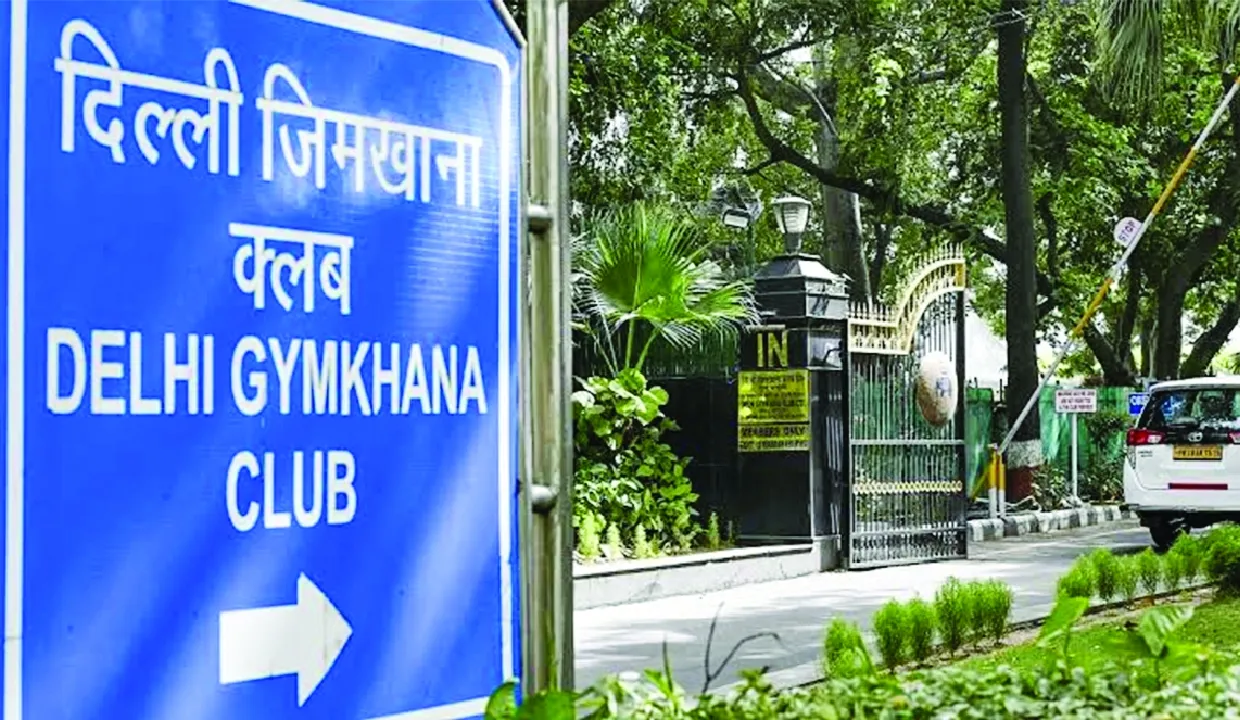
The Delhi High Court is set to examine a significant dispute over the future of one of the capital’s most prominent colonial-era institutions. On September 29, the court will hear petitions challenging the central government’s decision to terminate the perpetual lease of the Delhi Gymkhana Club and initiate steps for its eviction from the 27.3-acre premises on Safdarjung Road. The case raises questions about the validity of the lease termination, claims of due process, and the government’s stated public-interest grounds.
Background to the Lease Termination
On May 22, the Land and Development Office issued an order terminating the club’s perpetual lease and directing it to hand over the property by June 5. The stated reason was the need for strengthening and securing defence infrastructure. The premises, located in a sensitive and strategic part of Lutyens’ Delhi near key government establishments, have been described by the authorities as required for defence infrastructure, public security, institutional and governance needs, and related public-interest projects that can be integrated with adjoining government land.
The club, originally known as the Imperial Delhi Gymkhana Club and established in the early twentieth century, has operated from the site under a long-standing lease arrangement. Following the termination notice, the government maintained that continued occupation after the lease determination amounted to unauthorised occupation under the Public Premises (Eviction of Unauthorised Occupants) Act, 1971.
Petitions Before the High Court
Two key petitions form the core of the present challenge. One has been filed by club member Vijay Khurana and the other by the Delhi Gymkhana Club Ltd Staff Welfare Association. The petitioners have challenged both the May 22 lease termination order and a subsequent June 29 show-cause notice issued by an estate officer of the Land and Development Office. That notice called upon the club’s management to explain why eviction proceedings should not proceed.
The petitioners have sought interim protection, including a pause on the show-cause notice and any further coercive steps. They contend that the action lacks proper legal foundation, fails to follow due process, and relies on vague or generalised grounds. Senior counsel appearing for one of the plaintiffs informed the court that the matter is ready for arguments specifically on the question of interim relief.
Justice Subramonium Prasad is scheduled to hear the matter on September 29. The Centre has previously assured the court that it will not take any coercive action for the time being, an undertaking that has been reiterated across earlier hearings.
Government’s Legal Position
In its written submissions, the Centre has defended the May 22 notice as a valid exercise of the contractual right of re-entry reserved under Clause 4 of the perpetual lease deed. It has emphasised that the step does not constitute compulsory acquisition. According to the government, the purposes cited—defence infrastructure, public security, and broader institutional needs—are fully consistent with the lease terms and do not become invalid merely because the land has historically been used by a private club.
The Centre has further argued that long use of the premises, expenditure incurred on facilities, or any heritage recognition does not confer immunity from the lessor’s contractual rights. It maintains that members of the club cannot claim a personal estate in the land or enforce terms of a lease instrument to which they are not parties merely by virtue of membership privileges.
Importantly, the government has taken the position that under the Public Premises (Eviction of Unauthorised Occupants) Act, the jurisdiction of civil courts is barred in respect of eviction proceedings, and courts are also prohibited from granting injunctions against the actions of the estate officer once the process under the Act has commenced.
Parallel Developments and Related Proceedings
The dispute has seen activity in both the High Court and the Supreme Court. On September 15, the Supreme Court granted liberty to a group of eleven club members, who had approached it challenging the takeover and eviction steps, to either file a fresh petition before the Delhi High Court or join the ongoing proceedings. The members had argued that a government-nominated committee currently managing the club was not in a position to contest the government’s actions effectively.
Earlier hearings before the High Court had focused on interim arrangements. The Centre had repeatedly assured that no coercive steps would be taken until specified dates, allowing pleadings to be completed. The estate officer’s proceedings have also been subject to the High Court’s oversight, with directions ensuring that the matter progresses in accordance with law.
Broader Implications of the Dispute
The case sits at the intersection of contractual rights under long-term government leases, the scope of public-purpose resumption clauses, and procedural safeguards available to occupants of public premises. The government’s emphasis on the strategic location of the land and the need for defence and security-related infrastructure forms the core of its public-interest justification. The petitioners, on the other hand, question the adequacy of the stated reasons and the manner in which the termination and subsequent eviction process have been initiated.
The September 29 hearing is expected to address the limited but critical question of interim relief—whether the show-cause notice and further steps toward eviction should be stayed pending a fuller examination of the challenges to the lease termination. The outcome will determine the immediate status of the club’s occupation while the substantive legal issues remain under consideration.
As the matter moves forward, the High Court will weigh the contractual terms of the perpetual lease against claims of procedural fairness and the government’s assertion of public need. The proceedings underscore the continuing legal scrutiny that accompanies the resumption of long-leased government land in the capital, particularly when the land holds both historical significance and strategic value.
The Delhi High Court’s examination on September 29 will mark an important stage in a dispute that has already traversed multiple hearings and involved both the High Court and the Supreme Court. The focus remains on whether the Centre’s action under the lease and the Public Premises Act can proceed without interim judicial restraint, and on the broader questions of due process and public interest that the case has brought into sharp focus.
Read more – sevendollarmiracle.com