For many couples, the path to parenthood is neither short nor straightforward. One woman’s journey illustrates how multiple medical challenges—undiagnosed diabetes, hormonal imbalance, reduced ovarian reserve and male-factor issues—can combine to make natural conception difficult, and how a carefully coordinated approach involving fertility treatment and metabolic control can still lead to a successful outcome.
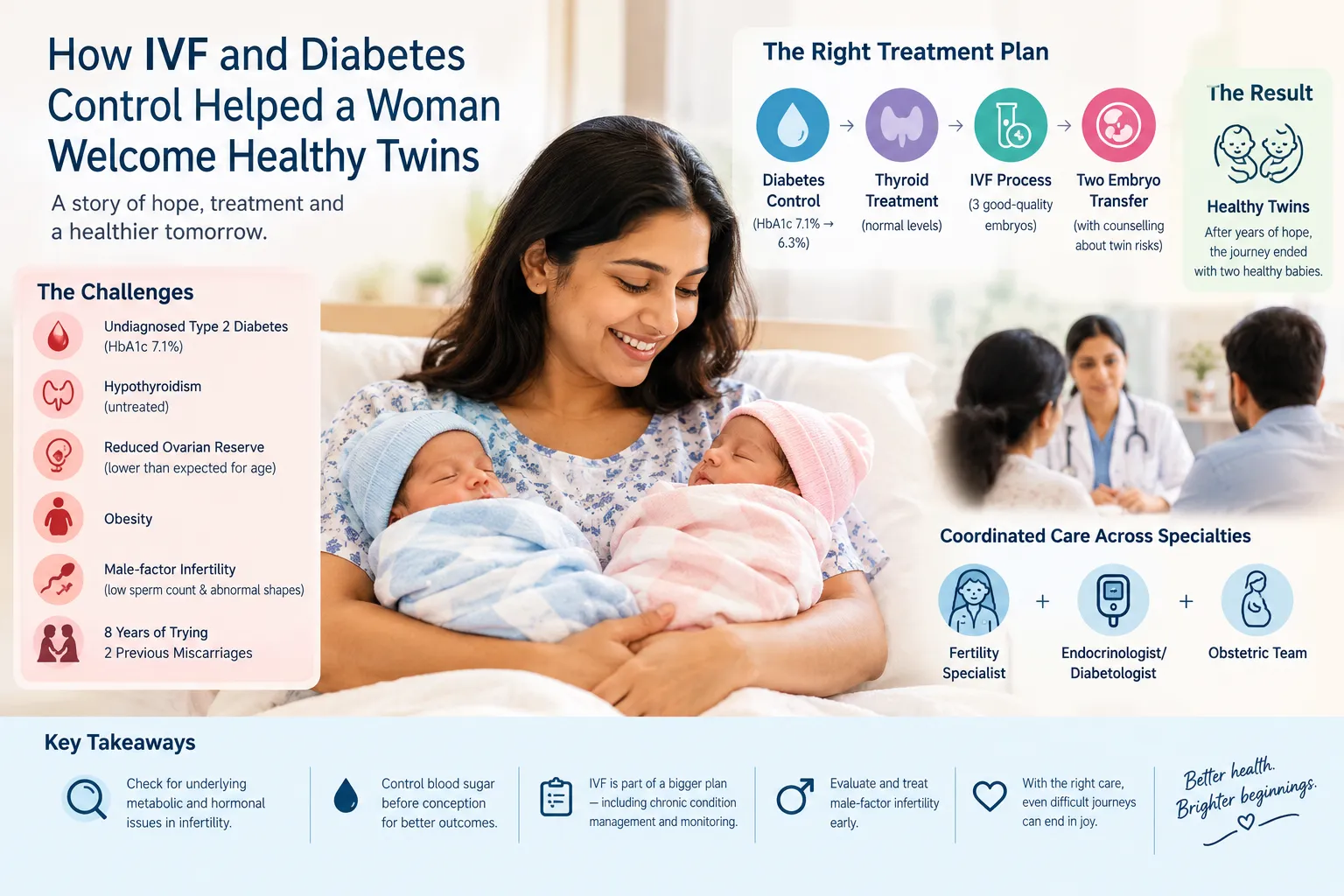
After eight years of trying and two earlier miscarriages, a woman in her early thirties reached a fertility centre with a complex clinical picture. Evaluation revealed obesity, a lower-than-expected ovarian reserve for her age, untreated hypothyroidism and, crucially, previously undiagnosed Type 2 diabetes. Her random blood sugar was significantly elevated and her HbA1c stood at 7.1 percent. Her husband also faced fertility challenges, including a low sperm count and a higher proportion of abnormally shaped sperm. Together these factors explained years of unsuccessful attempts and pregnancy losses.
Why Blood Sugar Control Matters Before Conception
Diabetes and elevated blood glucose around the time of conception increase the risk of miscarriage, congenital anomalies and other pregnancy complications. High sugar levels can affect egg quality, embryo development and the uterine environment. Guidelines and clinical experience therefore emphasise optimising metabolic health before attempting pregnancy, whether naturally or through assisted reproduction.
In this case, diabetes management became a central part of the treatment plan rather than an afterthought. Lifestyle measures, medication where appropriate, and close monitoring were used to improve glucose control. Her HbA1c declined from 7.1 percent at diagnosis to 6.8 percent around the time pregnancy was confirmed and further to 6.3 percent by six weeks of gestation. These improvements reflected better glycaemic stability at a critical period for embryonic development.
Hypothyroidism was also addressed, as inadequate thyroid hormone can interfere with ovulation, implantation and early pregnancy maintenance. Correcting both endocrine conditions created a more favourable physiological setting for the subsequent fertility treatment.
The IVF Process in a High-Risk Setting
Given the combination of reduced ovarian reserve, male-factor infertility and prior losses, in-vitro fertilisation offered the most realistic route to pregnancy. Controlled ovarian stimulation, egg retrieval, fertilisation and embryo culture produced three good-quality embryos. After the woman’s metabolic and hormonal parameters had been stabilised, two embryos were transferred.
The decision to transfer two embryos carried additional considerations. Twin pregnancies are inherently higher risk, with elevated chances of preterm birth, gestational diabetes, hypertension and other complications. The couple received counselling about these risks so they could make an informed choice. In this instance the transfer resulted in a twin pregnancy that progressed under close medical supervision.
Throughout the process, the emphasis remained on preparing the body as thoroughly as possible before embryo transfer. This pre-conception optimisation—rather than attempting to correct problems only after pregnancy is established—is a key principle in managing women with diabetes or other chronic conditions who seek fertility care.
Coordinated Care Across Specialties
Successful outcomes in such cases rarely depend on a single intervention. Fertility specialists, endocrinologists or diabetologists, and obstetric teams need to work in alignment. Blood sugar targets, thyroid levels, weight management and the timing of ovarian stimulation and embryo transfer all require coordination. Once pregnancy is achieved, monitoring intensifies because women with pre-existing diabetes face higher rates of complications and their babies require careful surveillance.
In this journey, the combination of improved metabolic control, correction of hypothyroidism, addressing of male-factor issues through IVF laboratory techniques, and a planned embryo transfer produced the desired result: the birth of healthy twins. The case underscores that even after years of disappointment and multiple risk factors, a structured, multidisciplinary approach can change the trajectory.
Broader Lessons for Couples Facing Similar Challenges
Several practical points emerge from experiences of this kind. First, unexplained infertility or recurrent miscarriage should prompt a thorough evaluation that includes metabolic and endocrine testing, not only reproductive hormone and imaging assessments. Undiagnosed diabetes or thyroid disease can silently undermine fertility and pregnancy outcomes.
Second, blood sugar control is most effective when achieved before conception. Waiting until pregnancy is confirmed means the critical early weeks of development may already have occurred in a suboptimal metabolic environment. Pre-conception counselling and optimisation therefore form an essential part of care for women with diabetes or elevated glucose levels.
Third, IVF is not merely a technical procedure of retrieving eggs and transferring embryos. In medically complex patients it becomes one element of a wider plan that includes stabilising chronic conditions, counselling about risks (including those of multiple pregnancy), and arranging appropriate antenatal and neonatal support.
Finally, male-factor infertility is common and should be evaluated early. In this case, sperm abnormalities contributed to the couple’s difficulties and were addressed within the IVF process.
A Message of Measured Hope
Stories of successful pregnancies after prolonged infertility and significant medical hurdles offer encouragement, yet they also highlight the importance of realistic planning and specialist care. Not every couple with similar profiles will achieve the same outcome, and twin pregnancies introduce their own set of challenges. What this journey demonstrates is that systematic preparation—controlling blood sugar, correcting hormonal imbalances, using assisted reproduction appropriately and monitoring closely—can overcome barriers that once seemed insurmountable.
For women with high blood sugar or diabetes who hope to become mothers, the central message is clear: metabolic health and reproductive care are inseparable. When both are addressed with equal attention, the possibility of a healthy pregnancy, even after years of trying and previous losses, remains within reach. In this instance, that careful integration of diabetes management and IVF allowed a couple to welcome healthy twins and close a long chapter of uncertainty.
Read more – SmallBizSeo.org